Every week, startups announce hundreds of funding rounds. But only a few of them show where investors think the next big opportunity is.
This week, the money went to the foundations of AI: the power that runs it, the data it learns from, and the scoreboard that ranks it.
1. Axiom Solutions: The $2 Billion Bet on AI Power and Cooling
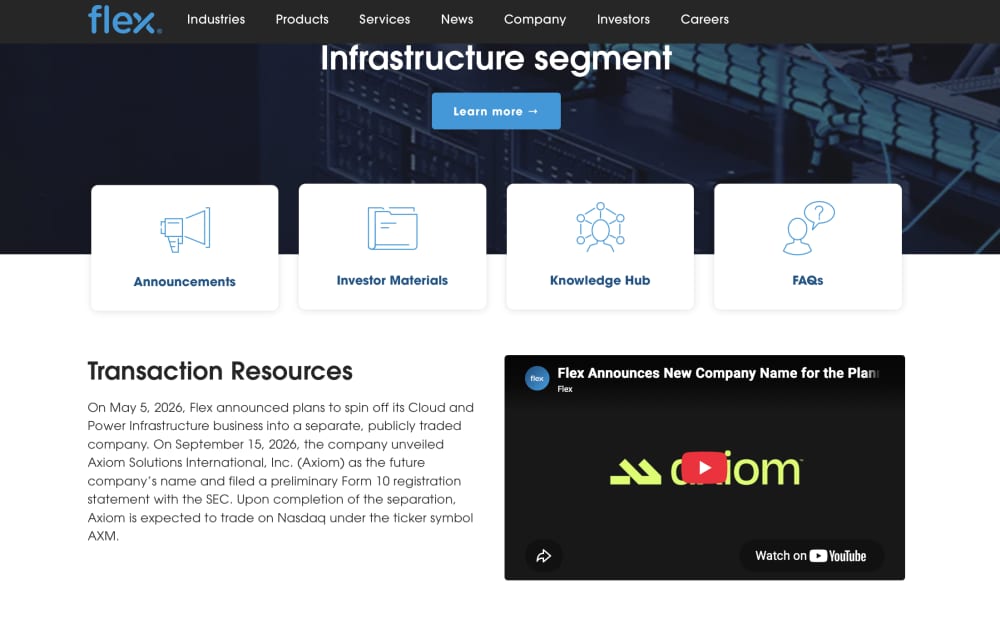
In fall 2026, one of AI’s biggest bottlenecks is no longer about chips. It is about electricity and cooling. As the next-generation AI models need enormous amounts of power, the chips running them demand unprecedented amounts of electricity and produce so much heat that conventional cooling often can’t keep up.
That creates an opportunity for companies building the physical layer behind AI. One of them is Axiom Solutions International, a business that grew inside the manufacturing and technology company Flex.
For years, Flex engineers developed power and thermal management systems for data centers and other demanding computing environments. As demand for AI infrastructure accelerated, this business grew into a multibillion-dollar operation, generating $6.614 billion in net sales in the fiscal year ended March 31, 2026. In May 2026, Flex announced plans to separate it into an independent company. In September, the new company was named Axiom, with the spin-off targeted for early 2027.
What does Axiom do? In simple terms, it builds the infrastructure that lets AI data centers operate at scale: power electronics, liquid cooling, and integrated computing systems. Its approach is to sell these as coordinated systems instead of separate parts. Customers get pre-engineered infrastructure rather than sourcing and integrating every component themselves, so new AI capacity can come online faster.
On October 5, funds led by General Catalyst and Koch Equity Development agreed to invest $2 billion in Axiom, valuing the business at $37.5 billion. The deal is expected to close after regulatory approvals.
The investment will help fund Axiom’s acquisition of EPC Power, repay short-term financing, and strengthen its balance sheet. The agreement also sets conditions to protect investors if the planned spin-off is delayed beyond the end of 2027.
What makes this unusual is the timing. Axiom is still a division of Flex, and it has already been priced by outside investors as if it were a standalone company.
The bigger picture. As demand for computing continues to grow, investment is flowing not only into model developers and software companies, but also into the businesses supplying the power, cooling, and infrastructure that make AI possible. Axiom’s story offers a specific example of how the infrastructure behind AI is becoming a major business in its own right.
2. SignSplit: $400M Seed Round for Data and Content Protection
AI companies have a problem that more computing power can’t solve: they need real human data, and it’s getting harder to use it freely as copyright disputes over training data keep coming. SignSplit is betting that licensed, consented data becomes its own market.
SignSplit, a startup that was founded just two years ago, in 2024, and emerged from stealth on October 5, 2026, immediately becoming a new unicorn after raising massive investments.
What does SignSplit do? It lets people and institutions protect, license and contribute their data, work and likeness. The company calls the result “signed data,” meaning human-generated content that carries consent, a clear record of where it came from, and agreed terms of use. To put it simply, SignSplit acts as an electronic notary and a marketplace for that data, turning text, photos, audio, video, into a digital product with a cryptographic stamp on it.
The business is primarily B2B: organizations pay for access to specific data, while contributors are compensated without paying fees. SignSplit handles everything required for using that data, starting from organizing the data to handling consent, rights, compliance, and payments.
SignSplit announced a $400 million “strategic seed” round at a $1 billion valuation, from a single investor. W Group, a fintech ecosystem serving more than 40 million users in 150 countries, is the sole investor and becomes the anchor strategic partner.
It needs to be mentioned that $400 million seed round is a package of money plus other business support spread over several years, rather than a giant pile of immediate venture capital, and SignSplit hasn’t disclosed how much of it is immediately available capital. The $1 billion valuation is also based on the company’s potential, which is common for very early companies and it means the headline number says more about ambition than about proven demand.
What makes it unusual is that a seed round is normally the smallest, riskiest stage of funding. This one is one of the largest seed rounds on record, and it comes from one backer rather than a group of investors.
The bigger picture. SignSplit shows how the AI market is maturing. First, the race was for models. Then it was for chips and power. Now investors are betting on the question of where legitimate training data comes from, and who gets paid for it.
3. Arena: The $3.1 Billion Scoreboard for AI
Every few weeks, a new AI model claims to be the best. The claims come from the companies that built them, so it’s fair to ask who can check.
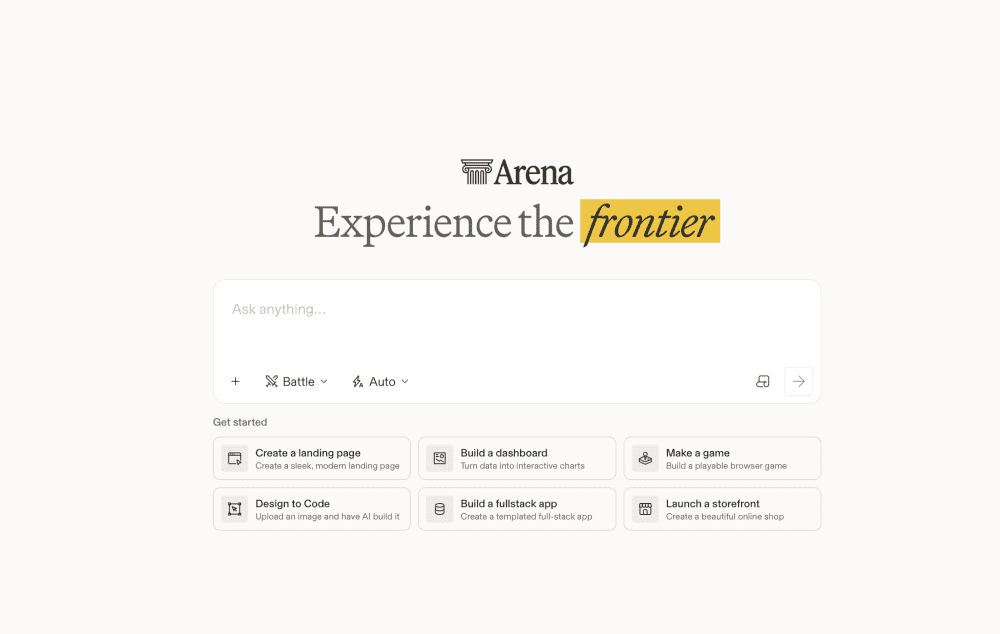
Arena is one of the most widely used answers. On October 8, 2026, the company officially announced the closing of a massive $200 million Series B funding round, which made its valuation soar to $3.1 billion.
The seed round in May 2025 valued the company at $600 million. The Series A in January 2026 brought it to about $1.7 billion. Now it is $3.1 billion, roughly five times the seed valuation in about 17 months. Across all three rounds, Arena has raised roughly $450 million. Behind the jump is revenue: Arena says it is now earning at a pace of more than $100 million a year.
What does Arena do? Arena ranks AI models using crowdsourced comparisons. It runs a public platform where people compare AI models without knowing which is which. A user enters a question, gets two anonymous answers, and votes for the better one. Millions of these blind votes produce an Elo-style leaderboard. Because the votes come from real users, the ranking reflects what people actually prefer rather than a score the model’s own maker chose.
Arena launched a new measure alongside the round. The Alignment Index tracks unauthorized AI actions and deceptive completions. The scoreboard is moving beyond “which answer do people like?” to “can this AI be trusted?”
The round was co-led by Lightspeed Venture Partners and Khosla Ventures, with Salesforce Ventures, 01 Advisors, Dell Technologies Capital, and Endeavor Catalyst taking part, and existing backers including a16z and Felicis also supported it.
What makes it unusual is that Arena didn’t start as a company. It began as a research project. It was created by two PhD students from UC Berkeley, launched in 2023 as Chatbot Arena, then renamed LMArena, and only later it became a company Arena. Those researchers were building a simple tool so people could compare AI models without knowing which was which. A research experiment is now one of the main places the AI industry looks to see which model is winning.
The bigger picture. As AI gets more powerful, buyers need independent ways to compare it. A ranking is only useful if people trust it, which makes independence a key question for Arena’s next stage.
This week’s rounds show where investors are placing their bets, from AI infrastructure to data and evaluation. If you’re building something in this space, ScrumLaunch can help you turn it into a working product.
Contact our team to discuss your project, or schedule a call with our CEO to talk through your idea.


