A pitch does not win you funding. It wins you the next meeting. That is the whole job of the first conversation with an investor - to show enough evidence that your AI startup is worth a closer look.
Most founders treat the pitch as a performance that must convince. But a pitch cannot create what the business does not have. It can only show what is already there, and needs to do it quickly and clearly.
This article shows what to cover in the first two minutes of a pitch for an AI product, so the investor says: send us the details.
What a pitch to investors actually is
A pitch to investors isn't a sales pitch, even though it feels like one. It is not even a trailer for your startup. It is a trailer for the trailer: just enough to make an investor want to see more.
So, you should avoid explaining every detail. What you need is to give a short, structured explanation of what your company does, why it matters, and give the investor a reason to keep asking questions. Think of the pitch as the beginning of a conversation, not an attempt to close the deal.
Y Combinator partner Kevin Hale offers a useful test in How to Pitch Your Startup. He says that from the investor's perspective, three questions matter: Do I understand it? Am I excited about it? Do I like the team? The first question is the one your pitch controls most directly: if an investor cannot explain your business after hearing it, or see why the opportunity matters, the presentation has not done its job.
What the investor is actually deciding
Startup returns follow a power law: a few companies generate most of the returns, while many others deliver modest results or fail. That’s why investors look for startups with the potential to become one of those rare successes.
They won’t be asking whether your startup will succeed. They know they cannot predict the outcome with certainty as nobody knows that. They are also not simply judging whether your idea sounds good. They are trying to decide whether it is a good enough bet.
In How to Convince Investors Paul Graham, co-founder of Y Combinator, identifies three important ingredients investors are looking for: formidable founders, a promising market, and usually some evidence of progress so far. The founders come first. He writes that most investors decide within the first few minutes whether the founder looks like a winner, and that the first impression is hard to change. Once they like you, they look for reasons to invest. Once they doubt you, they look for reasons not to.
The way 16VC describes its pre-seed AI startup evaluation offers a practical example. It evaluates the team first, then considers the market, early validation, and whether the terms are realistic. Startups that pass the initial screen move into deeper diligence, including technical review and references.
Why the demo no longer does this job
Building an impressive AI demo has become easy, and that is exactly why it proves so little.
Four partners from a16z, one of the largest venture capital firms, wrote in 2025 that creating a flashy AI demo is relatively simple with modern tools, but turning that demo into a product people actually use every day is much harder. Real users behave unpredictably, customer data is messy, and success depends on handling the long tail of things people actually do. They add that the gap between a demo and a product is wider for AI than for earlier software, because models keep changing and their outputs are nondeterministic.
A demo answers one question: can this work? Assume the investor already believes it can. The questions a demo cannot answer are the ones that decide whether you have a business. Will people pay for it? Can you reach them? Does it still make money when the inference bill arrives? Will it matter in three years, when the underlying models are cheaper and every competitor has access to the same ones? Is the market big enough to matter?
You still need a demo though. But use it to make one point vivid, not to prove the product exists. The rest of your pitch has to answer the questions the demo can't.
Your pitch, beat by beat
Here is a structure that works. It is a framework, not a law. Adjust the order to your product, but keep every beat. Each one answers a question the investor will otherwise ask you.
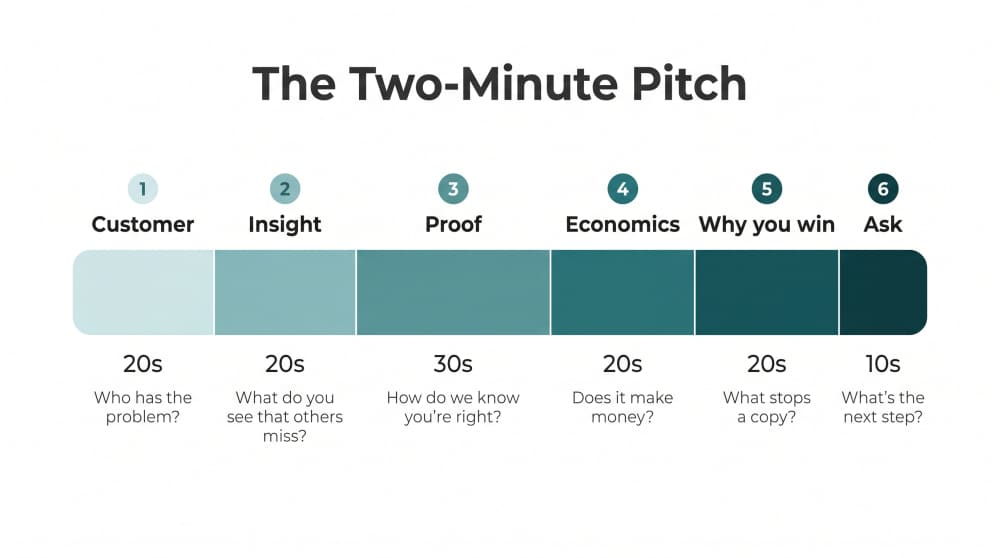
Beat one: the customer.
Do not open with technology. Do not float into mission-statement territory. Do not open with a market statistic either. Start with the customer. Who are they, what are they trying to do, and where does it break?
Then immediately ground it in one vivid, specific person’s pain at one specific moment. A recruiter grinding through three hundred applications by hand, or a customer-success manager losing most of a week to data collection instead of thinking. An investor should be able to picture the person and the friction in under ten seconds.
This does two jobs. It makes the problem real. And it shows you know the customer, which is the strongest early sign of a founder who understands their market. investors find out quickly whether you are a domain expert by how well you answer their questions. Start by proving it before they ask.
Beat two: the insight.
The insight is not "AI can help with this." Everyone knows that. The insight is the specific thing you understand that others miss. A good test: if the investor could have predicted your insight before you said it, it is not sharp enough. A good insight sounds surprising at first and obvious a moment later.
This is also where you answer "why now." Graham argues that every company that gets very large rides an external wave, so you need to name the trend that benefits you. For an AI product, be precise. What changed recently that makes this possible or worthwhile? A cheaper model, a new capability, market readiness, a shift in how customers buy? "AI is growing" is not an answer.
Beat three: one proof point.
By now the investor knows who your customer is and what you understand that others miss. Beat three shows you are right. This is where the demo belongs, if you use one.
Show one thing, not many. Nobody can judge ten features during a short pitch and a tour makes it harder to remember any of them. A single proof point sticks, and it is easy for a partner to repeat to colleagues.
Choose the one that most directly supports your insight from beat two. If your insight is that customer success managers lose their week to data collection, the proof is one real moment: a recruiter who used to spend three hours reviewing applications for one role now spends twenty minutes, and uses the saved time to talk to the best candidates instead of sorting through the rest. That can be a short live demo, a recording, or a sentence about a real customer. What matters is that it shows the insight at work, not the technology behind it.
Better than any demo is real evidence. If you have real evidence, lead with that instead. A paying customer. Retention after the first month. A measured result from a pilot. All count. Pick the strongest one you have.
Retention deserves particular care. Two partners from a16z wrote in 2025 that many AI products attract casual sign-ups who leave within a couple of months, so early numbers can flatter. They suggest looking at month three, when the curve usually flattens and the committed customers remain. The conclusion for your pitch is that customers still using the product at month three are stronger proof than a large sign-up count, so an earlier-stage should show who stayed, not who signed up.
Be honest about the real number, whatever its size. An investor who hears "we have three paying customers" respects it. An investor who hears "we are seeing strong early traction" starts to doubt you.
Beat four: economics.
Explain how you make money today, or how you plan to. What does a customer pay? What does it cost to serve them? And what happens to the margin as usage grows? If you have a plan to bring costs down, say what it is.
There is also a point most AI founders skip, and it is the one that most separates an AI business from an AI demo. Traditional software costs very little to serve one more customer. AI products often do not, because every query spends real compute. ICONIQ's July 2026 State of AI report, a survey of about 300 software executives, found average gross margins on AI products rising from 45% in 2025 to a projected 53% in 2026 and 59% in 2027. The direction is encouraging, though still well below traditional software.
In any case, in the room your own numbers are what count. You do not need them to be perfect. But you need to show you have thought about them. "We have not looked at this yet" is the one answer that ends the conversation.
Beat five: why you win when the models get better.
Sharp investors will ask this even if you do not raise it: if the models keep improving and getting cheaper, what stops a competitor from copying you?
The honest answer is that access to AI capability is becoming less of a moat. Your advantage cannot be the AI. It has to come from what you build around it. Maybe you have a customer relationship that is difficult to replace. Maybe your product is deeply embedded in a workflow, learns from data customers only share with you, or reaches a market through a distribution channel competitors cannot easily replicate. It could also be trust, especially when the product handles sensitive data or makes decisions customers cannot afford to get wrong.
As a16z's David Haber puts it, differentiation is not the same as defensibility. The stronger moat comes from things like owning the workflow, becoming deeply embedded in a customer's systems, and building a product customers trust and rely on.
The point is not to claim that your AI is impossible to copy. Investors know how quickly the technology is moving. They want to understand what remains valuable when the underlying models become cheaper, better, and available to everyone.
Beat six: the ask.
End with what you want from this meeting. Not “we are raising a round.” Something specific: a follow-up conversation, a look at your data room, an introduction to a partner. You are asking for the next step, so name it.
If the round comes up, give one sentence of context: how much you are raising and what it will get you. “We are raising $X to reach [specific milestone] in the next 12–18 months.”
A milestone gives the number meaning and shows you have thought about the runway the way investors expect (enough capital to hit the next fundable point).
Do the full breakdown before you walk in. Know how much goes to the team, to marketing, and to infrastructure over the year. Have an answer ready if you are asked about valuation or structure. But keep it ready for the follow-up instead of reading it out. This part of the pitch is not enough for a budget.
Make them trust you
Everything above is structure. This part is harder. It concerns the impression you make.
Inexperienced founders try to copy the swagger of experienced ones. This strategy fails. Investors are not always good at judging technology, but they are very good at judging confidence. If you act like someone you are not, you end up sounding neither sincere nor convincing.
Stick to the truth. People seem most credible when they say things they know are true. So that work happens before the meeting. Ask yourself honestly whether your startup is worth investing in, and why. If you can answer that, you will explain it plainly. If you cannot, no amount of presentation will fix it.
There is also a common trap founders should be warned about: implying that other investors are about to commit when they are not. If you have been turned down, say so and say why you think they were wrong. Candour reads as confidence.
Three habits to put into practice
First, be concise and plain. Skip grand language. Investors read vagueness as a sign you do not understand your own plan. Many use concision as an explicit test.
Second, make the pitch retellable. A partner who likes your pitch has to repeat it to their colleagues. If your pitch cannot be summarized by someone else in a few sentences, it will not survive the internal meeting. Before you pitch, imagine the investor explaining you to their partners. What would they say? If you do not like the answer, change the pitch.
Third, when you do not know something, say how you would find out. Do not bluff. Do not freeze. Explain how you would work out the answer, and if you can reach a rough answer on the spot, explain your reasoning as you go. Investors read this as the clearest sign that you will cope when things go wrong.
Sentences to cut from your pitch
Investors decide fast, so single sentences matter. Some of the most common lines in AI pitches do the opposite of what the founder intends. Here are some of them, with what to say instead.
"We're an AI-powered platform for..." This tells the investor the category and nothing else. Say what changes for the customer: "Customer success teams prepare quarterly reviews in twenty minutes instead of three hours."
"We have no real competitors." The investor hears either that there is no market or that you haven't looked. Know your main competitors and be ready to explain why your product is different. A comparison table can help you prepare, but in the pitch itself, focus on the alternative customers use today and why your approach is better.
"Our AI is trained on proprietary data." The word proprietary invites the question of where the data came from. Say what the data is and how you get more of it, in one sentence.
"The enterprise software market is worth trillions" or "We're seeing strong early interest." Interest is not a number and a big market tells the investor nothing about whether your slice is real and reachable. Replace it with the number: conversations that became trials, trials that became payments, number of specific customers, what they pay today, and how you reach them. If the number is small, say it anyway.
"We're going to be the Stripe of..." Comparisons borrow someone else's credibility and tell the investor you could not describe your own. Describe your business in its own words.
The pattern is the same each time. A vague phrase asks the investor to trust you. A specific one lets them check you. In the first two minutes of your pitch, only specific wins.
One mistake is not a sentence but a whole minute: spending the pitch explaining how the model works. Investors assume the technology works. A pitch that explains it is answering a question nobody asked, and using up time you needed for the customer, the proof, and the economics.
Final Thought
A pitch that earns interest from investors has a simple effect. The investor finishes the pitch and concludes that this person understands the customer, knows the numbers, knows what can go wrong, and can explain why this company matters. They want to learn more. That's the job of the first pitch. Not to close the round. To earn the next conversation. So the preparation is not about polishing slides. It is about making the business worth investing in, understanding exactly why it is worth investing in, and explaining that clearly to investors. If you do that, two minutes is enough.