Information security teams have spent the last decade battling shadow IT - that was when employees found slow corporate systems inconvenient, so they set up work chats on personal messaging apps, forwarded documents to their private email accounts, and saved files to free cloud storage services.
However, by 2026, those old issues with unauthorized file sharing seem trivial. The corporate world is facing a new, far greater threat that is quietly infiltrating every department. This threat is called "Shadow AI."
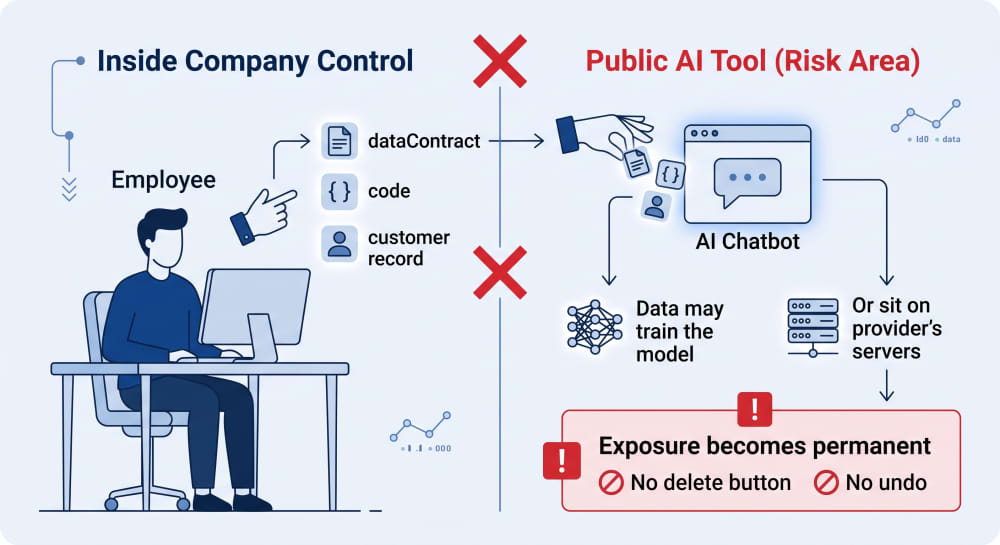
Shadow AI is an everyday data leak occurring right inside your organization. It isn't a hacker breaking in; it is your own well-intentioned employees, assigning routine tasks to AI models, pasting confidential contracts, customer records, and proprietary source code into free public AI tools and quietly handing over your most sensitive personal data and internal company information to systems you do not control. There is no malware to detect, no firewall alert to investigate, and no ransom note to find. The information simply walks out the door, one helpful prompt at a time.
If an AI model knows more about your company than some of your employees do, it is time to talk about security. What makes Shadow AI dangerous? What should absolutely never be entrusted to it, and how can you establish new security protocols?
The New Shadow AI Reality of 2026
Shadow AI emerges from the same logic as Shadow IT - the desire to streamline routine tasks where official corporate tools fail to keep pace with business needs. Yet it carries vastly different consequences.
It often starts with everyday workplace pressures: a tight deadline, the need to find a faster or better way to work, or a tool that is not quite getting the job done. When there is no formal guidance or the IT department takes weeks to approve access to the official task management tool, a project team simply signs up for a free Trello board using personal email addresses.
A marketer might ask a public AI to draft a strategy, an accountant might upload a financial report to check for errors, and a developer might copy a snippet of proprietary company code so the neural network can hunt for bugs.
Employees do not act out of malice. An employee summarizing a report, cleaning up a spreadsheet, or debugging code with a public chatbot is not trying to cause harm. They simply want to get their work done faster and head home at six o'clock. But the moment that data leaves your environment, you have lost control of it and you may have breached your legal obligations without ever knowing it happened. This is the silent leak, and it is spreading so fast precisely because it feels so harmless.
The difference between Shadow IT and Shadow AI
The difference lies in what happens to the data after it is uploaded. When you save a document to unauthorized cloud storage, it simply sits there. When you send confidential code, a legal contract, or a financial report to a free public AI model, that data is often used to further train the model. Your trade secrets, application architecture, or customer personal data could become part of a global knowledge base. So, there is a very real risk that tomorrow, this same public model could output your confidential code in response to a query from a direct competitor, simply as an "autocomplete suggestion."
Besides, data leakage via Shadow AI is irreversible. You cannot simply hit a "Delete" button, as you would with a standard cloud drive, because the algorithm has already processed that information.
Why Shadow AI Is So Dangerous
Shadow AI is dangerous because it combines maximum data exposure with near-zero visibility. When an employee enters sensitive information into an unsanctioned public tool, that data may be stored on external servers, used to train future models, or become subject to the provider’s own security risks, for instance data can get exposed if the provider suffers its own breach.
You cannot protect what you cannot see, and by definition you cannot see what your staff are doing on tools you never approved. The exposure is not hypothetical. Security authorities have long warned that employees are the weakest link in the data chain, and that cloud tools and BYOD trends make it easier than ever to put sensitive information at risk.
Real-World Scenarios and Consequences
To demonstrate the objective risks without unnecessary hype, one need only look at the numbers: 68% of organizations report having experienced a data leak tied specifically to employees sharing sensitive information with AI tools.
The problem is widespread, and many corporations realize the scale of the issue only after their intellectual property has already ended up in the weights of public models.
High-profile incidents serve as an excellent reminder that no one is immune to making mistakes.
One telling case occurred in the United States, where Madhu Gottumukkala, acting director of the Cybersecurity and Infrastructure Security Agency (CISA), uploaded government contracting documents marked "For Official Use Only" to the public version of ChatGPT, triggering automated security alerts and an internal Department of Homeland Security review. Although the data was not classified as top-secret, its exposure could have implications for government programs and infrastructure security. This case is particularly significant given that the individual involved was an official with direct responsibility for the country's cybersecurity posture.
Another early example came from an ecommerce giant Amazon. Company discovered that employees had shared confidential code and internal data with ChatGPT. Some of the chatbot’s responses later closely resembled Amazon’s proprietary information. The company responded by issuing internal guidance forbidding staff from entering any confidential code or company data into the tool.
One more prominent case is from Samsung. In 2023, an employee uploaded work-related source code to ChatGPT, triggering a data-leak controversy and prompting the company to ban external generative AI services. Three years later, Samsung reversed course, rolling out ChatGPT, Gemini, and Claude to employees while putting new security controls and training in place.
How Leaks Occur and What Is Leaked
Real-world incidents show that specific work materials end up in public AI services. Leaks involving AI services most often occur through employees, corporate AI tools, and agentic systems. Developers submit code snippets to neural networks to debug errors or simplify functions; along with the code, the prompts often include API keys, tokens, and configuration settings - anything that happens to be in the clipboard. 22% of all files sent by employees to such services contain confidential information.
Client databases, personal data, legal documents, and internal correspondence are also regularly uploaded to AI systems. Financial data leaks as well: analysts and executives ask AI to verify calculations or prepare summaries, resulting in the transmission of financial reports, forecasts, and deal terms to public services.
Below are the categories of data most commonly fed into unsanctioned tools and that are also the most damaging to lose. Knowing which are they is the first step to protecting them:
-
Customer personal data. Names, contact details, and account information pasted in for "help drafting a reply" can constitute a reportable data breach the moment they leave your systems.
-
Intellectual property and trade secrets. Proprietary source code, product designs, and strategy documents shared with a public model may be retained, exposed, or used to train systems your competitors also use.
-
Confidential business information. Financial figures, unreleased plans, and internal communications lose all confidentiality once they cross into a third-party tool you have no contract or control over.
-
Regulated and contractual data. Information you are legally or contractually bound to protect can trigger penalties and lost trust when it is exposed through a channel you never authorized.
Primary leakage vectors:
Employee-driven exposures usually include direct prompts and file uploads.
Direct prompts. A common scenario today involves simple copy-pasting from the clipboard. 77% of employees paste data into generative AI prompts, with the biggest part of these actions occurring via personal accounts outside IT control.
File uploads. Many services allow users to attach documents, images, and audio files. This is how presentations, reports, meeting recordings, and contract scans find their way into AI systems. File uploads most frequently result in the leakage of personal data and financial information.
Beyond what employees paste in themselves, the AI systems they use unsanctioned can also be deliberately attacked and no one may even notice. If an attack succeeds, security teams may have little visibility into what happened or how to contain it because these tools were never vetted. The consequences are especially serious when the AI agent can access sensitive data or take actions without human review.
Prompt injection attacks. Attackers can hide instructions in documents, webpages, emails, or other content the system processes, causing it to reveal information, ignore its original instructions, or take unintended actions. This isn't only a Shadow AI problem. Even an officially approved AI tool can potentially be targeted by prompt injection. The risk is higher with Shadow AI because unapproved tools or agents may not have been tested for these attacks or restricted to only the data and permissions they need.
RAG (Retrieval-Augmented Generation) injections. RAG apps connect a language model to your own internal documents like contracts, wikis, product docs, so employees can ask questions and get answers based on that private information, instead of just what the AI already knows. If an unapproved AI tool uses these documents, security teams may not know what data it can access or how that data is protected. Attackers who compromise the data source or retrieval layer could then extract internal documents or inject false information into the AI's responses.
Agentic pipelines. AI agents can read files, follow links, and interact with email, APIs, and other systems. If an employee uses an unapproved agent with access to company data or systems, security teams may not know what the agent can access or what actions it can take. A malicious instruction could then cause the agent to leak sensitive information or perform unwanted actions automatically, without the user realizing what happened.
How to Build a Defense System Against Shadow AI
The initial reaction of most CIOs and security teams is to block access to all popular AI services at the corporate firewall level. However, in 2026, this approach won’t be effective.
If you block AI on a work laptop, an employee will simply open it on their personal smartphone, transfer some data there, obtain the result, and email it back to their work account. Strict bans merely drive the problem underground, making it completely invisible to monitoring systems. Besides, companies that completely reject AI tools quickly lose their competitive edge due to low productivity.
That’s why rather than blocking access, companies need a defense system that allows controlled AI use. Here are the main components of this defence system:
1. Secure alternatives. The most effective way to reduce reliance on risky public bots is to provide employees with official, secure tools. If a company fails to provide tools that employees can use safely, they will find their own, resulting in Shadow AI. A BlackFog survey of 2,000 workers found that 49% of employees adopt AI tools without employer approval, 63% believe it is acceptable to use AI when no corporate-approved option exists. So, offer approved enterprise AI options with proper data protections so staff get the productivity they want without the data leakage you fear.
2. Updating security policies. Most organizations lack clear AI governance, with 54% having no AI policy, 24% developing one, and only 13% maintaining documented rules. "Do not share sensitive information" leaves too much room for interpretation. Define exactly what data may and may not be entered into which tools, using plain language. For instance, a clearer policy tells employees never to upload customer support exports, source code, contracts, credentials, unreleased financial results, or identifiable employee records to an unapproved service.
3. Training and security awareness. Most leaks occur not due to malicious intent, but due to a lack of knowledge. An IT Brew survey of 241 IT professionals found that 35% have little to no confidence that employees know their company's AI usage and data security policies, and only 12% felt "very confident." So, people simply don’t realize that pasting data into a public tool can expose it permanently. It needs to be explained to employees why uploading a PDF to an AI assistant constitutes data transmission to an external party, which data must not be copied into prompts, and what to do if a document has already been sent. Short, practical examples work better than long lectures. Regular, concrete training turns unaware users into an informed first line of defense.
4. Assign responsibilities and audit AI use. To prevent AI initiatives from descending into chaos, define roles - who is responsible for approving AI tools, managing security risks, and overseeing how AI is used across the organization. OneTrust survey determined that only 5% of organizations said coordination and accountability were clear across the AI lifecycle. Also, 45% of organizations that experienced an AI-related incident implemented formal AI review and approval processes afterward. Define IT can manage infrastructure, Information Security can handle risks and data controls, business units can oversee AI use in their workflows, and legal can manage regulatory requirements and vendor contracts. Assigning responsibilities ensures departments don't implement AI in a fragmented, inconsistent manner. Have a brief "what to do in the event of a leak" guide, designate staff responsible for initial assessment, and establish protocols for logging incidents. Create a simple registration process for new AI services that records who is using the tool, why it is being used, what data it processes, and where that data is stored. Periodically review approved tools and their use to identify new risks or unauthorized services.
Bottom Line
Shadow AI is not a future risk. It is already happening inside most organizations, driven by the same everyday pressure that once created Shadow IT: employees simply trying to get work done faster. The difference is that this time the data does not just sit on an unauthorized cloud drive - it can be absorbed into public models, become irreversible, and leave almost no forensic trail. Blocking every AI tool is not a viable strategy. Employees will find workarounds, and companies that refuse to provide any AI capability will fall behind. The only sustainable response is to make the safe path the easy path: sanctioned tools, clear policies, training your employees with concrete examples instead of vague warnings, assigning ownership and creating basic visibility into which tools are being used and for what purpose.