Like many AI tools, Claude uses natural language processing (NLP). In other words, Claude can both understand human language and produce natural-sounding human responses. Its capabilities span business process automation, content generation, data analysis, intelligent customer support, and deep integration with corporate systems. It stands out among other AI services thanks to its "Constitutional AI" technology, large contextual window, and natural conversational style.
In 2025, Anthropic significantly expanded the functionality of Claude 3: it now supports working with files, images, tables, and presentations, and can memorize dialogue and adapt to the user's style.
Claude’s Core Features
Safely first measures
Claude AI is built on the Constitutional AI architecture, a unique approach to training and controlling artificial intelligence. The Constitutional AI architecture means that the neural network learns not only from large volumes of data but also from a "constitution": a set of rules that shape its behavior. This approach makes it not only powerful but also secure for businesses as it ensures transparency, explainability of decisions, and mitigation of risks associated with inappropriate or toxic content.
Large Context window
Claude can process up to 200,000 tokens per request in its standard configuration, while the context window for the latest model, Claude Sonnet 4.5, has been increased to 1 million tokens in beta/enterprise contexts. It makes Claude AI capable of processing large volumes of information without losing context. It can better analyze long documents and complex queries. Imagine uploading a 500-page PDF of technical documentation, and Claude analyzes it in its entirety without the need to break it into parts. It makes it an indispensable tool for analytics, coding, and research. For users constantly working with briefs and reports, this feature saves hours.
Artifacts – Results Visualization
The Artifacts feature turns Claude into a true AI assistant for 2026. When users ask the model to write code, create a diagram, or design a simple web page, the result is displayed in a separate window on the right of the chat. Users can immediately see the finished product, edit it, and even export it. It is especially useful for those using Claude for no-code development or prototyping without programming skills. Artifacts acts as an interactive sandbox where it is possible to test code, visualize data, and create web elements in real time.
Claude 4.5 Models: Haiku, Sonnet, and Opus. What's the Difference?
Anthropic has implemented three main versions of Claude: Opus, Sonnet, and Haiku, available in several generations, but the most current models are the 4.5 family, released in late 2025.
Claude Haiku 4.5 – speed & cost
Claude Haiku 4.5, released in October 2025, is the fastest and most economical model in the current line, suitable for startups and freelancers on a budget. It’s ideal for speed-critical tasks, like when you need to process thousands of customer inquiries or create simple product descriptions for an online store. Haiku 4.5 is available on the free Claude web tier (with usage limits), while its API version is designed for high-volume, low-cost automation and integration into mobile and cloud services.
Claude Sonnet 4.5 – balanced, everyday professional work
When released in September 2025, Sonnet 4.5 became Anthropic's most powerful AI, surpassing even Opus 4.1 in many metrics. Sonnet 4.5 excels at writing articles, analyzing data, generating complex code, and solving logic problems. For users working with content, marketing, or business process automation, Sonnet 4.5 is a go-to tool that handles the majority of tasks at a professional level. In Claude’s web interface, it is available for registered users with a limit on the number of queries.
Claude Opus 4.5 – deep reasoning & complex tasks
Released in November 2025, Opus 4.5 is positioned as one of Anthropic’s most capable models. It is designed for complex tasks where accuracy is critical: deep data analysis, complex system architecture, creative projects requiring out-of-the-box thinking, long-term planning, and agent-based workflows. While the model is slower than budget versions and more expensive, the results are worth it. It is the optimal choice for those asking the question “which AI is the best” for complex business tasks.
Claude vs. ChatGPT: Key Differences
Let’s start with the obvious: both models are powerful - they can process text, program, work with images, and perform complex analytical tasks. However, their approaches to content generation, creativity, and coding differ, and each has different strengths.
Development Differences
ChatGPT uses reinforcement learning based on human feedback. It means the AI learns from interactions with humans, allowing it to become more confident and human-sounding in its responses. In simple terms, human reviewers helped fine-tune the model by ranking its responses, thereby teaching it which types of answers are preferable.
Claude AI was developed with safety in mind. It uses a different route, which helps make it safer and more aligned with human values. Instead of relying only on human feedback, Claude uses a “Constitutional AI” approach when the model is guided by written principles, critiquing its own outputs and refining them according to a set of rules. This approach results in a model that tends to be more balanced, more cautious, and less likely to produce misleading or harmful answers. In practice, this leads to differences in their responses: Claude often gives more cautious and balanced answers than other AIs, while ChatGPT sounds more confident and natural.
Text Processing and Generation
It is the category where users immediately notice the difference. Claude sounds more natural than ChatGPT, which still tends to feel more generic. Claude writes more like a human - warmly, intuitively, with an eye for emotion, more accurately conveying the desired style and tone of the text. ChatGPT writes more like a high-fidelity system - structured, precise, with a high degree of control, and switches between styles perfectly on command. But it still overuses certain trap phrases, like "in today's ever-changing landscape" and "let's dive in," which have become clear signals of AI-generated content. ChatGPT also tends to aggressively use bullet point formatting unless you instruct it not to. It's less "human-like," but much better at maintaining a clean structure, SEO-optimized output, and converting text into various formats.
The context window for Claude Sonnet 4.5 has been increased from 200,000 to 1 million tokens in beta/enterprise contexts, representing a 5x expansion from that available in previous models. Context window for GPT 5.2 has also been expanded to 400,000 tokens via the API, with smaller limits in the ChatGPT UI depending on the plan. Claude’s large context window allows for more effective processing of long texts, maintaining a coherent and consistent narrative. It's especially useful for processing large amounts of data, writing extensive articles, and editing complex documents and research papers.
Creativity
For tasks like writing stories, poems, or marketing copy, both AI models can be very creative. Content creators use ChatGPT as an ideation partner, story consultant, research assistant, and editor. It helps them brainstorm ideas, find the right words, refine thoughts, and provides feedback on the structure and flow of the text. ChatGPT is known for its versatility – it can adopt various styles and often produces polished, well-structured writing. However, it sometimes falls into overly formal or clichéd phrasing without specific guidance.
Claude also assists in creative and collaborative writing. It provides ample opportunities for generating ideas and making strategic decisions. Claude’s writing style tends to be more naturally human and nuanced out of the box. In side-by-side tests, Claude’s content is often more specific, varied in sentence structure, and less repetitive or “robotic”. That said, ChatGPT can be extremely creative when prompted well – it can write poetry, dialogue, or humor with excellent results. Claude is very capable too, sometimes showing a subtly “literary” tone. In general, Claude might require less editing for tone, while ChatGPT might provide a flashier first draft that users can further fine-tune for originality.
Problem Solving
For everyday tasks and questions, ChatGPT and Claude are both solid all-rounders. ChatGPT has been trained on slightly more recent data in its latest version, and it excels at step-by-step reasoning, translating languages, explaining concepts, and so on. Claude is also very strong here and often extremely helpful with nuanced Q&A and “deep” discussions. One noticeable difference is style: ChatGPT often gives very detailed explanations by default, whereas Claude is often more direct and to the point, cutting through noise to deliver a more straightforward answer unless asked to elaborate. ChatGPT’s detailed style can be useful for thoroughness (it “thinks out loud”), but some users prefer Claude’s more direct approach for quick answers. For simple queries, either works. For complex discussions or nuanced Q&A, Claude’s caution and grounded approach can be an advantage.
When it comes to more complex tasks, GPT 5.2 outperforms Claude Opus 4.5 on abstract reasoning tests. GPT 5.2 scores 52.9% at ARC-AGI-2 (Novel Problem Solving) versus 37.6% for Opus. These results indicate that GPT 5.2 has a superior ability to think complex thoughts and solve novel problems, which is key in scientific research, academic tasks, and logic-intensive workflows.
Image and Video Analysis and Generation
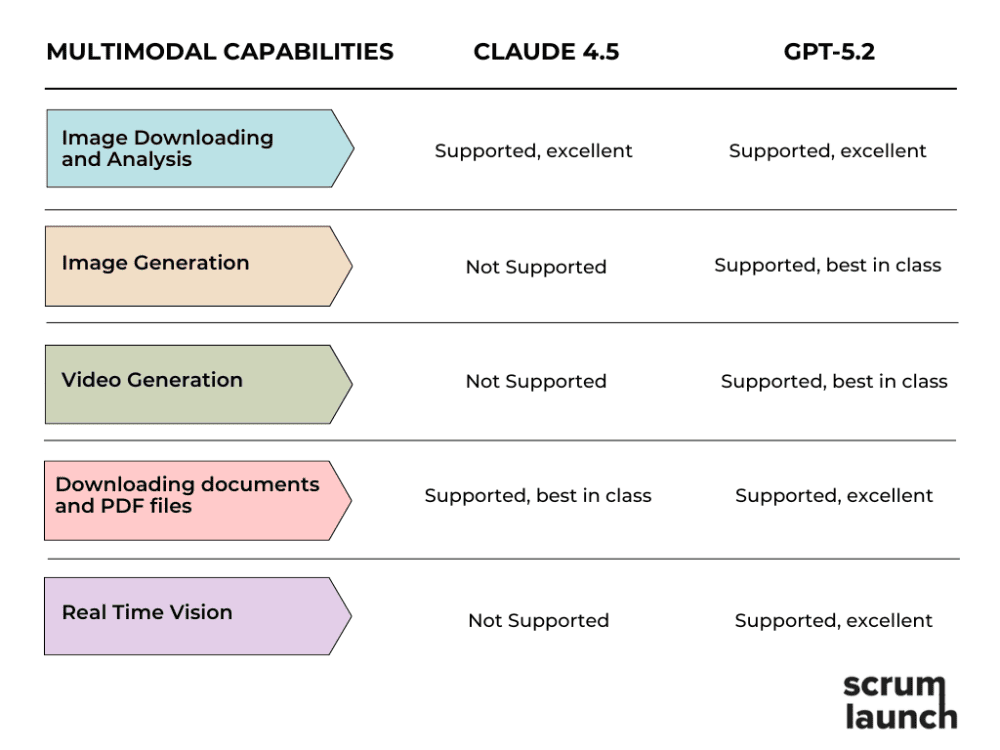
When it comes to multimodality, the difference between Claude and ChatGPT is huge. While both services offer image analysis capabilities, Claude cannot generate images. Claude 4.5 remains primarily focused on text - it can analyze visual data, describe content, and interpret text in images, but that's where its multimodality ends. GPT-5.1 dominates in all categories. Claude simply can't compete in this space yet.
GPT-5.1, on the other hand, is a full-fledged creative studio. It handles image generation, video creation, voice interaction, UI interpretation, screenshot-to-code workflows, and real-time multimodal reasoning, all in one place. ChatGPT is integrated with the DALL·E 3 neural network, one of the most powerful AI image generators available, allowing it to generate images based on text queries. Besides, thanks to the Sora model, which is still a separate product, but is available to anyone with a ChatGPT Pro and Plus plans, ChatGPT can create high-quality videos based on text descriptions. Along with using text prompting to create videos, you can also turn an image into a video, or take an existing video clip and extend it. Sora also lets you tackle basic video editing with options including recut, remix, blend, loop, and edit prompt. Thus, ChatGPT offers broader capabilities for working with visual content, including image generation and editing, as well as video creation. Claude focuses on image analysis and information extraction.
Programming
In terms of the coding capabilities of Claude and ChatGPT, both chatbots demonstrate strong results. Both can generate and debug code, write scripts, and help with software questions. But according to programmer reviews, the consensus is that ChatGPT, while powerful, still lags behind Claude. Claude Opus 4.5 recently became the first model to break 80% accuracy on the SWE Validated benchmark, a widely cited test that uses real-world GitHub issues to evaluate coding. It hits 80.90% on this test, which puts it slightly ahead of GPT-5.2, reaching 80%. While the difference is minor, Opus 4.5's leading position in the SWE-bench rankings reinforces a pattern many engineers already observe in practice: Claude tends to reason more patiently through complex code and edge cases.
Claude 4.5 indeed excels at deep engineering tasks. Some users report that Claude’s code outputs are cleaner and more context-aware, sometimes picking up newer frameworks or routes that ChatGPT missed. Developers notice this: Claude handles multi-file reasoning, long codebases, and complex refactorings in a way that feels like a senior engineer reviewing your work. Its outputs are often cleaner, more accurate, and less likely to invent things that don’t exist. That’s subtle, but in real projects it can save hours.
Artifacts feature take it further. It brings up a preview window so users can see the results of their code in real time or even make simple tests within the chat or request changes, which makes it very handy for debugging and verification. It is possible to use Artifacts for more than just code, for instance, for diagrams, documents, and interactive charts.
Claude also released Claude Code, an AI coding agent that connects to a user's computer command line, where they can see all their project files, understand how they work together, modify their codebase, run tests, and commit changes to GitHub, all through natural language commands. Claude Code integrates with GitHub and GitLab to handle the entire workflow, from reading issues to submitting pull requests, though it asks for permission before making changes or running commands.
ChatGPT, on the other hand, shines in a different way. It’s fast, flexible, and extremely good at turning rough ideas into something tangible. It quickly generates full-fledged applications, seamlessly integrates with multimodal inputs (screenshots, UI mockups, diagrams), and can turn ideas into working prototypes with fewer iterations. With GPT-5.2 Image + Sora 2 Pro, users can even convert UI sketches into front-end code or video demos. OpenAI offers ChatGPT's tighter integration with development tools, making it convenient for professional programmers.
In summary, pure code generation quality is excellent from both, but Claude may provide more nuanced code solutions in some cases, whereas ChatGPT offers an integrated environment to test and refine code. Both Claude and ChatGPT can now execute code, analyze datasets, and generate visual outputs directly in conversation. ChatGPT offers this through Advanced Data Analysis (formerly Code Interpreter), which is available for paid subscribers. Claude provides similar functionality through its Code Execution and File Creation feature, which allows the model to run code in a sandboxed environment when enabled on paid plans (Pro, Max, Team, and Enterprise). Claude, as a coding assistant, is useful for newer developers and non-tech users. They will especially appreciate its Artifacts tool. ChatGPT is less friendly to newbies, but can be useful for experienced developers to automate debugging, code analysis, and solve complex problems.
Additional Features
ChatGPT has a number of unique features that distinguish it from Claude. Some of those features are useful for professionals, but not all that game-changing for regular users. For instance, on ChatGPT, you can create your own custom GPT for others to interact with, tweaking settings to train it to generate responses in a certain way. You can also adjust how it interacts with users: for example, you can instruct it to use casual or formal language. In addition to the ability to create custom GPTs, ChatGPT offers a marketplace where anyone can release their own specialized GPT. Currently, it offers thousands of custom GPT models tailored to a wide range of tasks and domains, and OpenAI encourages ongoing growth of the ecosystem. Claude does not have a public custom GPT marketplace, so this is a real differentiator.
ChatGPT also supports voice mode. It accepts voice queries and provides verbal responses, enhancing the user experience. For Claude, Voice mode is currently available only in English and only on the Claude mobile apps.
Both Claude and ChatGPT are moving beyond chat; they’re starting to act like junior engineers users don’t have to babysit. Claude’s “Computer use” and ChatGPT’s “Operator” are essentially AI agents that can navigate your system, move the cursor, enter text, click buttons, and even complete workflows on your behalf. Think about it: you could have the AI collect data, fill forms, or handle repetitive tasks while you focus on strategy. That’s not just “faster answers,” it’s literally shifting work off your desk.
Right now, though, they’re not plug-and-play. Claude’s setup is still experimental. Users need the API, containerization like Docker, and some patience. ChatGPT’s Operator is locked behind the $200/month Pro tier. The potential is huge, but you’re basically getting early access to a lab tool rather than a polished product. In short, this is the future of “hands-off” automation, but it’s still in the R&D stage. Early adopters can experiment, but mainstream usability will come later.
Pricing, Token Value, and Developer Value
Prices vary depending on the plan and API. Claude AI has a plan for every user type. You can start for free if you just want to try it out, go Pro (~$20/month) for more power, coding tools, and longer sessions, or choose Max ($100–$200/month) if you rely on it for heavy work, big projects, or advanced features. Free users have access to Haiku 4.5 and Sonnet 4.5, but with usage limits. Pro and higher plans unlock broader access, including Opus 4.5, with bigger quotas and better performance.
For developers, Claude Haiku 4.5 costs $1 per million input tokens and $5 per million output tokens, while Claude Opus 4.5 costs $5 per million input tokens and $25 per million output tokens. The latter represents a 66% price reduction compared to Opus 4.1, making advanced AI more accessible to developers and enterprises. Its pricing is suitable for both small and large-scale applications, providing flexibility for a variety of use cases.
ChatGPT offers a Free plan with basic access, Go ($7/mo) for more messages and uploads, Plus ($20/mo) for advanced models and tools, and Pro ($200/mo) for full features, speed, and priority access. With ChatGPT Plus, users unlock more usage limits for GPT‑5.2 models, and Pro or Business plans add GPT 5.2 Pro and optional legacy models.
For developers, the API pricing has been revised upwards compared to version GPT-5.1. Input tokens are $1.75 per 1 million tokens, while output tokens are $14 per 1 million tokens.
It is also important to note that Claude tends to stop new responses once its free usage cap is exhausted, unlike ChatGPT, which usually switches to a lower model.
Conclusion
Anthropic's Claude is more than just another AI model. With its focus on safety, ethics, and user experience, Claude stands as a serious competitor to OpenAI's ChatGPT, especially when safety and ethics are treated not as secondary considerations but as integral elements of AI system design and functionality. In 2026, after multiple iterations and with AI agents on the horizon, obsessing over small benchmark scores feels less meaningful. The real question isn’t raw capability - it’s how each tool is applied. ChatGPT shines as a full-spectrum AI platform. Its image generation, custom GPT marketplace, and flexible integrations make it ideal for users who want to experiment across creative, analytical, and operational domains. Claude, on the other hand, excels when depth matters. Its more natural writing style, powerful coding capabilities with real-time visualization through Artifacts, and thoughtful analytical approach make it the superior choice for developers, writers, and analysts who need depth over breadth.