The gap between growing AI investment and limited financial returns is not just about how successfully companies implement AI projects. It starts with funding decisions: which initiatives are worth funding, how much budget to allocate, and which ones to leave out.
This article shows how to prioritize AI investments, cut unnecessary spending, and build a 2027 AI budget that gets more value out of every dollar spent on AI.
Why AI budgeting needs a different approach in 2027
In the early stages of AI adoption, many companies treated AI spending as an innovation initiative. A team asked for funding to explore something. Leadership agreed because the cost of falling behind felt higher than the cost of a pilot. The budget line was created.
Months later, the pilot had a demo, but nobody could explain what had changed in the business. The team had tested the technology but had forgotten to define the result it was supposed to deliver.
As AI becomes part of everyday operations, the budgeting question is changing. A significant share of AI funding is no longer entirely new money. Companies are increasingly paying for it by reallocating budget from software licenses, labor, and cloud infrastructure. Finance teams increasingly want more than vague productivity claims. They need to see the cost per outcome and how effectively AI delivers measurable results.
The sound approach for most companies in 2027 is to treat AI spending as a portfolio of investments with different expected returns, risks, and time horizons: fund what is already working, set limits on experiments, and reserve money for the capabilities that make future projects possible.
What to fund
Prioritize four categories, in this order.
1. Tools already in use
Start with what your company is already using. If AI is part of everyday work, your budget already includes the coding assistant your engineers open every day, the AI features inside your support platform, the internal knowledge assistant that reduces time spent searching for documents, and the API and subscription costs behind these tools.
These tools already have real users and established workflows, so you can measure what they actually deliver. That makes them the natural starting point for deciding which subscriptions to renew, which tools to expand, and which ones no longer justify their cost. Being already in use is not an exemption. A tool that has been running for a year without a named owner or a measurable result still has to earn its place in the 2027 budget.
When evaluating this category, distinguish true AI-specific spending from general cloud or software costs that would exist even without AI. This keeps the AI budget accurate and prevents AI-related expenses from disappearing inside broader IT categories.
2. Narrow workflows with easily measurable output
This is the first category for new money.
Pick one specific task you have not touched with AI yet that is done repeatedly, has a clear start and end, and is easy to implement: support triage, document processing, internal search, sales call summaries pushed into the CRM, or code review assistance.
Because the task is bounded, you can count it before and after. These are usually the best places for new money because the scope is tight and the results are easy to measure. Resist the urge to fund a “transform the company” initiative. Fund the ticket queue first.
3. Foundational capabilities that make other projects possible
Not every worthwhile investment produces immediate savings. Some investments make other projects easier, faster, and less expensive to build.
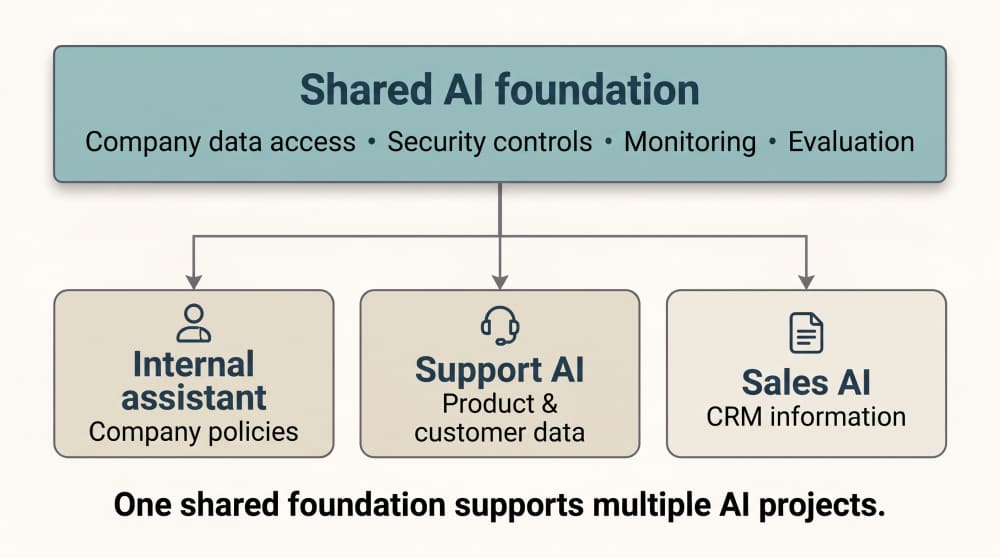
Consider a company planning to introduce an internal knowledge assistant, an AI customer support tool, and a sales assistant connected to its CRM. All three projects need access to company data, reliable ways to evaluate AI responses, and controls over what information each application can access.
Building these capabilities separately for every project would mean duplicating engineering work. Instead, the company could invest in shared data pipelines, evaluation tools, monitoring, and access controls that several AI applications can reuse.
The initial investment may not have a direct business outcome of its own. However, it can reduce the cost and complexity of subsequent deployments. Once several projects rely on the same infrastructure, the company can introduce new AI applications without rebuilding the same components from scratch.
These investments become particularly important when companies move beyond generic AI assistants to solutions that work with internal business data or take actions in existing systems.
Still, foundational projects need a business justification. Companies should identify which planned initiatives depend on them, what risks they reduce, and how their progress will be assessed. Shared infrastructure should not become an unlimited budget category simply because future AI projects might need it.
4. A small number of promising experiments with clear kill criteria
Set aside money for one or two high-potential but riskier bets involving broader workflows. Each experiment needs a named owner, a clear metric, and a pre-agreed stop condition. Set a review date, typically within 60–90 days for a narrowly scoped pilot, and agree in advance on the conditions for scaling, extending the pilot, changing the approach, or stopping it.
For example, a company might test an AI agent that processes incoming sales inquiries, qualifies leads, and updates the CRM. The pilot should have a defined scope, an accountable owner, a baseline for comparison, and a spending limit.
The goal is not simply to demonstrate that the agent works. It is to determine whether it improves the process enough to justify its total cost.
The funding rule: baseline, owner, path to production
Whichever of the four categories a budget line falls into, it has to pass three tests before it gets money.
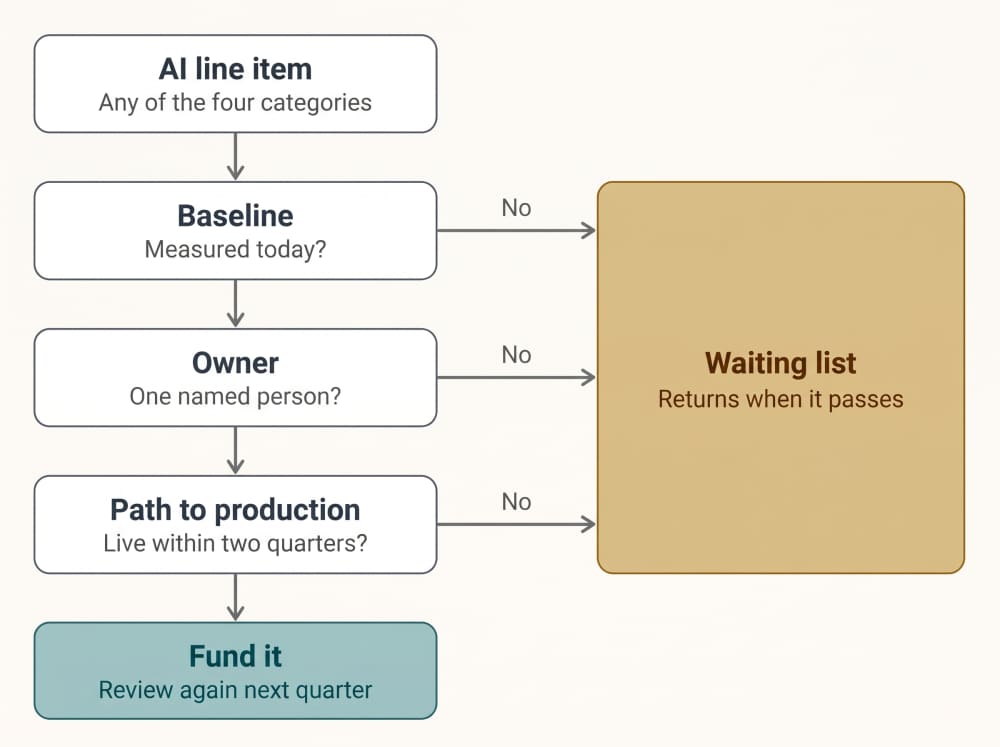
The first test is a baseline
A baseline is the current cost, time, or error rate of the process AI will change. If your support team closes a ticket in 14 minutes today, that is the baseline. Without it, “AI improved support” is a feeling, not a result. If you cannot measure the process now, you cannot fund the project yet. Measuring it is the first task.
The second test is an owner
One named person should be accountable for the outcome. Not a committee, “the AI team,” or a vendor. The owner is usually the head of the function the project touches, because that person sees the result in their own numbers. Projects without an owner drift. Projects owned by someone with a target move.
The third test is a path to production
The project should be able to reach real users within a fixed window, such as one or two quarters. That means the data is accessible, the integration points are known, and someone has decided who will use the output. A demo that impresses in a meeting but has no route into daily work is not a project. It is a presentation.
A project that fails any test does not get funded this quarter. It can come back when it passes. This sounds strict, but it helps avoid spending money on projects that are not ready.
What to cut or freeze
Cutting is where a budget gets its discipline, so be blunt about it.
1. Pilots past their deadline
Every pilot needs an end date, set on day one. If the date passes and there is no measurable result or path to production, the pilot ends. Activity is not progress. Extensions should require a specific reason, a revised milestone, and an explicit decision about what additional evidence the team expects to produce.
2. Custom builds where a commercial tool is enough
Building gives you control, but it costs more than it might seem initially. If a commercial product is readily available and does most of the job, stop funding the build and spend your engineering time on what is unique to your business. We cover that decision in the Build vs. Buy AI Agents in 2027 article.
3. Overlapping or redundant tools
Different teams often buy different AI tools for the same job: three subscriptions for meeting summaries, two for writing assistance, or AI features inside existing SaaS that nobody uses. Audit what you pay for. Consolidate to one. The savings are usually larger and faster than people expect.
4. Theater projects
Anything whose primary justification is “we need to show we’re doing AI,” “competitors are doing it,” or “the board asked for an AI strategy” belongs on a waiting list, not in the budget. Experimentation is healthy when it is capped and dated. If it has no process redesign and no measurable target, it is marketing, not capital allocation.
How to split the budget: a worked example
The right split depends on where a company is. A company that has run AI for two years has most of its money in tools already in use, and its new money is a smaller slice. A company just starting has almost nothing committed, so nearly all of its budget is new. Neither is wrong. The committed share is not a target you set; it is whatever you already pay. The decision you control is whether each committed line earns its renewal and whether each new line passes the three tests.
Here is the rule in practice. The company below is fictional, and so are the numbers. They illustrate the method. They are not industry benchmarks.
Take a 40-person B2B software company with an annual AI budget of $200,000. Leadership sorts every line into the four categories and runs each one through the three tests.
Tools already in use: $70,000. This covers coding assistants, AI writing tools used by the marketing team, and API usage for one customer-facing feature, for instance, AI search inside the product: users ask questions in natural language, and the system retrieves relevant information from their workspace and generates answers. The coding assistants stay because engineers use them regularly and report time savings on routine coding tasks. The company consolidates overlapping writing subscriptions into one tool. API spending is reviewed against usage and the value delivered by the existing product feature.
New narrow workflows: $80,000, split across two projects. The first is support triage, funded at $40,000. The baseline: support agents currently review and manually route incoming tickets. The company measures how many tickets reach the correct team before introducing AI. The owner is the head of support. The tool integrates with the existing helpdesk, such as Zendesk, and goes live within one quarter. The primary metric is the percentage of tickets routed to the correct team.
The second is sales call summaries that feed the CRM, also funded at $40,000. The baseline: sales reps currently spend an average of five hours per week writing call notes and updating CRM records. The owner is the head of sales. The AI-generated summaries are integrated into Salesforce within one quarter. The primary metric is the time reps spend on these administrative tasks per week.
Foundations: $30,000. Before launching new AI projects, the company needs tools to evaluate their performance, monitor their operation, and track their running costs. Two newly funded projects, the support triage tool and the sales call summarization feature, will both rely on these capabilities. For example, the company needs to check whether the support tool routes tickets correctly, whether the sales assistant produces accurate call summaries, and how much each application costs to operate as usage grows. The head of engineering requested a larger budget, but leadership approved $30,000 for the initial setup and will review whether additional investment is needed as the projects move into production.
Experiments: $20,000, split into small, capped bets with a 60-day review. One experiment, a prototype AI feature for the product, shows no usage signal at review and is cut. The freed money funds a second attempt with a tighter scope and the same review date.
How to prove it works and measure ROI
Hours saved and better experiences are useful indicators, but they are not enough on their own to justify further AI investment. A benefit counts only when it shows up as a figure: dollars, tickets, revenue, or hours redirected to work that has its own number. If a benefit cannot be counted after 90 days, treat it as unproven. Unproven is not the same as failed, but it is not grounds for more funding either.
Proof takes two steps. First, check that the number you care about moved. Then check whether the change was worth what it cost.
For the first step, you need a before: the baseline from the funding rule. Pick one primary metric per project: cost per ticket, cycle time, error rate, or hours saved converted into dollars. One only. A project with five metrics lets the team pick the flattering one. If the metric moves in the right direction, such as minutes per ticket going down, the project is working in a narrow sense. But that is not proof on its own. An AI tool can improve productivity without generating enough financial value to justify its cost.
The second step is to calculate ROI (return on investment). ROI translates the improvement into financial value. Did the company reduce operating costs, generate revenue, improve margins, or redirect employee time to work that produces measurable value?
Compare that benefit with the fully loaded cost, including licenses, inference, integration, development, maintenance, and monitoring. ROI is the result:
ROI = (value of the improvement − total cost) ÷ total cost
Here is the support triage project from our example. The numbers are fictional, and the $30 hourly cost is an assumption for the illustration. Tickets took 14 minutes before launch. At the 90-day review, they take 10 minutes, across 3,000 tickets a month.
That saves 12,000 minutes a month, or 200 hours. At $30 an hour, the value is $6,000 a month, or $72,000 a year.
Suppose the fully loaded cost for the year is $50,000.
ROI is ($72,000 − $50,000) ÷ $50,000, or 44%.
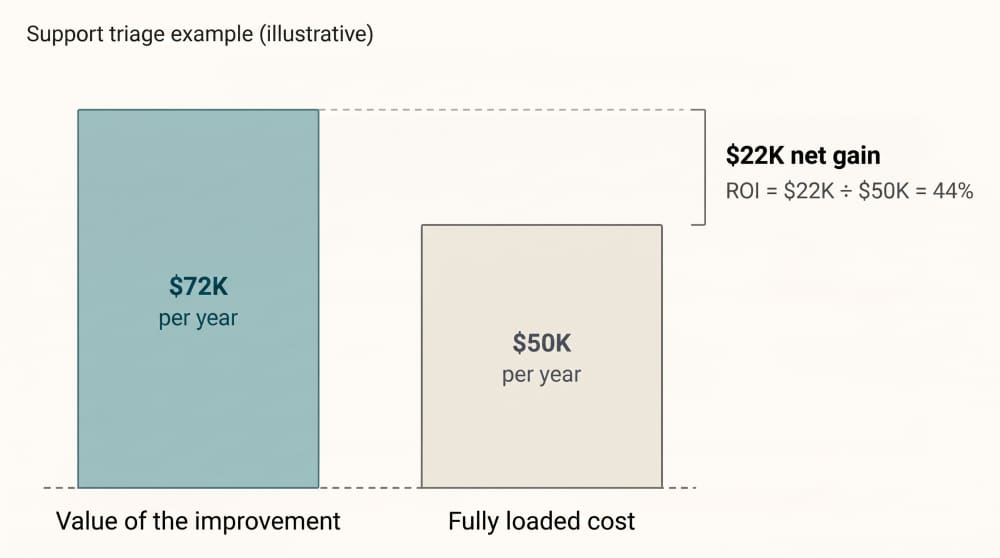
Two checks before you trust that figure. The $72,000 counts only if the saved hours go somewhere: less overtime, more tickets handled, or work the team never had time for. And confirm that nothing else moved the same number. A seasonal dip in ticket volume or a new hire can look like a result.
At 90 days, review each project against its baseline and its kill criteria, the stop condition you agreed on before launch, with the owner in the room. Keep, adjust, or cut based on the number.
Make the review a quarterly habit
An AI budget stays useful only if it is reviewed regularly. Once a quarter, hold a review of the AI investments that need a decision: projects reaching their 90-day checkpoint, ongoing experiments, shared infrastructure that supports multiple projects, and usage-based spending that may be growing faster than expected. Existing subscriptions get a separate review once a year, ahead of renewal, when there is still time to cancel, renegotiate, or reduce seats.
Apply the same criteria to every investment: Is it delivering the expected outcome? Does the measured value justify the fully loaded cost? Projects that meet their targets can continue or scale. Those that miss them should be reassessed, adjusted, or stopped. New requests go through the same process.
Keep the review short. One page per line should be enough: baseline, owner, primary metric, result, total cost, and decision. One meeting, with a clear outcome for every investment. After a year, those pages show which AI use cases delivered value in your company and what they cost to maintain.
Bottom Line
Planning your 2027 AI budget is not about predicting which technology will be most popular next year. It is about deciding which business problems are worth solving, how much you are prepared to invest, and what evidence will justify continuing that investment.
Start this week. List every AI subscription, API cost, and pilot currently running. Next to each one, write a named owner and a clear baseline. The lines you cannot fill in are your first candidates for cuts. From there, the priorities are simple: scale the systems that already deliver measurable value, invest only in the foundations that multiple projects will actually use, and give every experiment a clear limit and review date. Change course when the results do not match expectations.