On November 23, 2026, Anthropic introduced Claude Ship, a suite of AI agents intended to automate verification, correction, and approval of routine changes in the code.
Anthropic explains that while AI agents have removed most practical limits on how fast code can be generated and what used to take days can now be produced in hours, the systems responsible for reviewing, testing, and validating that code have not scaled in the same way. Till now those processes mostly remained time-consuming and required human expertise. So, the bottleneck simply shifted downstream.
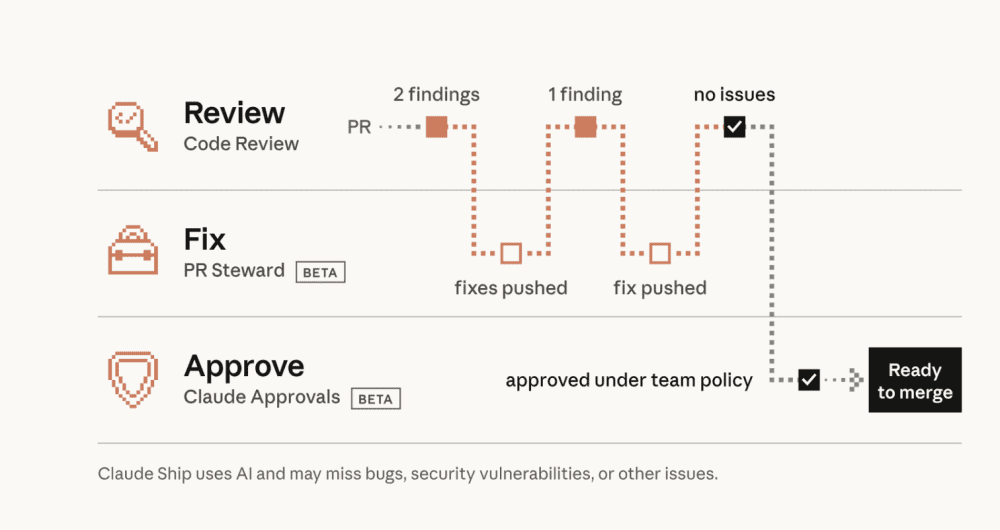
Claude Ship has been designed to automate exactly these tasks and reduce that shifted bottleneck. New AI agents are expected to independently take a pull request through review, fixing errors and an approval decision before it is merged into the codebase.
How Claude Ship works
Claude Ship comprises three tools.
Code Review
Code Review analyzes proposed pull requests in the context of the existing codebase, rather than the diff in isolation, identifies potential errors, categorizes them, and leaves comments. Users can select the review depth they need: "Quick," "Standard," or "Deep."
PR Steward
PR Steward works on detected issues, including failed automated CI checks, merge conflicts, and requested changes based on feedback from other developers. After pushing the updated code to the pull request, the agent also explains the changes it made and provides instructions on how to revert to a previous version of the code if necessary.
Claude Approvals
Claude Approvals determines which pull requests can be approved automatically and which require human review. The team sets these rules for the agent by creating an approval policy and keeping it as a file in the repository. They can use natural language to define the conditions under which the AI is permitted to approve changes, as well as the scenarios that require a human expert to make the decision.
Anthropic admits the AI can miss bugs and security vulnerabilities and recommends initially using Claude Approvals in observe-only mode. In this mode, the AI indicates which changes it would approve, without actually granting approval. This allows the team to evaluate the AI’s decisions before letting it approve changes.
How to use Claude Ship
There are two ways to use Claude Ship. A developer can run the /ship command in Claude Code to process their own changes. This usage counts toward the developer's regular Claude Code usage. Whether the pull request can be merged still depends on the developer's permissions and the repository's rules.
Alternatively, an admin can configure Claude Ship for specific repositories, allowing its agents to work on pull requests automatically without developers having to invoke /ship every time. Teams can control where Claude Ship operates by selecting only some of the projects. Claude Ship settings can be found under Organization settings → Claude Ship. To access them, one must have the Owner role. Claude Approvals is activated when the repository contains an approval policy file on its default branch. An admin can turn Claude Approvals off at any time.
Pricing and availability
Charges for Code Review and PR Steward in this case are based on token usage. The total cost depends on the number and size of pull requests, the depth of review selected, and how often you use PR Steward. Administrators can also set spending limits for Code Review and PR Steward features.
There is no base fee for Claude Approvals, but its classifiers within a policy are billed based on the tokens they consume, and a policy that relies on review triggers a billable Code Review, even in observe-only mode.
Anthropic has rolled out access to Claude Ship for teams with Claude Team and Enterprise subscriptions that host their code repositories on GitHub. If your code lives on GitLab or Bitbucket, Claude Ship isn’t for you yet, because it works with GitHub only. Organizations on Zero Data Retention, the HIPAA configuration, or customer-managed encryption keys are out too.
When Claude Ship was launched, only Code Review was made generally available. PR Steward and Claude Approvals remain in beta.
To encourage businesses to try out this new offering, Anthropic is offering eligible Enterprise customers between $10,000 and $50,000 in credits for using Claude Ship. The amount depends on the number of active Claude Code users within the company. According to Anthropic’s promotional terms, credits can be activated until January 15, 2027, and must be used within 30 days of activation.
Bottom Line
Claude Ship automates what comes after writing code: it reviews changes and fixes errors. PR Steward can save time by working on failing tests and merge conflicts while the team moves on to other work. Approvals need more care. It’s not just about automating code reviews and fixes, it’s also about AI receiving the power to approve pull requests without human involvement. While teams define what changes AI can approve, the policy on what it is authorized to do is then stored in the repository and teams should control who can change those rules on the default branch. This makes ownership particularly important. Someone on the team should be responsible not only for deciding what AI is allowed to approve, but also for ensuring those rules remain appropriate. Giving AI approval authority doesn't mean giving up responsibility for its decisions. If you need engineers to set up or review these workflows, explore ScrumLaunch’s engineering teams.