Construction estimating is one of the most document-heavy jobs in construction, and it has always carried responsibility. It’s about determining how much a building project will actually cost before work begins, from calculating material quantities based on drawings to accounting for equipment, subcontractor costs, overhead, permits, profit margins, and a buffer for surprises.
Calculating this figure accurately is crucial: if it is too high, you risk losing the contract, while if it is too low, you risk losing money.
Estimators are being asked to review thousands of interdependent details under severe time constraints, then make decisions that can define profitability for years. A single tender package might consist of 50 drawings, a 250-page specification, preliminaries, pre-construction info, and a formal tender document, all of which must be reviewed and returned within a couple of weeks.
That reality creates a risk of errors even for the most experienced professionals. And that’s the reason why, in recent years, artificial intelligence has entered this process, not as a trend, not as a replacement for expertise, but as a response to an industry that has outgrown purely manual review.
Below, we will examine why construction estimation is still slow on AI adoption, which aspects of construction estimating benefit from AI, and where it proves to be less effective.
Why estimators are cautious about AI
Construction estimates are not just internal calculations. They become the basis for bids, contracts, and financial commitments. A wrong number or error that goes unnoticed in a fixed-price bid gets you a contract you lose money on.
Consider the case of Olympus Painting Contractors, which submitted a bid of $5,606,316.34 to repair and repaint the Veterans Memorial Bridge ordered by the West Virginia Division of Highways (DOH). It was the lowest bidder by about $1.6 million.
As it turned out, a data-entry error amounting to $708,000 had occurred. Olympus’s owner calculated the prices, and an employee misread his handwriting, confusing figures 9 and 5 and entering $5,340 instead of $9,340. On the per-foot price for 177 ft of expansion-joint replacement, that created a $708,000 error.
Olympus notified the DOH of the mistake and asked it to reject the bid. The DOH refused, awarded Olympus the job, and later demanded payment of the approximately $280,000 bid bond when Olympus would not sign the contract. The surety refused to pay, and the DOH sued Olympus and the surety. The trial court ruled for Olympus. In February 2025, the West Virginia Intermediate Court of Appeals held that state law allows a bidder to withdraw an erroneous bid after bids open if four statutory conditions are met. It affirmed the trial court on three conditions, but vacated part of its ruling and sent the case back to assess whether the DOH acted arbitrarily, capriciously, or abused its discretion when it found no bidding error. The official appellate opinion sets out that distinction; ASCE summarizes the case.
The Olympus case illustrates why construction companies may be cautious about introducing AI into estimating. When a single error can put a contract and a company's profitability at risk, relying on automated calculations and document processing is not an easy decision. Yet there is a certain paradox here: AI could help prevent some of the very mistakes that make companies hesitant to trust it in the first place.
Where AI helps
The Olympus case illustrates not only the financial consequences of a mistake, but also how easily an error can enter an estimate during manual data handling. At the same time, construction estimating involves much more than entering and checking numbers. Estimators need to review and analyse information which is often spread across dozens of drawings, specifications, schedules, and subcontractor documents. A discrepancy between two drawing versions, a missing requirement in a specification, or an overlooked exclusion in a subcontractor quote can all affect the final estimate.
Reviewing these documents individually makes it difficult to catch every inconsistency, especially when estimators have only a couple of weeks to prepare a bid. Those missed discrepancies, overlooked requirements, and data-entry errors are not necessarily failures of diligence or competence. They are symptoms of scale. As project documentation grows, the time and effort required to review every detail increases, while deadlines rarely allow for proportionally more scrutiny.
AI can help bring this information together, cross-check documents, and identify potential gaps. AI-assisted document processing and validation tools can flag unusual figures, inconsistencies, or information that needs clarification before it makes its way into a submitted bid.
AI performs best on the following repetitive, data-heavy tasks in construction estimating:
Quantity takeoffs from clean documentation and drawings
Quantity takeoffs are among the most time-consuming parts of construction estimating. They involve identifying materials and measuring quantities from project drawings. For example, an estimator working on a commercial building may need to calculate the floor area, wall lengths, number of doors and windows, concrete volume, and quantities of structural materials. AI-powered takeoff software can analyze digital drawings and identify many of these elements automatically. Computer vision helps recognize symbols, shapes, and objects, while measurement tools calculate areas, lengths, and counts. This can cut the time spent on basic measurement significantly, especially on large commercial projects with many similar rooms or floors.
Processing Construction Documents
Construction projects generate large volumes of documentation. Drawings, technical specifications, material schedules, and contract documents often contain overlapping or conflicting information. AI can help extract relevant details and organize them into structured data. For example, an NLP-powered system can scan long PDF specifications and RFPs, pull out key requirements, like material specifications, equipment requirements, dimensions, and other project details. It can help compare different document versions, flag compliance language, and highlight potential risks, special conditions, and potential discrepancies. This is particularly useful when estimators need to review multiple files before preparing a bid. Instead of searching through every document manually, estimators can use AI to locate specific information and highlight areas that may require closer attention.
Comparing historical data for material and labor cost
Once quantities are established, estimators need to assign costs to materials, labor, and equipment. When a company has good past project records, AI can surface similar jobs and typical cost ranges. This helps estimators start with more realistic baseline numbers instead of guessing. For example, a system could use previous estimates to identify typical labor requirements for similar projects or compare current material prices with historical averages.
It should be kept in mind though, that historical data doesn't always reflect current market conditions. Material prices fluctuate, labor availability varies by location, and project-specific requirements can significantly affect costs. So, reliable cost estimation requires regularly updated pricing information and adjustments for local conditions.
Bid Preparation
Preparing a construction bid involves more than calculating a total project cost. Estimators must organize cost items, compare subcontractor quotes, review exclusions, and prepare documentation for clients. AI can help automate parts of this administrative work. For example, it can extract pricing information from subcontractor proposals, organize quotes into comparable categories, identify missing information, and generate preliminary cost breakdowns. This doesn't mean the software can independently decide which subcontractor offers the best deal. A lower quote may exclude important work, use different materials, or include conditions that affect the final project cost. Still, automating document organization and comparison can save time and help estimators focus on evaluating the actual differences between proposals.
Where AI falls short
In 2020, All Phase Services built a bid to replace roofs at the Buffalo VA Medical Center on a roofing subcontractor’s single lump-sum price, with no scope breakdown. All Phase could not tell what the price covered, and when the VA asked it to verify the bid, it did. The subcontractor’s president later said he had dropped two items while moving figures between his own worksheets: lightning protection at $82,500 and roofing over the ambulance entrance at $175,000. In November 2025, the Civilian Board of Contract Appeals denied All Phase’s request to rescind the contract, citing weak evidence of the mistake and the delay in raising it. No AI was involved. And while an AI tool could see that a quote has no breakdown, it won’t be able to see what the number leaves out. That information sat with the roofer, and someone had to ask for it.
AI tools fall short in the very qualities that make a skilled cost estimator a valuable professional: the ability to recognize that a particular subcontractor consistently submits low bids only to demand additional payments later; to identify site-specific issues, like when the site has restricted crane access that will slow down construction; or to know that a client’s representative in charge of budgets has a reputation for aggressively challenging or cutting the contractor's general site running costs. That judgment stays with them.
Here is what remains human-specific:
Incomplete, Inconsistent or Messy Project Documentation
AI systems depend heavily on the information they receive. If drawings are outdated, complex, or messy, specifications are missing, or different documents contain conflicting details, automated estimates may be unreliable. A system might calculate quantities correctly based on one drawing while overlooking a revision in another document. Accuracy drops sharply on scanned plans, hand-marked revisions, overlapping systems, or non-standard symbols. Mechanical, electrical, plumbing, and civil work are especially challenging. An experienced estimator can recognize when information doesn't make sense or isn't sufficient, and request clarification. AI can flag some inconsistencies, but it cannot always determine which information should take priority.
Site Conditions and Unexpected Expenses
AI only sees what is on the drawings or in the documents it is given. It does not understand that the soil report shows rock, that truck access is limited, or that local regulations can all affect project costs and cause major delays. These factors may not be visible in the architectural plans. AI can incorporate site reports, historical data, and other available information, but it cannot reliably account for conditions that haven't been documented or inspected.
Experienced estimators will catch these issues. Current AI tools usually won’t.
Unusual Designs and Project-Specific Requirements
AI performs better when it encounters patterns similar to those in its training data. Standard building elements and recurring layout solutions are generally easier to recognize and process than unusual architectural details or complex structural schemes. Think of a project that requires non-standard shapes, atypical connection joints, or specialized installation methods. AI systems might be able to identify individual components required for unusual constructions, but they may be unable to account for the additional labor, materials, or equipment required for their installation. Such scenarios should still be evaluated by an expert, a specialist with knowledge of construction methods who is capable of assessing the practical implications of design decisions.
Real pricing and local market knowledge
AI may suggest unit rates, but these figures are often outdated or too generic. Local labor shortages, specific subcontractor pricing, current fluctuations in material costs, and the productivity of crews on a particular type of project still require human expertise. Consider a project that involves specialized concrete work: an AI system might calculate the required quantity of materials and suggest labor rates based on data from past projects. However, if there is a scarcity of skilled specialists in the area, the actual rates charged by subcontractors could be significantly higher. Similarly, a supplier’s quoted price may not account for current material availability, delivery costs, or bulk discounts.
Judgment, Risk and Responsibility for the Final Estimate
Perhaps the most important limitation of AI in construction estimating is accountability. An inaccurate estimate can lead to underestimating project costs, unforeseen expenses, reduced profitability, or disputes with clients. Even if AI performs fast calculations, someone must still verify the underlying assumptions, analyze the results, and approve the final figures. Defining the scope of work, assessing how aggressive to be on a bid, navigating incomplete project documentation, and accounting for risks based on professional experience - all of these remain exclusively human strengths. In construction, profit margins are thin, so even a minor error can completely wipe out a project’s profitability.
Buy vs build decision
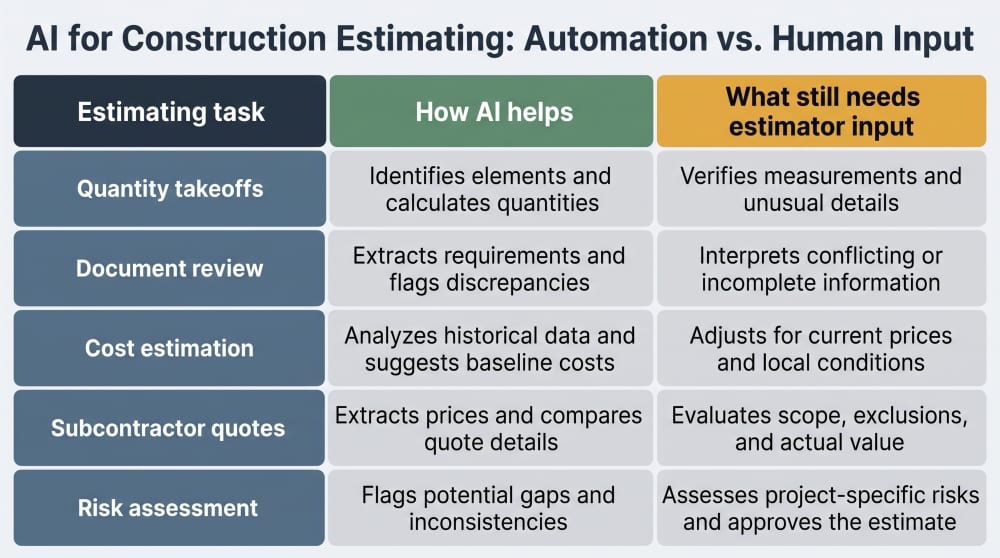
The table below sums up the split: which estimating tasks AI tools handle well, and which ones stay with a person. The tasks AI handles well are the ones you need tools for. The next decision is where those tools come from: buy them ready-made, or build something custom.
Buy first. Takeoff and document processing are crowded categories with established products, from STACK and Togal.AI to Buildxact for residential builders. In our view, for most contractors, buying an established tool is a more practical starting point than building one from scratch.
Build where the value sits in something a vendor can’t see. Three cases come up.
The first is your own cost history. A tool that knows regional price indexes doesn’t know how fast your team pours slabs or which supplier delivers late. Connecting years of closed jobs to an estimating workflow takes custom work.
The second is subcontractor quotes and your history with them. Existing bid-leveling tools, such as Procore, can compare quotes for the same project, flag missing scope items, and highlight differences between bids. But they work with the quotes in front of them. They don't necessarily know which subcontractors have left work out on previous jobs or which omissions tend to recur. A custom workflow can connect those historical records to the quote review process, helping estimators spot patterns that a standard tool might miss.
The third is integration. If the estimating tool doesn’t connect to your accounting, project management or bid systems, someone retypes numbers. Olympus shows what one misread number costs.
At ScrumLaunch, we build custom software and staff engineering teams for founders and CTOs. If your estimating workflow needs a layer the off-the-shelf tools don’t cover, we can scope it with you before you commit to a build.
Test it on closed bids first
Whichever route you take, don’t start on a live bid. Take five closed bids, across different project types, and run the tool on the same drawings your estimators used. Put its quantities next to what was actually built, and its unit prices next to what you actually paid. Since you're using completed projects, no live bid is at risk. If your documentation doesn't record estimated versus actual cost, fix that first. The tool can only be judged against the history you kept.
The comparison shows two things. The first is where the tool is strong: counting materials, measuring quantities, and estimating unit prices close to what you paid on previous projects. That tells you which tasks to hand over first. The second is what the tool couldn’t see. Go through each job’s final cost and list every dollar no drawing or spec showed: a subcontractor exclusion, a site condition, a scope item nobody assigned. On the All Phase job, that list would have opened with $257,500 of omitted work. The length of that list is the length of the human review you still need.
Decide who checks what before anything goes live. Scope and subcontractor quotes stay with the estimator who signs the bid. Then track how often estimators change what the tool produced. A high correction rate on one task says pull it back. A low one says expand.
The test shows what the tool misses on jobs you’ve already finished. On the next bid, it will still see only the drawings. What the site holds still needs someone to walk it.
Final Thoughts
AI in construction estimating is not a black box that produces reliable prices without human input. It can take over more of the mechanical work, from quantity takeoffs and document processing to comparing quotes and flagging inconsistencies. As technology evolves, these capabilities will continue to improve, but they won't eliminate the need for an estimator to understand project-specific risks, interpret incomplete information, and make sound commercial decisions. The goal is not to automate the entire estimating process, but to use AI where it can save time and help catch errors while ensuring that humans remain responsible for the decisions that determine the final bid. Start with a clearly defined task, validate the results against completed projects, and expand its role only when the tool proves reliable.