This guide explains what technology due diligence is, what reviewers look at, what they want to see, and which issues investors are likely to flag.
What Technical Due Diligence Actually Is
Technical due diligence is not a line-by-line audit of your code. Perfect code does not exist, and nobody expects it. It tests whether the product and engineering team can support the company's next stage of growth. The process is not adversarial. Investors just need to verify claims before they write a large check. The easier you make it for the investor to check, the faster it goes.
The depth of technical due diligence generally increases as a startup grows. There is no fixed rule, but at pre-seed, investors may focus on a product walkthrough and a conversation with the founders. At seed, they may examine the architecture or code more closely, especially if the technology is central to the business. By Series A, a more structured review is common, covering architecture, code quality, security, and the engineering team’s ability to support growth. The reviewer is usually a partner with an engineering background, an outside technical advisor, or a specialist firm.
They judge how clearly you describe your architecture, whether you keep a record of who has access to what and what you depend on, and whether you are honest about technical debt instead of hiding it until the last moment. They write a report. That report shapes the valuation conversation, the closing conditions, and sometimes whether the deal closes at all.
Main questions every reviewer answers
Every item on this checklist maps to one of five questions: Is the technology what you say it is? Can it scale with users, data, and markets? Is it secure and reliable? Does the company own and control what it sells? And are the risks known and managed?
The last question shapes how the reviewer reads the other four. A team that names its own weak points earns trust. A team that says everything is fine loses it, because the reviewer will find the problem anyway.
The sections that follow show where reviewers look for answers to these questions.

1. Architecture and scalability
The reviewer asks one core question in many forms: what breaks first when usage grows tenfold? Does ten times the users force a redesign, or just a bigger cloud bill?
Start with a clear picture. Draw the system on one page: the main applications and services, the databases, the key integrations, the cloud provider and regions, and the path user data takes through it. Be ready to explain how users authenticate and what permissions they get. If you cannot draw it, the reviewer will conclude that nobody fully understands it.
Provide evidence of scale readiness. Show production numbers or load-test results if you have them. Reviewers also look for basic scaling patterns: caching, optimized database queries, and background processing for slow tasks. If the product is used across several countries, they will expect a plan for content delivery and regional data, typically a CDN and local data replicas.
Show that the structure was deliberate. Name your bottlenecks yourself, and write down why you made your major design choices: the options you weighed and the tradeoffs you accepted. When the reviewer asks why you picked a solution, the answer “it happened historically” is a red flag. A short written record is a green one.
Last, know what reviewers mark down. Nobody expects a microservices showcase, and a well-built monolith is a perfectly fine Series A architecture. A tightly coupled one where any change risks breaking three unrelated features, or a product where every part depends on a single large database with no plan for when it reaches its limit, are the classic red flags. Name your bottlenecks yourself. Other red flags are an architecture that works only because one person intervenes by hand, or a scaling plan that says 'we will rewrite it later' with no budget attached.
2. Code quality and technical debt
Reviewers sample the code. They look at how a feature is built, how it is tested, and whether a new engineer could follow it.
Automated tests are the clearest signal. You do not need full coverage. You need tests around the paths that earn or lose money: signup, payments, data handling. Add a working continuous integration pipeline that runs them on every change. No automated tests at all is the deepest red flag in this section. The team cannot prove that a change did not break something, so every release is a gamble. Teams either break things or slow down out of caution.
Technical debt is expected, and every growing company has some. It is not a problem on its own. Hiding it is the mistake. Left unmanaged, it can take up a large share of a team’s time and budget, spent maintaining old code instead of building new features. Deloitte’s 2026 Global Technology Leadership Study estimates that technical debt accounts for 21% to 40% of IT spending. in large organizations. That slows growth, and reviewers price it in.
Keep a written debt register with one line per issue: what it is, the business impact, how severe it is, the remediation plan, the owner, and a rough timeline. A founder who hands over that register looks in control. A founder who says 'the code is clean' looks unaware.
If your MVP was built fast with AI tools or a no-code platform, say so and show the hardening plan. Reviewers have seen it before, and pretending otherwise costs you credibility. For the details, read our guide on: From Vibe-Coded MVP to Production-Ready Product.
3. Security and compliance
Cybersecurity is often one of the most critical aspects of a technology due diligence process, especially for companies that handle customer, financial, or medical data, payments, or corporate systems.
The reviewer checks the basics first. Secrets and API keys belong in a secrets manager, not in the repository. Multi-factor authentication must be on for every engineer and every cloud account. Access to production should be limited and logged, and separate from development access. Customer data should be encrypted in transit and at rest. The application should be tested against common web vulnerabilities (the OWASP Top 10 is the usual reference), and your dependencies should be scanned for сommon vulnerabilities and exposures.
Then they ask about people and processes. What happens to a former engineer's access on their last day? Have you run a penetration test? Do you have an incident response plan, even a one-page one? It should say who is in charge, how incidents are reported and rated, who talks to customers, and who handles notification to regulators where the law requires it.
Finally, they check compliance requirements that depend on your market, customers, and the type of data you handle. Enterprise buyers ask about SOC 2 or ISO 27001. EU personal data brings GDPR. Health data brings HIPAA, and card payments bring PCI DSS. You do not need the certificate at Series A - you need a credible path to it.
Never claim compliance you cannot evidence. If you are working toward a standard, say so and show the roadmap. Requirements vary by industry and country, so involve qualified legal, privacy, or security professionals for your specific case.
4. Infrastructure, DevOps, and reliability
The reviewer wants to know how code gets from a laptop to production, and what happens when production fails.
They look for separate development, staging, and production environments, and real visibility into whether the system is healthy, with people who actually read monitoring, alerting, and logs.
They look for repeatable deployments. A release should not be a ritual performed by one senior engineer on a Friday. Anyone on the team should be able to trigger a release through an automated pipeline (CI/CD). The process should be documented, repeatable, and not dependent on one person.
Backups matter more than founders expect, and simply having them is not enough. The reviewer asks when you last restored one. If the answer is never, you do not have backups - you have hope.
Bring evidence: an infrastructure diagram, monitoring dashboards, uptime history, and reports on past incidents. If you have had outages, be ready to explain what happened, how the team responded, and what changes you made afterward. Reviewers care less about whether outages occurred and more about whether the team learned from them.
Cloud cost is part of this review too. Show monthly spend and how it scales per user, because gross margin at Series A depends on it.
List your critical vendors too. If one payment, data, or AI provider can switch you off or double its price, the reviewer will flag the dependency. Show your fallback. If your product runs on third-party AI models, name the providers and explain what their terms allow you to do with outputs and with customer data.
5. Code ownership, IP, and licenses
The reviewer wants proof that your company owns what it is selling and has the right to use everything inside it. That means two checks: the code your team wrote, and the code it did not.
Start with the code your team wrote. Founders must assign any code written before incorporation to the company. Every employee needs a signed invention-assignment agreement. Paying a contractor’s invoice does not make you the owner of the code.
Every contractor and agency developer needs explicit assignment language in their contract. Unless the contract says the rights pass to your company, the person who wrote it keeps them. Look for clear wording such as “hereby assigns.” Wording like “may transfer” does not do the job.
Then check where the code lives. Repositories, domains, app store accounts, cloud accounts, and API keys should belong to the company, not to a former cofounder’s personal account. Keep a record of who contributed what, and confirm that nobody brought in code from a previous employer or copied it from another company’s product, because that invites a legal claim. Patents, trademarks, and copyright registrations matter only where your business depends on them. If it does, have the records ready.
Now the code your team did not write. Almost every product contains outside components: open-source libraries, paid software, and increasingly code produced by AI tools. Open source means code that its authors publish under a license that lets others use it, usually for free and always with conditions.
The reviewer asks whether each license allows commercial use. Open-source licenses broadly fall into two groups. Permissive licenses such as MIT and Apache 2.0 allow commercial use with light conditions. Strong copyleft licenses such as GPL and AGPL can oblige you to release your own source code when a component is used in certain ways. A copyleft component buried inside a proprietary product is a classic diligence surprise. Reviewers find it with a software composition analysis scan, a tool that lists every component in your code along with its license.
Black Duck’s 2026 OSSRA report shows how common the problem is. Of 947 audited commercial codebases, 98% contained open source and 68% had license conflicts, up from 56% the year before. 17% of components entered through copied snippets, direct vendor inclusions, or AI generation instead of standard package managers. Tools that only read package lists cannot see them.
AI coding tools add a risk of their own. Black Duck links part of the rise in license conflicts to assistants producing code derived from copyleft sources without carrying the license along. Not many organizations perform comprehensive IP, license, security, and quality evaluations of AI-generated code, so a clear answer to how you check it sets you apart.
6. Team, process, and roadmap
The reviewer interviews your engineers, often without you in the room. They are testing two things. Does the team understand the system it runs? And what happens if the strongest person leaves?
The industry term for this risk is the bus factor: how many people would need to leave before the team could no longer maintain a critical part of the product. If only one engineer understands a critical part of the product, its bus factor is one, and that is a red flag. Fix it by writing down how the service works, having a second engineer review every change to it, and pairing two people on the critical modules.
The reviewer will also run two simple checks. The first is onboarding. They ask how long a new engineer takes to ship a first change. A short answer means knowledge lives in documentation and code reviews. A long one means it lives in people’s heads. The second is ownership. They ask who is accountable for technology, for security, and for data. In a small company, one person can wear all three hats, but the reviewer wants a name.
Be honest about the shape of the team. Reviewers look at its size, its mix of senior and junior engineers, and who reviews whose work. A junior-heavy team can be fine when senior engineers review everything that reaches production. If part of your engineering is contractors or an outsourced team, show how knowledge stays inside the company. Show retention, the hiring plan, and the incentives for key engineers. If your team is distributed, that's fine, but if it is undocumented - that’s a weakness.
When it comes to processes, investors back teams that ship predictably, and the reviewer looks for proof that yours does. Show how work is planned, reviewed, and released. Pull request reviews, a visible backlog, and regular releases tell a stronger story than any slide. If you track delivery metrics, use the standard set. DORA now measures five: deployment frequency, lead time for changes, failed deployment recovery time, change failure rate, and deployment rework rate. You do not need elite numbers. You need numbers and a trend.
Then connect the roadmap to the team. The reviewer compares what you plan to build with the engineers you have. A roadmap that needs twenty engineers, presented by a team of five, is a funding story, not an engineering plan. Link each priority to a business goal, name the technical improvements you will fund, and show where you will hire or bring in outside help.
7. Documentation and the data room
Good documentation turns a stressful review into a short one.
A data room is one organized, access-controlled folder where you collect every document a reviewer is likely to ask for. Instead of answering requests one by one over several weeks, you give them a single link. They find most answers on their own, and the interviews can focus on judgment instead of paperwork.
Build it before diligence starts, and group the documents by the same topics this checklist follows.
For architecture, include the one-page diagram and the record of design decisions. For quality, include the technical debt register and a short description of how you test and release. For security, include your policies, the incident response plan, and summaries of any audit or penetration test. For infrastructure, include an overview of your environments, your monitoring, your backup and restore procedure, and your runbooks, which are step-by-step instructions for routine tasks and for handling incidents. For ownership, include the IP assignment and contractor agreements and a list of your repositories and accounts. For outside code, include the license scan, the software bill of materials, and the vendor list. For the team and roadmap, include the team structure and the roadmap tied to the use of funds.
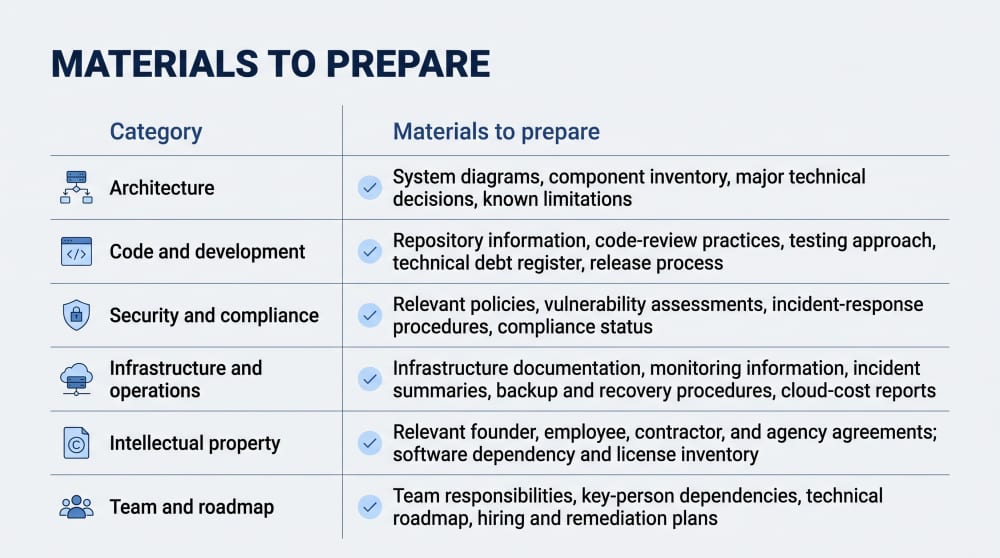
Not every company needs every document. Prepare the materials that are relevant to your product and likely review scope.
Make it easy to navigate. Use one folder per topic, clear file names, and a one-page index at the top that says what is where. A stranger should find any document in under a minute. Give one person the job of keeping it updated, because a document that is outdated does more harm than one that is missing.
Control who sees it. Use Google Drive, Notion, or a dedicated virtual data room, which adds permission levels and activity logs. Share it view-only with named people and close access when the process ends. Leave out passwords, API keys, and customer personal data. The reviewer needs to see that your controls exist, not your secrets.
The best data room is a dull one. Everything is where the reviewer expects it, and nothing needs explaining. Every document you hand over unasked answers a question you would otherwise face in an interview.
How to prepare in the time you have
One common mistake is waiting until an investor requests a review to start preparing. Technical due diligence can reveal issues that take time to address, from architectural limitations to missing documentation. Starting too late leaves little room to make improvements before the process begins. Ideally, founders should start preparing a few months before a planned fundraising round.
So, start at least three months before you plan to raise. Spend the first month on ownership and security, the second on documentation and the data room, and the third on a full rehearsal of the real thing. Ask a trusted outside engineer to play the reviewer and give them the same access a real one would get. A pre-diligence review is cheaper than a failed one.
Don’t try to make the product look flawless. When you find a problem, disclose it early and attach a plan. Problems become harder to explain when their impact is unclear, or there's no realistic plan to address them. Document the risks, assign owners, and agree on timelines rather than trying to make the system look better than it is. If a module needs refactoring, explain why the issue arose, how it affects the product, and what the team plans to do about it. A known issue with an owner, a timeline, and a budget is a manageable risk. The same issue discovered by the reviewer looks like concealment, and concealment is what damages trust. Investors price risk. They walk away from surprises.
Closing
Technical due diligence is not a test of perfection. It is a test of whether you understand your system, own it cleanly, and can grow it without hidden surprises. The founders who come through the process calmly are not the ones with flawless code. They are the ones who prepared early, documented the important parts, and treated known risks as something to manage rather than something to hide. Start with the areas that take the longest to fix - ownership, security basics, and key-person risk. Build the data room while you still have time. And when the reviewer arrives, give them clear answers instead of improvisation. That is usually enough.


