Here’s a practical playbook for building your first engineering team. It’s for founders hiring their own engineers, directly or through a staffing model, and not for handing the whole product to an agency.
Who to hire first
Three profiles are usually competing for your first hire.
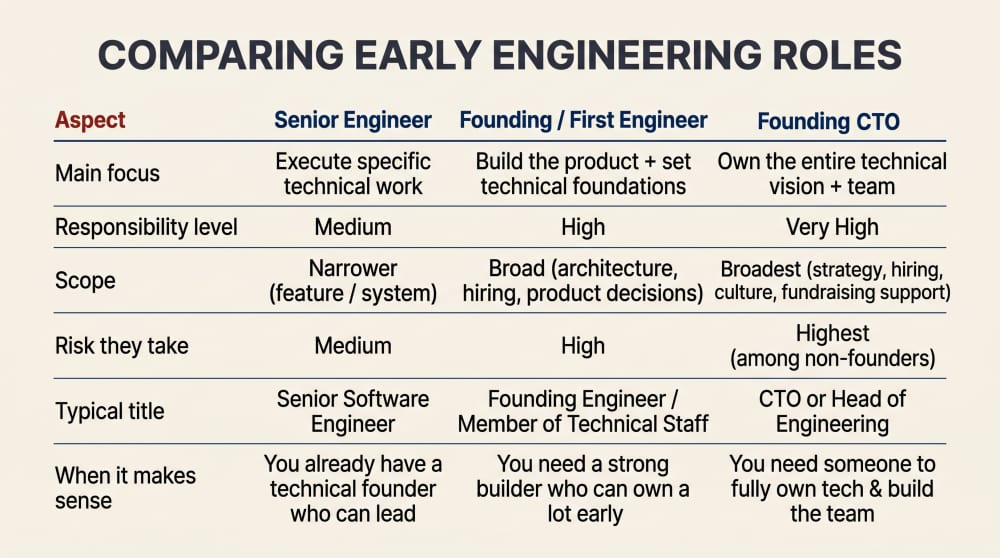
The first one is a senior generalist who can own the technical side of the product from day one. Look for someone who has built a product from scratch, works across the stack, and doesn't need a team around them to be productive. A senior generalist costs the least equity. But they also build what you point them at. If your product direction is vague, their speed gets you the wrong product sooner. Choose the generalist if you know exactly what to build and need it built.
The other profile competing for the slot to become your first hire is a CTO. A CTO can give you technical leadership and a partner for decisions you can't make alone. But it has a real cost, and it’s your equity—you hand a large share of the company to someone you have known for a few weeks. Choose the CTO if you plan to raise a Series A on a technical story and nobody else on the team can tell it.
And finally, the third profile is a founding engineer who sits between the two. They write most of the code, shape the architecture, and take equity that reflects the risk. When people say “hire a founding engineer,” they almost always mean: hire a senior generalist who is willing and able to operate as a founding engineer, which presupposes high ownership, high ambiguity, high impact, and meaningful equity. The title is soft. The role means whatever the offer says it means, so put specific responsibilities in writing.
If you can't say which of these possible first hires you need most, talk to an outside technical advisor before you post the job.
Hires two to four, in order
A common trap in business growth is hiring to fill a neat picture rather than solving real operational problems. According to Carta, the median seed-stage team has four employees across all functions. Order your next hires by what is blocking your product, not by the org chart you'd draw on a whiteboard.
Your second hire should be another full-stack engineer. One engineer is a single point of failure. If your first hire gets sick, leaves, or turns out to be wrong for the job, the product stops. The second engineer fixes that. They also do something you can't: they read the first engineer's code. Within a month, they will know whether the architecture is sound. Ask them directly, and ask them privately. This is the cheapest technical review you will ever get.
Your third should be the specialist your product leans on. Look at what users touch. If it is a mobile app, hire the mobile engineer. If the product depends on data pipelines or machine learning, hire that person now. If it is a web product with a complex interface, hire a front-end specialist. Don't pick the role because a competitor has one. Pick it because the generalists keep running into the same wall.
Fourth is the hire your first engineer complains about. It's usually the answer. Sometimes it is the first person who owns infrastructure. Sometimes it is a lead who takes the coordination work away from your first hire, who is now spending half the week in meetings instead of writing code.
What to delay
Three roles are tempting at this stage and rarely pay off yet.
A dedicated DevOps engineer is the most common early mistake. Your generalists can run a simple deployment setup while the product has few users. Hire DevOps when a real user would feel the difference.
A full-time QA engineer comes next. Early on, the engineers who write the code should test it, and your users will find what they miss. Once releases start breaking things people pay for, the math changes.
An engineering manager is last. Three engineers don't need one. They need a founder who sets priorities and a senior engineer who makes technical calls.
One role that may deserve attention earlier is the product designer. Depending on your product, you may need one before hiring a third engineer. Engineers can build faster when someone has already worked through the user flows, interface, and key product decisions. Without that direction, they may spend time figuring out what to build rather than building it.
There is no universal hiring order. The right team depends on your product, its complexity, and the skills you already have. Use these recommendations as a starting point, not a fixed rule.
If you already have a technical co-founder
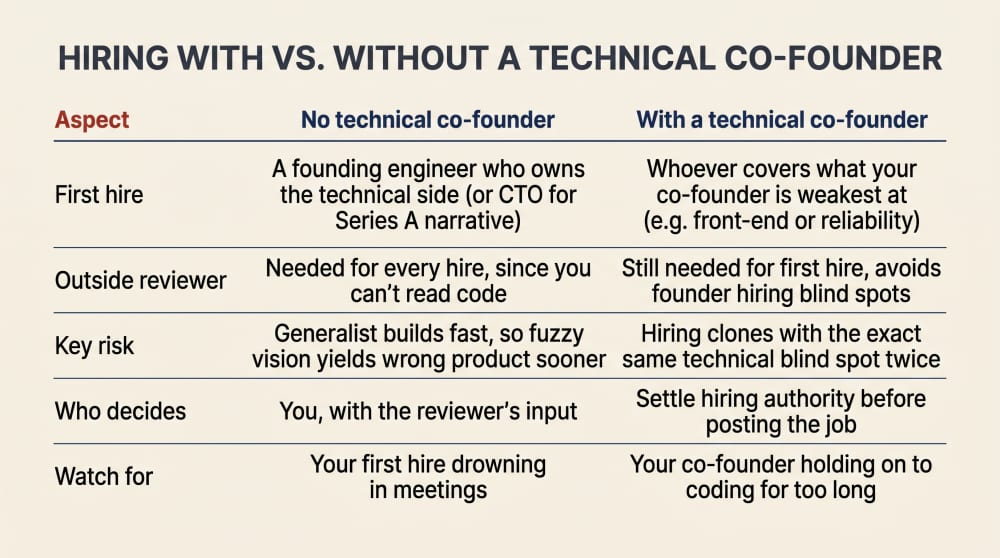
Some of the earlier advice changes if you have a technical co-founder. Your first hire is no longer the technical owner, because your co-founder already is. The first-hire section mostly drops out, and the order of hires changes.
Your first hire should cover what your co-founder is weakest at. If your co-founder is a backend engineer who thinks in systems, hire someone who builds interfaces people enjoy using. If your co-founder is a product-minded generalist who ships fast, hire someone who cares about reliability. Co-founders tend to hire people like themselves. They understand those candidates better and feel comfortable with them, and you end up with a team that has the same blind spot twice.
A hard question that comes up in this case, and there is no rule for it: who decides when you and your co-founder disagree about a candidate? Some founding teams give the final call to whoever will work with that person daily. Others let the CEO decide. Both arrangements work for some companies and wreck others. Settle it before you open the job post, not during the third interview.
One more thing to watch: your co-founder will be tempted to stop writing code once the team grows, and the moment to stop is different for every company. Some founders stay hands-on until they have six engineers and do fine. Others should have stopped at two. Ask your first hire what they need from your co-founder. If the answer is "less review and more decisions," your co-founder has already outgrown the coding role.
Finding and paying your first engineers
A strong senior engineer already has a better offer than yours. It has more cash, a bigger name, and a company that will still exist in three years. So you aren't selling a job. You are selling a bet, and the engineers who say yes to it are a specific kind of person.
Where to look
Start with people who already trust you: your investors, your advisors, and the engineers they have worked with. A warm introduction from someone a candidate respects does more than any job post, and the person making it has a reason not to waste your time. Ask each advisor for three names, and ask what each person built, not just where they worked.
Then go where startup engineers actually read. Referrals, niche communities and LinkedIn are still useful channels to consider for 2027. For instance, if your product runs on a particular framework, its forum, Discord or local meetup is where the people who know it spend time.
Look hardest at two groups. The first is engineers who were early at another startup. They know what the work is like and won't be surprised by it. The second is engineers who recently left a large company and want to build something from scratch. They carry more risk for you and sometimes more energy.
Expect hard questions from both. Experienced startup engineers read runway the way you read a bank statement. They will ask how many months you have, who invested, and what happens if the next round doesn't close. Have the real answers. A vague one, like "we're well funded," ends the conversation faster than a low salary does.
Write one paragraph, in plain language, on why a good engineer should take this risk. Skip the mission statement. Say what they will own, who they will work with, and what they can build in the first year that they couldn't build anywhere else. Then tell them what they won’t have: a safety net, finished processes, and tidy early code. If you can't write that paragraph, you aren't ready to hire.
What to offer candidates
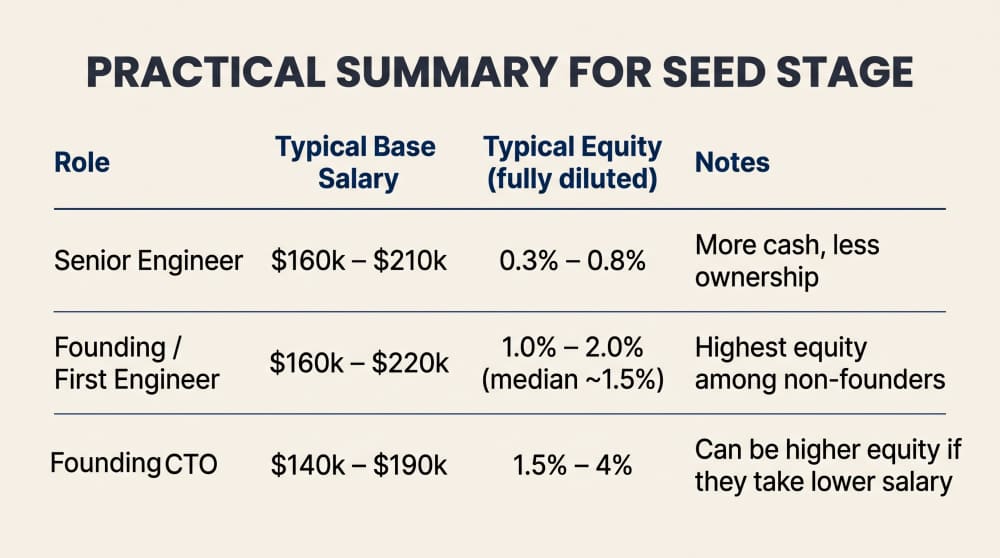
You can't match big-company salaries, and pretending otherwise can cost you trust. Offer fair compensation, below the top of the market, and make up part of the difference with equity. How far below depends on your runway and on how much the candidate needs the paycheck. A senior engineer with a mortgage and one with savings and no dependents want different offers.
Equity at seed usually comes as stock options with a vesting schedule, most often four years with a one-year cliff, meaning nothing vests until the first anniversary. The cliff protects you from someone who leaves after six months holding a piece of the company. It also tells the candidate you expect them to stay.
The tension here is real. A larger grant for your first hire makes the offer competitive and keeps them through the hard stretches. It also shrinks the pool left for engineers two through four, and you will want to hire them before the next round. Some founders protect the pool and lose their first choice. Others spend freely on hire one and pay for it with hires three and four.
A candidate who asks about the value of their equity deserves a straight answer. Explain what percentage of the company you're offering, how the company is currently valued, and how future funding rounds may affect their ownership. Be transparent about the risks, too: equity is not guaranteed income. It may become valuable if the company succeeds, but it may also end up being worth nothing.
Don’t grant equity without vesting, as it protects the company if someone leaves shortly after joining, and don’t promise it in conversation and write the paperwork later. Make sure the agreement clearly explains what happens if someone leaves the company or their contract ends. Have a startup lawyer draft the documents instead of using a generic internet template.
How to vet engineers when you're not technical
Judge engineers by work they produce in front of you, not by how they talk about work. Confidence is the one signal a non-technical founder can read in an interview, and it costs a candidate nothing to fake.
Our guide to hiring developers walks through the full process: a short take-home task, an outside developer to review it, and a paid trial.
Follow it.
Have the candidate walk you through something they built, then ask what went wrong. “Everything went smoothly and we shipped on time” is a weak answer, because real projects don’t go that way. A strong answer names a failure: “We chose a queue system that couldn’t handle peak load, found out in the second week of launch, and replaced it over a weekend.” You don’t need to understand the queue system. You need to hear a mistake, what it cost, and what the person changed afterward.
Don’t let a big-company résumé do the work. A famous employer proves the person passed that company’s hiring process. It says little about building a product with three people. Ask what they built without help, and compare the answer with one from an engineer who shipped a whole product alone at a four-person startup. The smaller résumé may be worth more. At seed, look for ownership, speed of learning, and comfort shipping without a finished spec.
Know the red flags. Be wary of an engineer who can’t explain a technical choice in plain language after two tries, blames every previous employer, designs for a million users when you have forty, or refuses to estimate anything. Notice if they never ask about your customers. At seed, an engineer who only asks about technology is building for themselves, not for your users. Then call two references and ask just one question: would they hire this person again for a role with no supervision? A quick, confident yes is a good sign. A pause or a “well...” tells you to look closer.
Setting the team up to work
Start with ownership. Give every engineer one area they own. An engineer who owns something makes the decisions in it. An engineer who doesn’t own anything asks you, and you can’t answer. Name an owner for each part of the product: payments, onboarding, the mobile app, whatever your product has. Write the names in one shared document and tell the team where it is. Don’t make everyone own everything. At four people it looks flexible. In practice it means nobody feels responsible when something breaks on a Sunday.
Ownership also means your first hire stops reviewing every change the second engineer makes. That will feel like losing control. Decide in advance what you will still look at yourself: usually spending, security, and anything that touches customer data.
Next, set up the norms. These are the working rules of the team, and the first engineers decide them regardless of whether you ask or not. Every later hire copies what is already there. You can’t write the rules yourself, but you can ask four questions. Who reads a change before it goes live? Where do you write down why something was built a certain way? Who is on call when the product breaks at night? How does one engineer tell another their work has a problem? For four people, a shared document of decisions and dates and two engineers reviewing each other’s changes is enough. Ask early. A team that skips these questions has answered them anyway, by accident.
Then, write a short roadmap: what the team will build in the next two to four weeks, in order of priority, with a reason beside each item. For instance, “Add referral codes” is a task. “Add referral codes because paid ads cost us a lot per user and referrals are the only channel we haven’t tried” tells the engineer what the work is for, so they can make small decisions without asking you.
Finally, describe problems to your engineers, not fixes. If you say “Make checkout faster,” an engineer will rebuild the payment flow and three weeks later checkout is slightly faster. Try this instead: “[X]% of people who add something to the cart never pay, and support keeps hearing the payment page feels stuck. Find out why and tell me what you’d change, with a rough estimate, by Friday.” (This is a hypothetical, so use your own numbers.) Maybe the cause is a slow third-party script that takes a day to fix. Maybe it is the rebuild after all. Either way, you’ll know before you decide.
You will feel out of your depth in some meetings. That is normal, and you should say so. Founders who nod through terms they don’t understand end up approving decisions they can’t evaluate.
On status updates: a short weekly demo of working software shows you more than five days of written reports, and most engineers read daily reports as distrust. Some founders still want them, and for a very young team that can work. Agree on the format first.
Where this stops working
Somewhere around eight engineers, most of what is in this article stops being true.
Your first hire built the product. They decided how the code is organized, which tools it uses, what was built quickly and what was built carefully. Every engineer who joined later works on top of those choices. Some love that. Some quietly hate it and keep taking on code to avoid it. The role of first hires has changed in parallel. They spend their week in reviews and in answering questions from people who joined after the architecture was set. With more people on board, the team slows down without anyone saying why.
The vetting methods from earlier also stop working. A paid trial task shows you whether someone can write a feature. It tells you nothing about whether someone can run a team of eight. That is a different skill, and the first hire may not have it. You might need to hire a manager for that. The ownership map gets crowded too. Two people claim the same area, or nobody claims the new one. At four people you fixed this over lunch. At eight you need a person whose job is to fix it.
Some founders move first hires into a role that fits. Some let them go with a generous exit. Nobody has a clean rule for it, and the right call depends on what you owe the person.
If you’re hiring your first engineers now, ScrumLaunch’s staffing team can help you find and vet them. Schedule a call with our CEO to learn more.