Hiring a senior software developer is a significant investment for any company. It’s tempting to compare rates and pick the cheapest option, but the lowest rate doesn’t always mean the lowest overall cost. You also need to account for the time it takes to hire a developer, the months they spend learning your product, and what happens when you no longer need them.
In 2027, businesses have three main options: hire an employee, bring in an external developer through an outstaffing provider, or work with a freelancer. Each model offers a different balance of cost, flexibility, and control.
So, which option makes the most financial sense for your company? Let’s compare the costs, examine the trade-offs, and see when each hiring model works best.
In-House Hiring: Salary is the Wrong Number
An in-house hire gives you full ownership. You receive direct and full control over priorities, working processes, and long-term product development. The developer learns your product, stays close to your team, and helps preserve technical knowledge within the company.
You pay for that in several ways. First, salary. The market rates for 2027 are not yet available, but current figures can help startups build a budget that should be treated as planning benchmarks.
According to the US Bureau of Labor Statistics (BLS), the median annual wage for software developers was $135,980 in May 2025. This figure covers software developers at different experience levels, not senior developers exclusively. Experienced engineers with specialized skills may earn substantially more.
According to PayScope’s analysis of 16,979 US job postings that stated pay (January-August 2026), the median base salary for software engineers is $157,500. For postings labeled senior, it is $173,200.
But what is important here is that salary is only the first line of the bill. According to the latest Bureau of Labor Statistics Employer Costs for Employee Compensation data (June 2026), benefits for professional and related occupations add roughly another 31% on top of base wages. That means a senior developer earning $160,000-180,000 in salary typically costs the company $210,000-235,000 once you factor in health insurance, paid leave, retirement contributions, Social Security, and other mandatory benefits, before recruiting and onboarding costs, equipment, or equity are even considered.
Time-to-hire is another major hidden cost of in-house recruiting. According to Recruiting Benchmarks (based on 165 million applications and 1.2 million hires), from Gem, a recruiting software company, engineering roles often take 50–60+ days to fill. Besides, according to SHRM 2025 Benchmarking Report the hiring cost itself it is about $5,475 on average for nonexecutive roles. From industry analyses and modeling (InterviewCost, ConnectDevs, various recruiting blogs, etc.), real costs are typically even higher, often in the $8,000-15,000 range once you include longer interview loops, technical assessments, and scarce talent.
During that period, you are still paying for the open role’s opportunity cost, interviewer time, and delayed product progress - costs that are largely avoided when you engage a senior freelancer or dedicated outstaffed developer who can start in days or a couple of weeks.
A permanent hire is a longer-term commitment. If priorities change or funding tightens, reducing headcount can involve notice periods, severance or other termination costs, and the loss of time invested in recruiting and onboarding.
When does in-house hiring make sense?
In-house hiring is often the strongest choice when a startup has a stable, long-term need for engineering capacity. It works particularly well when a developer must own core product architecture, maintain critical systems, or build deep knowledge of the business.
The model becomes less attractive when the workload is temporary, funding is uncertain, or the company needs a specialized skill for only a few months. In those situations, paying for permanent capacity is difficult to justify.
Freelancers: Flexible, but Not Always Cheaper
Freelancers are independent professionals hired for specific tasks, projects, or periods. They set their own rates, which vary with experience, specialization, location, and demand.
Self-reported data from ContractRates.fyi, a crowdsourced rate database, puts the median US rate for senior software engineers at $100 an hour, with the middle half of freelancers charging between $80 and $130. The figures come from 260 records and include historical entries, not only 2026 data.
A freelancer who also spends time on admin and finding clients typically bill 1,200 to 1,600 hours a year, according to Harvest, a timetracking platform. At 1,600 billable hours, that range would translate to $128,000-208,000 annually. This is a mathematical illustration though, not necessarily a typical annual freelancer income. A freelancer may not be available for that many hours, and a startup may not need a full year of work.
Besides, the hourly rates above hide the real costs. Though you don’t pay any extra on top of developer’s wage, you still have to find and vet each person yourself. And once the work begins, someone on your team must manage priorities, answer questions, track progress, review code, and make sure the deliverables meet your requirements. This takes time from your founder, product manager, or tech lead, who may have other responsibilities. These management and coordination costs can add up fast, especially when requirements change, communication is irregular, or the freelancer needs frequent guidance.
There is also a big continuity risk. If the person leaves mid-project, they take the knowledge of your codebase with them, which is often the case.
When does hiring a freelancer make sense?
Freelancers are a good option for short-term assignments, specialized technical tasks, and projects with a well-defined scope. In other words, they work well for a narrow, defined job: one integration, one feature, one audit. For instance, when you need to integrate a payment provider, fix a specific performance problem, or complete a limited migration. They can also help startups validate an idea before committing to a larger team.
And it works well only when you or someone on your team can write the spec and review what comes back. They fail when a non-technical founder hires one generalist and expects the plan to emerge from conversation.
Long-term product development can be more complicated. Requirements change, new dependencies emerge, and developers need to understand decisions made months earlier. If the freelancer works only intermittently, the startup may spend more time on coordination and knowledge transfer.
For a core product that requires continuous development and long-term technical ownership, a full-time employee or a dedicated outstaffed developer provides much better continuity.
Outstaffing: Paying for Development Capacity
Outstaffing allows a company to bring an external developer into its existing team without employing that person directly. The developer works on the client's product, follows its priorities, and collaborates with its internal team, while the provider manages the employment or contracting arrangement.
For many businesses, this model can offer a middle ground between building an internal team and hiring independent contractors. It means a vendor employs already pre-vetted developers you can attract when you need. The developer joins your team, uses your tools, takes tasks from your lead and you direct the work as it is with in-house developers, but you don’t have to deal with recruiting, payroll, benefits, equipment, and replacement if the person leaves, as the vendor handles it for you.
The client typically pays an agreed hourly or monthly fee. No independent survey publishes outstaffing rates, so the best available figures are the ones vendors publish. Most US augmentation runs $110-160 per hour for a senior US-based software developer. Actual rates vary by specialization, location, and contract terms. KORE1 lists $108 to $160 for a senior engineer placed by a staffing firm, NextGen Coding Company gives $120 to $170, and Akoode puts US boutique agencies at $110 to $160. The rate covers the developer’s compensation and the provider’s profit margin. Over a 1,920-hour working year (40 hours a week for 48 weeks), for $110 to $160 comes to roughly $211,000 to $307,000, with a midpoint of about $259,000.
The main financial advantage of outstaffing when compared to both in-house and freelance developers is that the client pays for development capacity without assuming the costs of direct employment and recruitment. With outstaffing, the provider typically takes responsibility for sourcing and employment administration and may help with replacement. The provider handles much of the hiring process, and you can often adjust the engagement as your needs change. But while outstaffing reduces the internal effort required to source and vet candidates and manage employment administration, your team still needs to provide technical direction, review the work, and integrate the developer into the product.
The model saves the most on a time-limited need. You get a senior developer in weeks, not months, and you can end the engagement when the work ends. There are no severance costs and no idle salary.
Outstaffing breaks in three places. It breaks when nobody on your side can direct technical work. The vendor supplies execution, not strategy, and a senior developer with no one to set direction has nothing to build toward. It breaks when your processes are weak: no documentation, no code review, no clear priorities. And it breaks when contract terms are vague about code ownership and handover. Check those terms before you sign.
For example, a startup might need a senior backend developer for six months to help build a new service. Hiring a permanent employee would mean opening a full-time position, managing the recruitment process, and deciding what to do with that capacity after the project ends. Outstaffing can provide the required expertise for the period in which it is needed.
When does outstaffing make sense?
Outstaffing is particularly useful when a startup already has a product and an internal team but needs additional capacity or expertise. It can also help companies scale engineering teams without committing to permanent employment for every role.
The model is less suitable when the company cannot provide clear technical direction or expects the external developer to independently manage every aspect of product delivery without the necessary supporting roles.
The Numbers Side by Side
This table prices one year of full-time work on the rates above. Freelancer figures assume ~1,600 billable hours per year (common for independent freelancers), not full-time utilization. For Outstaffing the calculation uses 1,920 working hours per year.
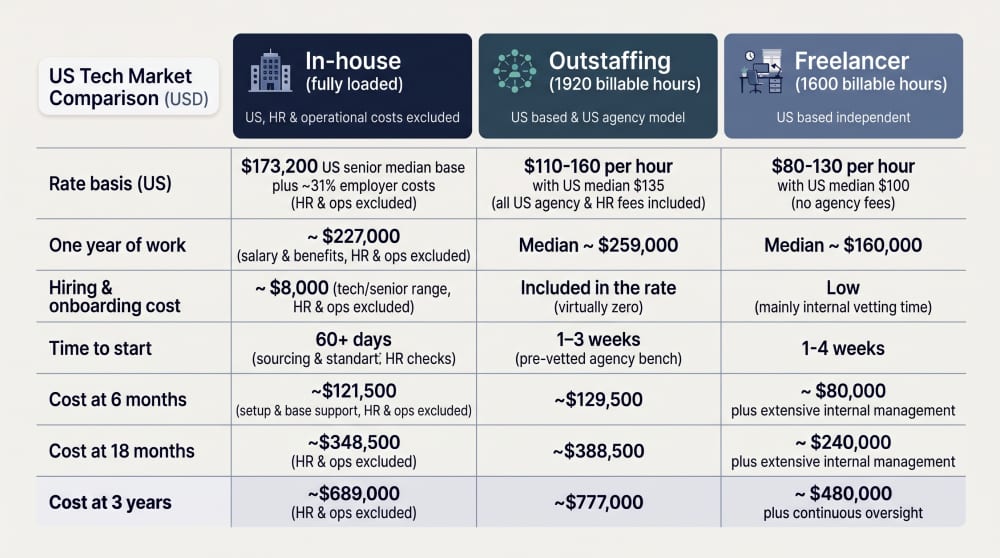
On rate alone, outstaffing is not cheaper than hiring in-house for a full year. The midpoint of its range, about $259,000, per year is even higher than the in-house figure. Its advantage appears when the need is shorter or less certain. This approach gives you access to talent, faster hiring, flexibility, and reduced administrative work. It spares you the recruiting cost and the cost of ending the role.
Outstaffing providers maintain networks of developers they have already sourced and vetted, giving startups access to a broader talent pool across different locations and technical specializations. Instead of running a recruitment campaign and competing for candidates in the local job market, a startup can approach a provider that may already have suitable developers available. This can shorten the time needed to fill a role, although availability depends on the required skills and the provider's current talent pool.
The provider also handles much of the recruitment and vetting process, along with employment administration, payroll, and benefits. Your team still needs to set priorities, provide technical direction, review code, and integrate the developer into the product, but it spends less time sourcing candidates, conducting interviews, and managing employment paperwork.
Flexibility is another important advantage. You can add developers when the workload increases, scale the team as project requirements change, and end an engagement when the additional capacity is no longer needed, subject to contract terms. This can help startups avoid committing to permanent headcount when project needs or funding are uncertain.
For a startup that needs extra engineering capacity for six or twelve months, these benefits may outweigh the higher hourly rate. The value is not necessarily a lower price for each development hour, but easier access to suitable talent and the ability to adjust capacity without taking on the full responsibilities of direct employment.
A note on remote hiring
Remote work doesn’t change which model fits. It changes the price. Any of the three models can be remote, so location stops being a reason to choose one over another. It becomes a separate lever. Where the developer lives will change the price, but the model decides how much control, continuity, and risk you carry.
Remote hiring can reduce development costs when a company recruits in countries with lower salary levels. Even salaries for developers from Denver or Austin and San Francisco and New York can be different. However, remote work and international employment are two different things. A US company can employ someone remotely within the US without dealing with another country's employment laws. Hiring an employee who lives abroad may require local payroll, tax compliance, benefits, and a compliant employment arrangement, potentially through a local entity or an employer of record.
Freelancers offer another way to access international talent, but engaging an independent contractor does not automatically eliminate cross-border tax, contractual, or worker-classification obligations.
An outstaffing provider can simplify this process because it already has the employment infrastructure and local expertise to engage developers in its operating markets. The provider's fee covers those services, so the company avoids building the same infrastructure itself.
According to Accelerance’s 2026 Global Software Development Rates guide, senior developers in Latin America typically range $60-75 per hour, while rates in Central and Eastern Europe (including Ukraine) are around $64-76 per hour.
Here are simple calculations for outstaffing model based on these assumptions:

Which Hiring Model Should Your Startup Choose in 2027?
Start with one question. Can someone on your side make technical decisions and judge technical work? If yes, all three models are open to you. If no, hire or rent that person first, because no model fixes the gap.
Then look at the horizon. If you need the developer for less than a few months and the scope is clear, hire a freelancer. If you need them for six to twenty-four months, or you cannot predict the end date, use outstaffing. If the role is core to your product and will last for years, hire in-house.
Most companies end up with a mix. A small in-house core owns the architecture. Outstaffed developers add capacity for the work that has a start and an end. Freelancers fill specific gaps. The mix changes as the company grows.
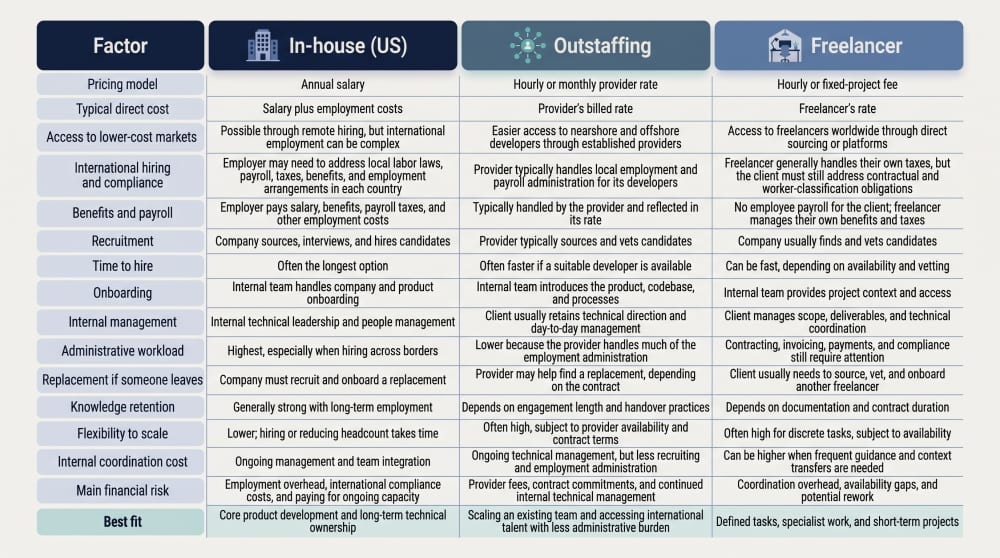
The table below compares what the rates leave out.
The bottom line
A senior developer typically costs $160,000 as a US freelancer (at 1,600 billable hours), about $229,000 fully loaded in-house in the US, $259,000 through US outstaffing (at 1,920 billable hours), and roughly $130,000 through nearshore outstaffing in Latin America or Central & Eastern Europe. But hiring a senior developer isn’t just a cost decision - it’s a fit decision. A senior developer you need for core architecture is a different decision from one you need for a six-month feature push or a two-week integration. In-house, outstaffing, and freelancers each solve a different type of problem. So, do not compare rates. Compare what each model costs over the time you need it, and what it costs when something goes wrong. Choose in-house for what you will own for years, outstaffing for what you need to build now, and freelancers for what you can define on a single page.


