Anthropic highlights that the release of these new models comes amid intensifying debates regarding the risks associated with the development of artificial intelligence. At the same time, the company states that, during the testing of the new models, it did not identify any critical increase in the risk of dangerous behavior. Internal evaluations indicated that alignment metrics were either on par with or better than those of previous models.
The Evolution of Claude Fable and Claude Mythos: What Changed & When?
On April 7, 2026, Anthropic announced Project Glasswing - the launch partners—Anthropic and eleven outside organizations, including Apple, Google, Microsoft, AWS, NVIDIA, Cisco, CrowdStrike, Palo Alto Networks, Broadcom, JPMorganChase, and the Linux Foundation—received access to Claude Mythos Preview for defensive security work. More than 40 additional organizations that maintain critical software were also given access. These partners were given restricted access to use Mythos Preview defensively to scan and patch their own systems. Anthropic backed this with up to $100 million in usage credits and $4 million in donations to open-source security groups.
Anthropic restricted access to Mythos Preview, citing the potential cybersecurity and national-security risks of releasing such capabilities broadly. The company said the preview should first be used to help critical-software defenders find and fix vulnerabilities. Reportedly, the White House later objected when Anthropic wanted to grow the group from about 50 organizations to 120.
The first results came in May. Anthropic said that after one month, its roughly 50 partners had found more than 10,000 high- or critical-severity vulnerabilities. Cloudflare alone logged 2,000 bugs, 400 of them high or critical. Finding bugs stopped being the hard part. Triaging, disclosing, and patching them became the bottleneck. In June, Anthropic widened the program by about 150 organizations in more than 15 countries.
Then came June when Anthropic introduced Claude Mythos 5, the successor to Mythos Preview, along with Claude Fable 5. The new models were based on the same underlying model with different safeguards. Mythos 5 stayed restricted to vetted partners. Fable 5 went public, but because of the threat profile inherited from the Mythos line, it launched with classifiers watching for offensive cybersecurity, biology and chemistry, and distillation. When a prompt triggered these safety filters, the request fell back to a less capable Claude Opus model to reduce potential misuse. Anthropic said that happened in under 5% of sessions.
The safeguards were initially so aggressive that Anthropic blocked almost all biology queries and suffered a high rate of "false positives". In August, Anthropic pushed updates specifically to minimize these accidental blocks. It retrained the biology classifier, which cut biology fallbacks by about 85% in its tests. Everyday health and study questions mostly went through after that. Virology, toxicology, and molecular design still fall back to Claude Opus.
On September 1, Anthropic released Claude Fable 5.1 and Mythos 5.1, again one model under two safeguard levels. Fable 5.1 was generally available. Mythos 5.1 is invite-only, reached through Glasswing’s trusted-access programs.
What the benchmarks have shown
In Anthropic's tests, the new Fable 5.2 outperformed Opus 5.5, GPT-6 Astra, and Gemini 4 Carbon across a number of metrics.
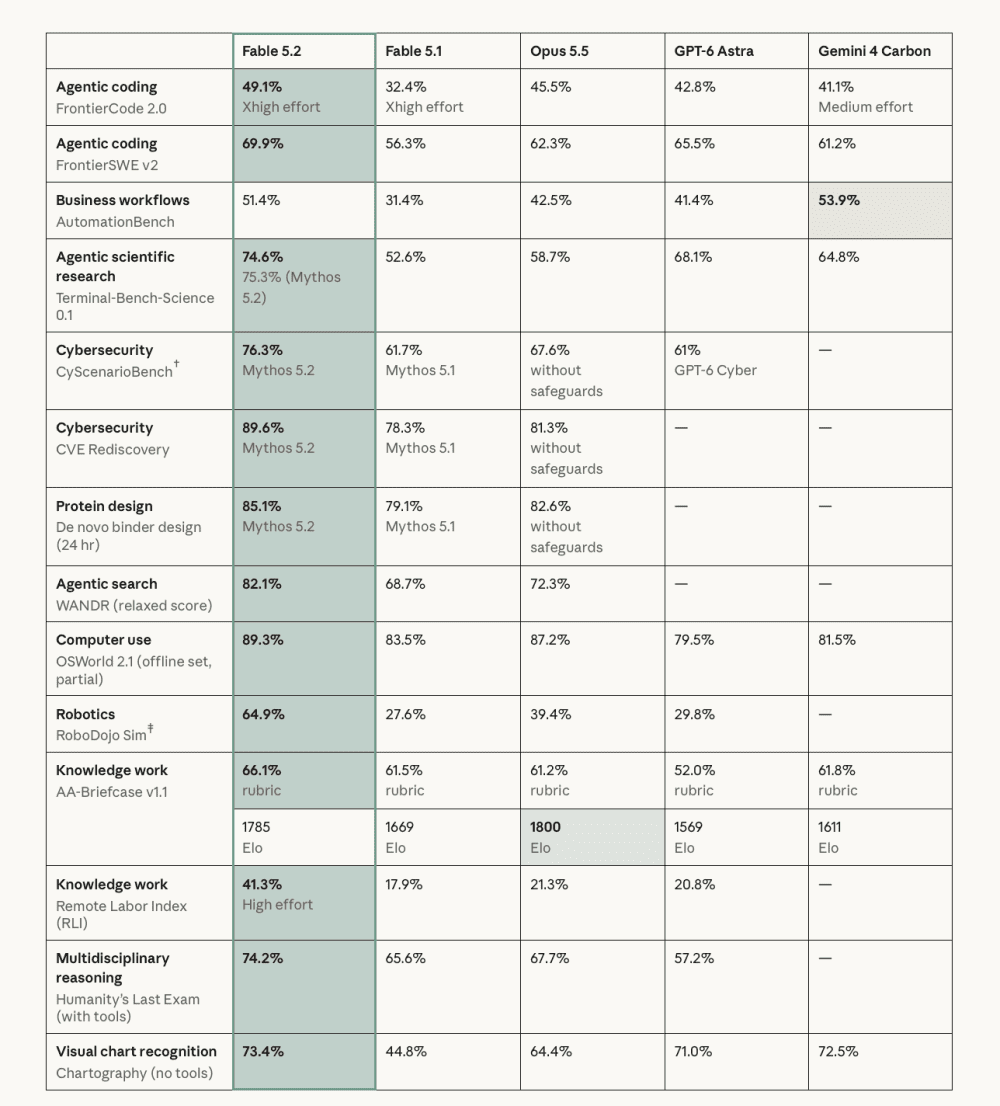
For instance, in the FrontierCode 2.0 programming test, Fable 5.2 scored 49.1%. For comparison, Opus 5.5 scored 45.5%, OpenAI's GPT-6 Astra scored 42.8%, and Google's Gemini 4 Carbon scored 41.1%.
In FrontierSWE v2, where agents are required to independently solve software engineering tasks, Fable 5.2 achieved a score of 69.9%. GPT-6 Astra scored 65.5%, while Opus 5.5 reached 62.3%.
In the "Humanity's Last Exam" benchmark, where models are permitted to use tools, Fable 5.2 scored 74.2%, compared to 57.2% for GPT-6 Astra.
In the RoboDojo Sim robotics benchmark, Fable 5.2 achieved a benchmark score of 64.9%. This is more than double the scores of GPT-6 Astra (29.8%) and Fable 5.1 (27.6%).
Still, on the AutomationBench test, which checks the automation of business processes, Gemini 4 Carbon outperformed the new Claude with a score of 53.9% versus 51.4%.
What has the model demonstrated in practice?
According to Anthropic, Fable 5.2 is capable of handling more complex engineering tasks relating to software development. The model can also simultaneously coordinate the work of over a thousand digital AI agents and carry out tasks related to hardware, specifically, managing operations.
Anthropic demonstrated several real-life examples.
An Anthropic engineer demonstrated Fable 5.2's programming capabilities in an experiment. The engineer tasked the model with developing an operating system prototype, starting from an empty folder. Fable 5.2 coordinated the work of more than a thousand Fable 5.2 agents that worked together for eight days, writing, testing, and verifying code, and created a working operating system from scratch. The resulting system boots up on a laptop and includes device drivers, file storage, a window-based interface, a login screen, and an installer.
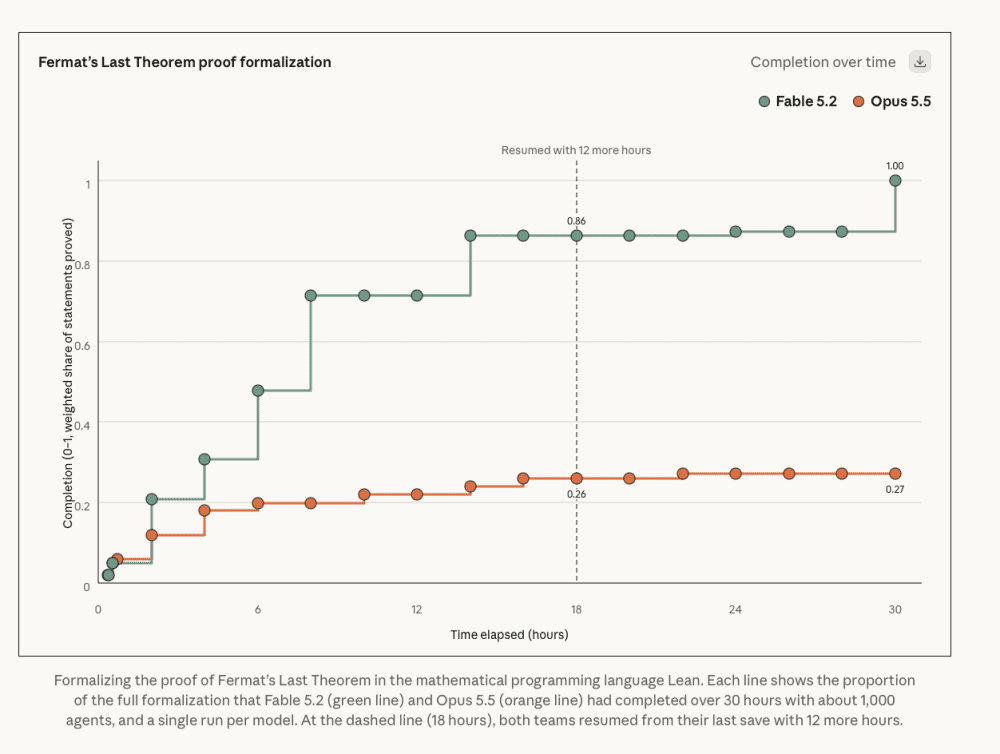
Another notable result is how the model formalized the proof of Fermat's Last Theorem. It was not supposed to find a new proof, but rather to write down an already known mathematical result in such a way that a computer could verify every step. A team of 1,000 Fable 5.2 agents completed the task in 30 hours with minimal human intervention. In the same experiment, Opus 5.5 mastered 26% of formalization in the first 18 hours and barely made any progress in the remaining 12. The preliminary formalization, involving another version of Claude, took 11 days.
In addition, Fable 5.2 designed three working electronic devices: a voice assistant hub, a USB speakerphone and a virtual pet. Anthropic described the devices as working designs, each with its own circuit boards, housing, and software.
Also, according to Anthropic, in the field of theoretical physics, Fable 5.2 has solved two previously open problems related to black holes and quantum gravity.
Mythos 5.2 found more vulnerabilities
Anthropic has designated Mythos 5.2 as its most powerful model for cybersecurity engineering tasks, which lacks some of the limitations of Fable. In an internal CVE Rediscovery test, evaluating AI models on their ability to independently rediscover known Common Vulnerabilities and Exposures (CVEs), the model achieved 89.6%, compared to 78.3% for Mythos 5.1 and 81.3% for Opus 5.5 (without safeguards).
For this test in October 2026, Anthropic used 1,829 previously published CVEs. Mythos 5.2 detected 14.4% more vulnerabilities than the previous version, Mythos 5.1, and 10.2% more than Opus 5.5.
According to Anthropic’s Mythos 5.2 announcement, a security company found that other tested advanced models missed every sixth confirmed vulnerability found by Mythos 5.2.
At the same time, access to these opportunities is limited. Organizations must be verified as part of the Cyber Verification Program. Corporate clients can also use Mythos 5.2 through the Claude Security tool to search for vulnerabilities in software code.
Availability and prices
Claude Fable 5.2 is now available in Claude, Claude Code, the Claude API, and on the AWS, Google Cloud, and Microsoft Azure platforms. The API identifier for the new model is claude-fable-5-2.
Claude Mythos 5.2, as already mentioned above, operates through Anthropic’s Cyber Verification Program or Life Sciences Verification Program, while enterprise clients gain access to its capabilities via Claude Security.
The cost for both models has been reduced compared to version 5.1. Processing one million input tokens now costs $8, while one million output tokens cost $40. In version 5.1, these rates were $10 and $50, respectively.
Anthropic also states that the new models generate responses up to 30% faster than Fable 5.1 and Mythos 5.1. Additionally, both models feature an accelerated mode that can increase the token generation speed by up to 2.5 times (priced at $16 per million input tokens and $80 per million output tokens).
The company recommends using Fable and Mythos for the most complex and large-scale technical tasks. For everyday work involving code and text, Anthropic suggests starting with Claude Opus 5.5 and moving on to more powerful or more lightweight models as needed.