
When you are thinking about launching an e-commerce business, one of the first decisions you'll face is choosing the technology behind your store. For most early-stage founders, the answer is clear: start with Shopify. It's faster, cheaper, and requires no technical team to get up and running. A custom build starts at $25,000 and takes a minimum of three to six months. Shopify gets you live in weeks for a fraction of the cost, with hosting, security, and payments handled out of the box.
But Shopify does have a ceiling. Founders who don't know where that ceiling is tend to hit it at the worst possible time - usually when the business is growing, and they can least afford a major platform migration.
This article explains where that ceiling is, when Shopify starts to become a constraint rather than an advantage, and how to recognize when a custom build may be the better path forward.
Why Do So Many Businesses Choose Shopify?
Shopify has become one of the world's most popular ecommerce platforms for a simple reason: it removes complexity.
When you're launching an online store, two challenges run in parallel. The first is building a product and acquiring customers. The second is managing the technology required to run the business. Shopify eliminates most of the second challenge.
With a monthly subscription, merchants can manage products, payments, shipping, and orders from a single admin panel without touching code. Unlike marketplaces, Shopify gives businesses their own branded online store. Merchants retain control over their website, content, customer experience, and brand identity, while Shopify handles hosting, security, PCI
compliance, updates, and infrastructure scaling. The checkout has been refined across millions of transactions and consistently outperforms custom-built alternatives without any additional investment.
The app ecosystem extends this further. Loyalty programs, subscriptions, reviews, advanced search, multi-currency selling - most of what a growing store needs can be added without custom development. The honest caveat: many of these apps come with recurring subscription costs. Individually they're manageable. Collectively they can become a meaningful part of your operating budget as the business grows.
Speed to market is where this all comes together. A well-executed Shopify store can launch in four to eight weeks. A custom build often takes three to six months at minimum. For a business that hasn't yet validated demand, that gap isn't a minor inconvenience - it's the difference between learning quickly and spending months building before knowing whether customers actually want what you're selling.
Where Shopify Starts to Break Down
Shopify is built for the common case. If your business fits that case, it works exceptionally well. If it doesn't, you often end up adapting your business around the platform instead of the other way around.
The real constraints are not missing features - they are architectural limits. Checkout is the first place these limits show up. Shopify’s checkout is highly optimized, but only partially customizable. You can adjust the experience and extend logic through Shopify Functions, but once you move into complex pricing rules, contract-based ordering, or multi-step quoting flows, you quickly hit boundaries. Shopify Plus extends what is possible, but it doesn't remove the ceiling - it simply raises it.
B2B and wholesale is another common friction point. While Shopify has introduced B2B capabilities, businesses with customer-specific pricing models, approval workflows, or highly customized catalogs often find themselves pushing against the platform’s structure rather than working with it.
Fulfillment and operations introduce similar constraints. Standard order flows work well, but once you need multi-warehouse routing logic, advanced bundling, subscription variability, or orchestration across multiple systems, Shopify’s native tools become limited, and app-based solutions start to feel like layered workarounds rather than a unified system.
A deeper constraint is data ownership and control. Shopify provides APIs and export options, but the core infrastructure remains platform-controlled. For businesses that rely on real-time synchronization across ERP systems, custom analytics pipelines, or tightly coupled operational logic, this becomes a structural limitation rather than a technical one.
At scale, costs also become part of the equation. Transaction fees, paid apps, and third-party services accumulate over time. In many cases, businesses reach a point where they are effectively paying for layers of functionality that, in a custom system, would be owned directly.
None of this changes the core reality. Shopify is still the right choice for the majority of businesses, especially startups, SMBs, and teams without dedicated engineering capacity. The constraints only matter when your business model starts to diverge from standard ecommerce patterns. The key is understanding this upfront: Shopify is not a limitation for most companies. It becomes a limitation only when your requirements stop being standard.
5 Signals that Mean You've Outgrown Shopify
These are specific. If several of them apply to your business, the platform isn't the right fit anymore.
-
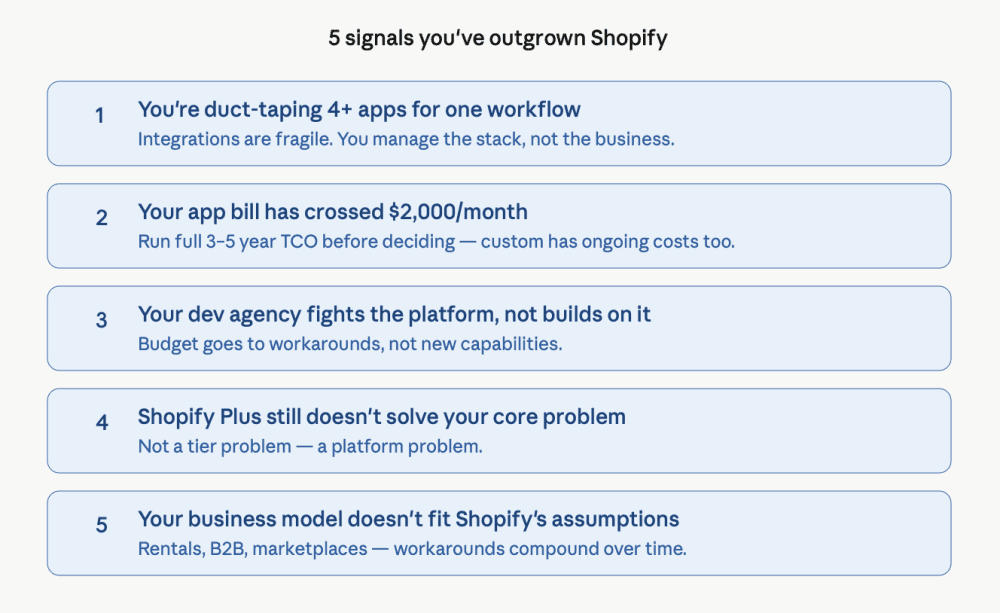
You're duct-taping four or more apps together to get one workflow to function. Each app works in isolation, but the integrations between them are fragile, and every Shopify update risks breaking something. You spend more time managing the stack than running the business.
-
Your app bill has crossed $2,000 per month and keeps climbing. Combined with Shopify Plus fees and transaction costs, you're paying recurring expenses for functionality that a custom build would own outright. At a certain scale, the math often starts to favor a one-time investment over indefinite platform drag. However, don’t forget that a custom solution comes with its own ongoing costs, typically at least one developer or agency retainer every month. Always run the full 3–5 year Total Cost of Ownership numbers before deciding. Many businesses discover that Shopify remains cheaper for the first few years, while custom pulls ahead only at high scale and complexity.
-
Your development agency spends more time working around Shopify's constraints than building new capabilities. When a significant portion of your dev budget goes toward fighting the platform rather than improving the product, that's a signal.
-
You've looked at Shopify Plus and it still doesn't solve your core problem. Plus is worth the cost for high-volume merchants who need the infrastructure. If you've evaluated it and the fundamental limitation remains, you're not dealing with a tier problem - you're dealing with a platform problem.
-
Your business model doesn't map cleanly to Shopify's assumptions. Shopify is built around physical or digital products sold directly to consumers. Rental models, service-based products, complex B2B relationships, and marketplace dynamics all require significant workarounds that compound over time.
What Going Custom Actually Means and Costs
The decision to build custom tends to get romanticized. Full control, built exactly to spec, no platform constraints. That's all true, but it's also an incomplete picture. A realistic custom e-commerce build starts at $50,000 for something modest and runs $150,000 to $300,000 or more for a full-featured platform with integrations. That's the build cost. It doesn't include what comes after.
Hosting and infrastructure run $500 to $3,000 per month depending on traffic and architecture. Security is now your responsibility - PCI compliance, penetration testing, patch management. You need someone on call when things break, because things tend to break. A custom build requires either an in-house technical team or a reliable development partner on retainer. There's no Shopify support line.
Feature development that Shopify ships automatically - performance improvements, new payment methods, fraud detection updates - now requires your team to build, test, and deploy. The platform doesn't maintain itself.
None of this means custom is the wrong choice. For businesses that have genuinely hit Shopify's ceiling, a custom build is often the right call and the economics work out over time. But the decision should be made with a clear understanding of the full cost, not just the build invoice.
The Hybrid Path Most People Miss
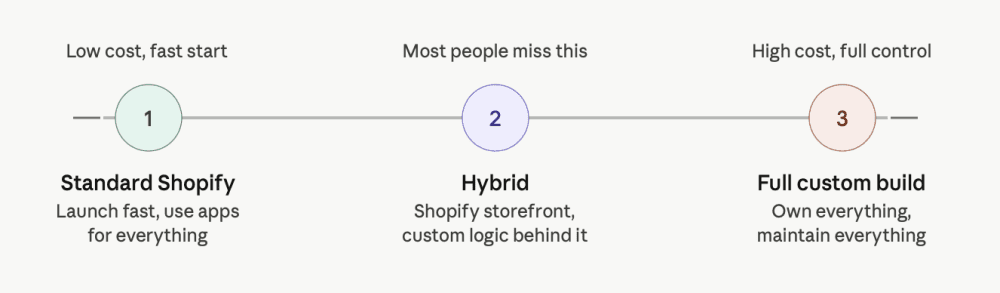
Businesses often assume the choice is Shopify or a full rebuild. In practice, the choice isn't always binary. Many businesses that have outgrown vanilla Shopify don't need to replace everything - they need to extend it in the right places.
The most common pattern is keeping Shopify as the customer-facing storefront while building custom systems behind it. Shopify handles the product catalog, checkout, and payments. A custom backend handles the complex logic - the B2B pricing engine, the fulfillment orchestration, the ERP sync, the subscription management. The two systems talk via API.
This approach preserves what Shopify does well - the conversion-optimized checkout, the app ecosystem, the zero-infrastructure overhead, while removing the constraints that were blocking the business. It's also significantly cheaper than a full custom rebuild and faster to execute. In many cases, this approach also replaces a growing stack of paid apps with systems built around the business's actual needs. The goal isn't to eliminate Shopify. It's to stop forcing Shopify apps to solve problems they weren't designed to solve.
Other companies have the opposite problem. Their operations fit Shopify, but their frontend experience doesn't. In that case, a headless architecture allows them to build a completely custom frontend in a framework like Next.js, while keeping Shopify as the commerce engine engine running behind it via API. This solves frontend flexibility problems without abandoning Shopify's commerce infrastructure entirely.
Neither of these is a permanent answer. Some businesses will eventually need a full custom platform. But for many, the hybrid path buys years of runway and avoids a painful, expensive migration at exactly the moment when the business can least afford the distraction.
Final Thoughts
Shopify is a strong default choice for entering the market quickly with minimal technical overhead. For roughly 80–90% of businesses, especially startups, SMBs, and teams without deep engineering resources, it’s the most efficient way to launch and start selling.
If your priority is speed, simplicity, and operational stability, Shopify is usually the right answer.
But the tradeoff is clear: you are operating within a controlled system. As your business becomes more complex - in logic, integrations, or scale - those constraints start to matter. And if those constraints start shaping your roadmap more than your strategy, it’s time to reassess whether you should extend, migrate, or rebuild based on your long-term direction.
Extend, migrate or rebuild — we have done all three, and the page that says which we would recommend is the one on Shopify developers. It also says when a custom build is the wrong answer.


