
Almost every startup runs into the same wall right after launch: even if you build a genuinely good product, you can still watch it sit unused simply because early adopters don't show up on their own. The bitter reality for founders is that getting those first users is hard work, regardless of how valuable your product actually is.
Finding your first customers should not be a funnel you build and wait for. It should be a search you run deliberately. For the first 10–20 B2B SaaS customers, that usually means manual, founder-led acquisition.
The reason is simple: early customers are not buying a perfect product. They are buying into a relationship. They hope you understand their problem, will listen to their feedback, and will keep improving the product. At this stage, the founder is usually the only person who can hold the whole picture: the customer context, the product intent, the trade-offs, the roadmap, and the constraints.
But, what’s even more important is that your early adopters aren't just about closing the deal or even revenue. It's about testing your positioning and getting your first real proof of demand. It's also about learning what language resonates, which objections are real, what outcomes people want, and why they abandoned your product after the trial. A sales hire brought in too early can generate activity and meetings, but not the depth of that learning.
The part that hasn't changed: do things that don't scale
Y Combinator's Paul Graham wrote the definitive essay on this over a decade ago, and it remains the most accurate description of what actually gets a startup its first customers: recruit users manually. Through direct, individual, often uncomfortable effort.
His most-cited example is Stripe's founders, personally setting up early users on the spot rather than sending them a signup link - a technique YC internally nicknamed the "Collison installation." The point wasn't efficiency. It was removing every possible reason a busy person had to not become a customer today.
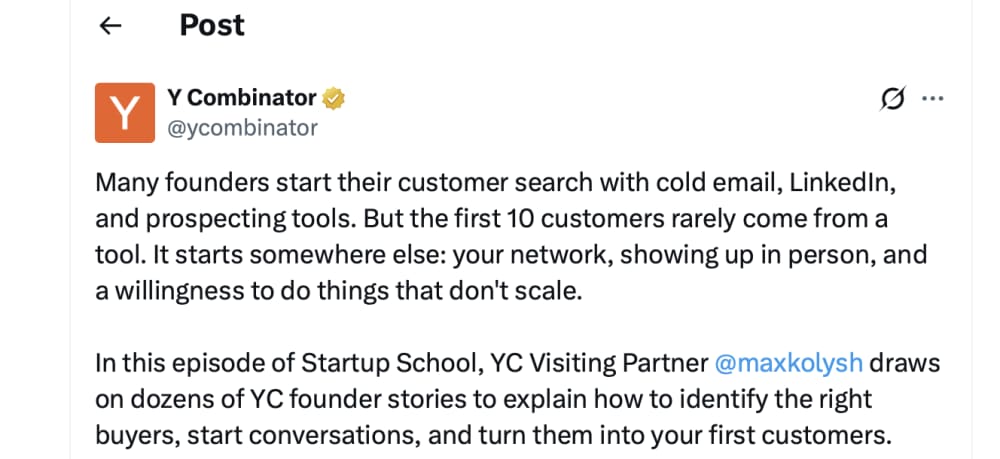
This is still the operating model YC pushes founders toward. In a June 2026 Startup School episode, YC visiting partner Max Kolysh made the same point to a new cohort: most founders start their customer search with cold email, LinkedIn, and prospecting tools, but the first 10 customers rarely come from a tool. They come from your network, from showing up in person, and from a willingness to do things that don't scale.
Practically, this looks like:
- Messaging people in your own directly, one at a time, describing the specific problem you solve - not a generic pitch
- Going to the physical or virtual places your first buyers already gather, and being useful there before you're selling anything
- Sitting on video calls with early prospects and walking them through setup yourself, rather than pointing them at documentation
- Treating your first 10-20 customers as a research project, not a revenue milestone - the goal is depth of understanding, not volume
Graham's broader argument is that startups are fragile at the beginning and founders have to force momentum by hand. It’s tedious and doesn't feel like ‘building a company.’ But at this stage, it remains one of the most reliable ways to generate both customers and the learning needed to improve the product
Before You Go Looking: Nail the Offer and the Audience
Articulate value, without noise
Ask one question: what specific problem does this solve? Not what the product is built with or how it's architected as customers don't care. They care whether it saves time, saves money, or removes a specific pain. "Cuts onboarding time from two weeks to two days" beats a paragraph of feature description every time. That sentence becomes the spine of every outreach message you send.
Target specific audience, not everyone
The most common early mistake is believing the product fits anyone with the problem. Your message has to land with a narrow segment where the pain is sharpest. Write your ideal customer profile as a query, not a description: "Head of Support at a 50-to-200-person e-commerce brand" is something you can turn into an actual list of names. "Companies that need better support" aren't.
Create places for customers to find you
A basic landing page or a short demo video is often enough at this stage to communicate the offer and collect contacts as a finished product isn't a prerequisite for starting outreach. Some startups go further and validate demand (and even pricing) before writing a line of code, publishing a simple pre-launch page describing the product and gauging signups or willingness to pay. It's a way to find out whether anyone wants this before spending months building it, and modern AI-assisted tools have made that kind of lightweight validation page fast to put together.
Consider ProductHunt and similar launch platforms as well as smaller, pre-launch-focused sites like Betalist as additional places to find information about your product. If there's an AI angle to the product, AI-specific directories are worth a listing too, since they've become a real discovery channel in their own right. The mistake, across all of these, is treating launch day as a repeatable growth channel rather than what it actually is: a one-time event that only pays off if onboarding and follow-up are strong enough to convert the spike into retained users.
Go find the first customers: What Channels actually works right now
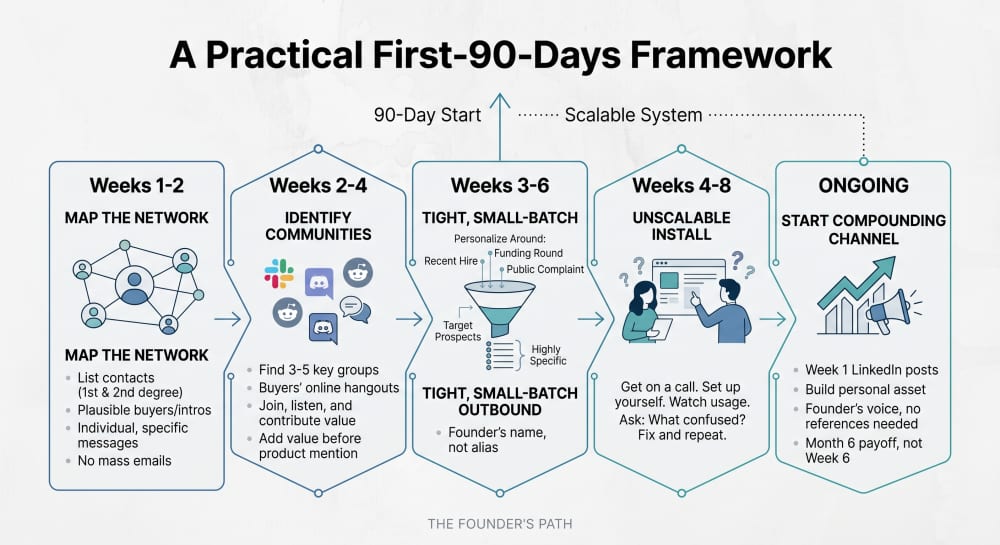
Your own network
This one is often the highest-conviction channel for a first customer, and the most underused, because it doesn't feel like "real" go-to-market work. List everyone you know who fits the profile, or who might know someone who does. Message them individually and specifically. Describe the problem, not the product, and ask if they or anyone they know has run into it. Direct, specific outreach to people who already trust you, like your former colleagues, people in adjacent roles, warm intros from investors or advisors, these convert at a different rate than any cold channel, because you're skipping the trust-building step entirely.
Niche communities
Discord and Slack Communities, LinkedIn, and Subreddits organized around your buyer's specific role or workflow, are where your target early adopter already spends time. Identify four or five communities where the pain point you are trying to solve already has active discussion. Join and observe first, then start adding real value by answering questions, commenting on pain points, without product mentions. Once you identify people who are engaged with your replies, start talking about what you're building and sharing early screenshots. From there you can start reaching out directly to those people, offering early access and personal onboarding.
Partnerships with adjacent, non-competing businesses
Look for companies that already sell to your buyer without competing with you, and propose a simple, informal exchange: you refer clients to each other, and you look for ways to promote each other directly - a joint webinar, a shared case study, a mention in each other's newsletter. No contract needed at this stage, just a clear agreement both sides actually follow through on. Done consistently, this becomes a small but steady source of warm introductions over time.
Cold outbound
Cold outreach still works, but at the first-customer stage precision matters more than volume.
The goal isn't to send thousands of messages and optimize for the highest possible reply rate. It's to identify a small number of prospects who fit your ideal customer profile, have a reason to care now, and are likely to give you useful feedback. Build small, highly targeted lists of those prospects. Look for signals that suggest the problem is active: a recent funding round, a new hire, rapid team growth, a product launch, a public complaint, or a change in the way the company operates. Use those signals to make your outreach relevant to what is happening in the prospect's business right now. Explain why you're reaching out to them specifically in a short message, connect it to the problem you solve, and ask for a 15-minute call. Don't try to explain the entire product, push a demo, or close the deal in the first message. At this stage, the conversation itself is valuable: every response helps you test whether your positioning and assumptions are right. And don't measure success by reply rate alone. A thoughtful response from someone who owns the problem and has buying influence is far more valuable than several generic or automated replies. The objective isn't simply to get more people responding. It's to get the right people talking to you.
Double down on what works
No single channel needs to do all the work. Someone who doesn't respond to an email may be more receptive on LinkedIn, through a mutual connection, or after seeing you contribute to a community they already trust. The goal isn't to bombard the same person everywhere. It's to meet potential customers in the channels where they already pay attention.
After running two or three channels in parallel, the signal usually becomes obvious: one channel is generating real replies and real conversations, and the others aren't. Put the bulk of the next stretch of effort into whichever one is actually working, keep the second-best channel active in the background rather than dropping it, and keep the rest alive at a low, occasional level. A channel that produces nothing this month can still start working once the message or targeting improves. The point isn't to lock in one channel forever; it's to stop spreading effort evenly across channels once one of them is clearly outperforming the rest.
Systematize: When to Move Beyond Manual Outreach
Consider moving from manual outreach once you have enough customer data to identify repeatable patterns, often around your first 10–20 paying customers. At this stage, you should know which industries convert faster, which roles respond best, what triggers make prospects ready to buy, which messages resonate, and which channels consistently bring qualified conversations. Once you have that clarity, you are scaling something proven instead of guessing.
Here are the signals you've reached that point when outreach stops being exploration and starts being a process you could hand to someone else:
-
You have several paying customers with similar characteristics and a clear understanding of why they chose your product, not just early users who joined because they knew you or wanted to experiment.
-
Your customers continue using the product and see enough value to stay, showing that you are attracting the right audience, not just closing random deals.
-
You know your audience very well: who your best customers are, what problems they have, who makes the buying decision, what triggers create urgency, and who is not a good fit.
-
You are closing new paying customers through the same repeatable outreach motion, rather than relying on one-off opportunities or luck.
-
Your outreach performance is predictable: you have a reasonable understanding of reply rates, meeting-booking rates, and conversion patterns.
-
You can explain why prospects say no: If you know that they're missing a feature, already using another solution, don't have enough urgency, or simply aren't the right customer, then you've learned enough to start systematizing the process.
Once those signals show up, stop personalizing every message from scratch and start systematizing: templatize the outreach, build a repeatable list-building process, and start layering in the first inbound experiments on top of process you already trust.
Common mistakes Early Founders Make at this stage
Optimizing for scale before you know what works
Scaling go-to-market too early tends to create noise: leads that aren't ready, weak conversion that gets misread as a product failure when it's really a positioning failure, and money spent before anyone knows what's actually working. Building automation, hiring a growth team, or investing in paid acquisition before you've manually acquired and deeply understood your first customers is solving a problem you don't have yet.
Confusing a spike with traction
A strong launch day, a viral post, or a batch of signups from a single community thread all look like progress. The real signal isn't how many people tried the product, but it's how many are still using and paying for it weeks later. Thirty signups with no repeat usage can still mean there's no real market need. A handful of customers who keep coming back and keep paying is a much stronger signal than a much larger number who tried it once. If early customers keep using the product and start referring others, that's a real signal. If they churn after a trial period, adding more top-of-funnel volume won't fix it.
Buying tools instead of talking to people
Prospecting software, sequencing platforms, and AI-assisted outbound tools all promise to compress the work of finding customers. But in fact, at the very first-customer stage, they tend to compress the wrong thing - they make it easier to reach more people faster, when the actual constraint is depth of understanding with a small number of the right people.
Treating every reply the same
A thoughtful response from someone who owns the problem and influences the buying decision tells you far more than an automated “not interested” from someone simply filtering messages. Early on, evaluate responses by relevance and buying authority, not just reply rate.
Bottom Line
Your first customers should be found deliberately, not waited for. And no channel is more valuable than direct founder conversations when you're still trying to understand who your customer is and why they buy. Cold outbound has gotten harder and rewards precision over volume. One of the most reliable paths at this stage remains unchanged - get uncomfortably close to your earliest users, do things that don't scale, and treat every early customer as a research project.


