Vinted vs. Depop: Two Models, Two Different Builds
Vinted and Depop are both secondhand fashion marketplaces, but they have meaningfully different business models, and that difference has direct implications for what you build.
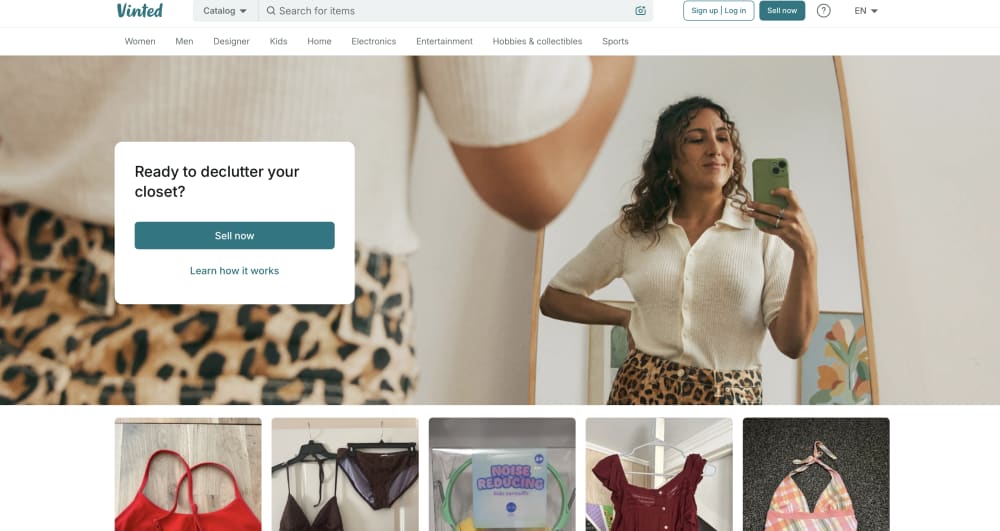
Vinted is one of the leading secondhand marketplaces that focuses on everyday secondhand fashion, making it easy for users to buy, sell, and even swap items directly. The platform’s success is attributed to the fact that it has eliminated seller fees, removing the biggest friction point for casual sellers. Instead, the platform charges buyers a protection fee (typically 3–8% of the transaction amount) to cover payment processing and purchase security. Their approach highlights how marketplaces can become competitive simply by adapting to consumer preferences, local market needs, or regional regulations. From a build perspective, the complexity lives on the buyer side: the fee calculation, the protection terms, and the dispute resolution flow all need to be clearly communicated and enforced at checkout.
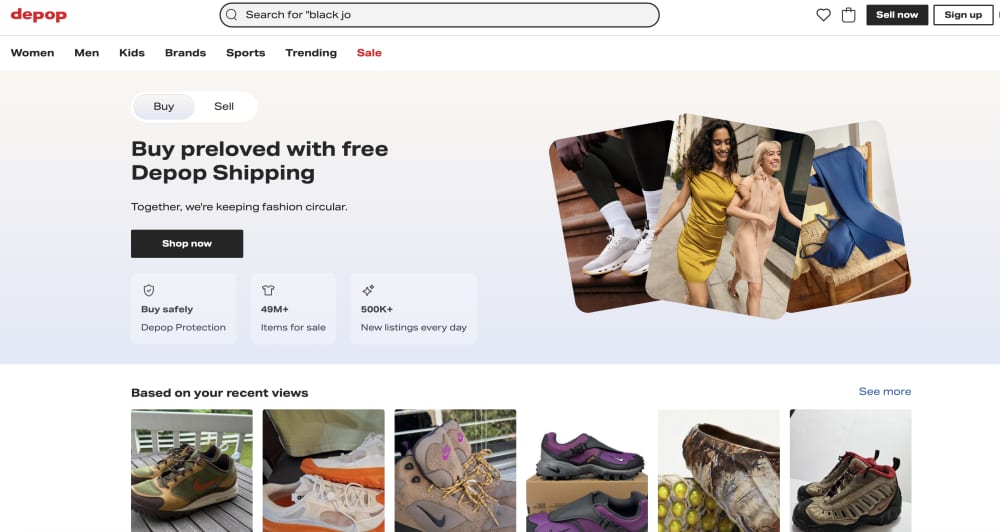
Depop stands out by combining a secondhand marketplace with social networking features. Sellers create listings much like social media posts, building followers, showcasing their style, and interacting with buyers through comments and messages. Buyers discover items through seller profiles, categories, hashtags, and personalized feeds. Features such as likes, follows, reviews, and item sharing create a community-driven shopping experience that feels more personal than traditional e-commerce marketplaces.
Depop charges the seller a commission of around 10% on each sale. It is a conventional marketplace monetization model and is relatively simple to implement, since fee logic is applied uniformly at transaction settlement rather than being surfaced and explained to buyers mid-checkout.
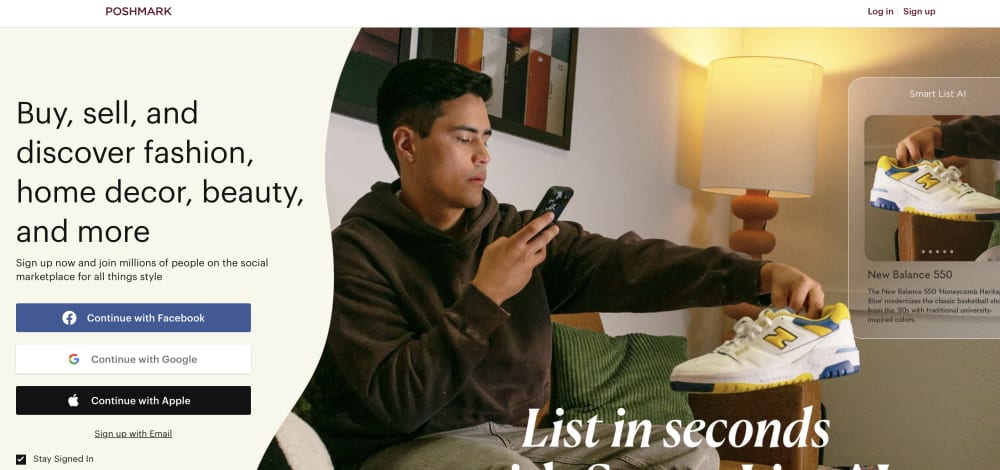
There are also other popular platforms, for instance, Poshmark. It focus on professional women and designer fashion, and offers a more structured shopping experience than social-first marketplaces like Depop. Its standout feature is a simplified shipping process, with prepaid shipping labels provided for every order, making selling easier for users. The platform also encourages engagement through virtual shopping events called Posh Parties and social features such as sharing and following. In exchange for these services, similar to Depop, Poshmark charges sellers a commission on completed sales, while listing products remains free.
Why does this matter for your build? Because your monetization model isn't just a business decision - it's an early technical decision. Before you write a line of code or brief an agency, decide which model you're building. It affects not just the payment layer but your onboarding flows, seller incentive structures, and marketing positioning.
What You're Actually Building (It's Not Just a Listings App)
The most common misconception founders bring to this type of project is thinking of a secondhand marketplace as a listings platform, essentially a Craigslist with better design. It isn't. What Vinted and Depop actually built is a trust infrastructure. The product isn't the listing. The product is the reason a stranger will hand money to another stranger for a used item they can't inspect in person.
So, in addition to such basic functionality as user profiles, photo-first listings, mobile-optimized experience, and messaging, that trust infrastructure includes:
Seller verification and identity management. At minimum: email and phone verification, linked social login, and some form of fraud flagging. At scale: ID verification, behavioral analytics, and seller reputation scoring.
Advanced search and discovery. Users don't browse through thousands of listings manually. They need smart filtering, category taxonomy, and increasingly, visual search and recommendation algorithms. Getting this right is what separates a functional MVP from a platform people actually return to.
Payment deposit and dispute resolution. Money doesn't go directly to the seller when a buyer pays. It's held and only released after the buyer confirms delivery or a dispute window closes. It is a non-trivial payment architecture that has to be bulletproof from day one.
Moderation. Fake listings, counterfeit goods, prohibited items - all need to be caught. Manual moderation works at a small scale; automated content moderation is a later-phase investment, but you need a plan for it from the start.
None of this is technically impossible. But each piece adds complexity, timeline, and cost that founders routinely underestimate in early scoping conversations.
Should You Build It at All?
This is the question most cost articles skip. They jump straight to feature lists and hourly rates. But the right first question for any founder is: do you actually need a custom build?
There are three paths, and the right one depends on where you are in validating the idea.
Path 1: White-Label / No-Code Platforms
Tools like Sharetribe and Kreezalid exist specifically for marketplace founders who want to validate before investing into a custom build.
Sharetribe offers a flexible tiered structure: a no-code / low-code hosted solution with plans starting at $99/month (Lite) for simple marketplaces, scaling to $199/month (Pro) for full professional use, and $299/month (Extend) for advanced customization with full code and API access.
Kreezalid starts at approximately $249–$379/month and is often preferred by founders who want stronger visual design and polish right out of the box.
These platforms provide many of the core features a marketplace needs, including listings, user profiles, payments, messaging, and ratings. However, they also come with limitations. Advanced customization, unique monetization models, proprietary recommendation systems, and highly specialized workflows can be difficult or impossible to implement. Even on Sharetribe's Extend plan, you're still relying on Sharetribe's backend infrastructure. While you can build custom interfaces and integrations, you're operating within the platform's framework.
What you get: functional listing flows, basic payments, user profiles, messaging, ratings. What you don't get: full design control, custom trust mechanics, unique monetization models, or the ability to build features your competitor doesn't have. Even with Sharetribe Extend plan for developers you're still using Sharetribe's backend and infrastructure. You're mainly customizing the frontend and connecting through APIs. If you eventually need completely unique business logic, payment flows, recommendation algorithms, or marketplace mechanics, you may still outgrow Sharetribe and need a fully custom solution.
Use this path if: You're pre-validation, your category is standard (fashion resale, electronics, furniture), and your differentiator is community or curation, not proprietary technology (smth like a proprietary authentication flow, a unique escrow mechanic, a matching algorithm). You can go live in weeks, not months.
The ceiling: Once you need something these platforms don't support, you're rebuilding from scratch. That migration cost is real. Go in knowing it exists.
Path 2: Build on Existing Rails
Shopify is one of the world's most popular cloud-based, all-in-one platforms for building and managing ecommerce stores. It is built for single-vendor e-commerce, but it is also possible to turn it into a multi-seller platform using third-party apps.
To launch a lightweight secondhand platform, some founders combine an established Shopify with marketplace plugins (like Multi-Vendor Marketplace by Webkul, or Shipturtle for C2C flows).
The advantage is the ecosystem that this platform provides - it offers anything you may literally need to start selling immediately, including payment infrastructure or shipping integrations. The limitation is that this path works for specific use cases, particularly brand-owned resale programs or curated resale within a specific product category (like a branded thrift store or consignment shop). Shopify is fundamentally a single-seller storefront; force-fitting peer-to-peer dynamics onto it gets messy quickly, especially around escrow, dispute resolution, and seller identity.
Use this path if: You're launching a curated resale vertical with a managed seller base, for example, a brand running its own recommerce arm, or a niche reseller with tight category control. Not ideal for open peer-to-peer marketplaces.
Path 3: Custom Build
A fully custom build is the right choice in a specific set of circumstances rather than a default starting point.
Build custom when:
Your monetization model doesn't fit standard templates. For instance, you want to offer seller subscriptions instead of transaction fees, implement dynamic commission rates based on item price, category, or seller performance (2% for your top 100 sellers, 8% for new sellers, 5% for mid-tier), or introduce unique mechanisms like bundled sales with automated revenue splits.
You've already validated demand on a white-label platform and are ready to compete on product quality. For instance, after successfully testing on Sharetribe or another no-code tool, or you want to create a smoother mobile-first flow, or your users are asking for features like advanced search with visual similarity, or personalized recommendations that generic tools can’t deliver well.
You're targeting a niche where existing platforms have no presence, and the UX needs to be built around the specific behaviors of that community. For instance, athletic gear, luxury consignment with built-in authentication, kids' clothing swaps, regional or ethnic wear communities - in each of these, the entire user experience needs to be designed around the specific behaviors and expectations of that audience. Generic filters, generic discovery, and generic trust signals won't cut it. The platform has to feel like it was built for them, not adapted from something else.
Your trust mechanic is proprietary. For instance, you need to offer a specialized authentication process for luxury goods (e.g., partnering with Entrupy, an authentication service in the luxury resale market, or real-time expert verification), a peer-to-peer reputation system based on video reviews, AI-powered condition grading, or a unique “try-before-you-buy” virtual fitting integration.
Even when your idea is truly unique and justifies a custom build, that uniqueness must be validated first. The specific features or mechanics that make you choose custom (proprietary trust system, niche-specific UX, complex transaction logic, etc.) should be tested and proven with real users before committing to expensive development. It is usually done by launching a simple MVP, either on a no-code platform (if possible) or a lightweight custom prototype. Building the full custom version without validation is one of the most expensive mistakes founders make.
Feature Set and Cost Breakdown for MVP and Beyond
Assuming you've decided to build custom, here's a realistic feature breakdown and cost ranges.
A solid MVP covers the full transaction loop: users can sign up, list items with photos and condition details, find what they're looking for, message sellers, pay securely, and leave a review when it's done.
Even with a solid outline, certain features routinely expand scope and budget. They are:
Mobile-first requirement. Vinted, Depop, and every platform competing in this space is mobile-first. Building for the web only is not a viable MVP strategy. A cross-platform mobile app (React Native or Flutter) adds $20,000–$50,000 to a typical MVP scope. Cutting this is not a cost saving - it's a product decision that limits your market from day one.
Payment and escrow complexity. Stripe is not plug-and-play for marketplace escrow. You need Stripe Connect (or an equivalent) to route funds between buyers, sellers, and platform fees. Edge cases - partial refunds, split disputes, international payouts - add engineering time fast. Budget this at 20–30% of the total backend cost.
Moderation infrastructure. At launch, a human moderation flow and an admin panel are sufficient. But the design needs to accommodate eventual automation - flagging systems, image recognition for prohibited items, duplicate listing detection. If this is designed as an afterthought, retrofitting it is expensive.
Shipping integrations. Vinted's tight integration with national postal carriers in each market is a significant competitive advantage that took years to build. For an MVP, basic label generation and tracking via a service like Shippo or EasyPost is sufficient, but it still adds scope that founders frequently forget to include.
Fraud prevention. Fake listings and payment fraud are not edge cases on secondhand marketplaces - they're constant. Basic fraud tooling (velocity checks, flagged accounts, chargeback handling) needs to be built in, not bolted on after the first incident.
Custom development costs will also significantly depend on team composition, experience level, and location. A typical marketplace team includes frontend and backend developers, a QA engineer, a UI/UX designer, a DevOps engineer, and a product or project manager. Mobile adds dedicated mobile developers to that mix. Not every project needs all of these from day one - team size scales with project complexity.
How you structure the team matters as much as who's on it. In-house hiring gives you full control but comes with overhead - salaries, benefits, onboarding time. Local agencies are convenient but expensive. Freelancers are flexible but hard to coordinate across a complex build. Outsourced or outstaffed teams from lower-cost regions offer the best cost-to-quality ratio for most marketplace projects at MVP stage - the key difference being that outsourcing hands off delivery responsibility to the agency, while outstaffing gives you direct control over a dedicated remote team.
Experience level also affects both cost and speed. Senior developers cost more per hour but move faster and make fewer expensive mistakes. Trainees cost less but require more oversight. The math isn't always obvious.
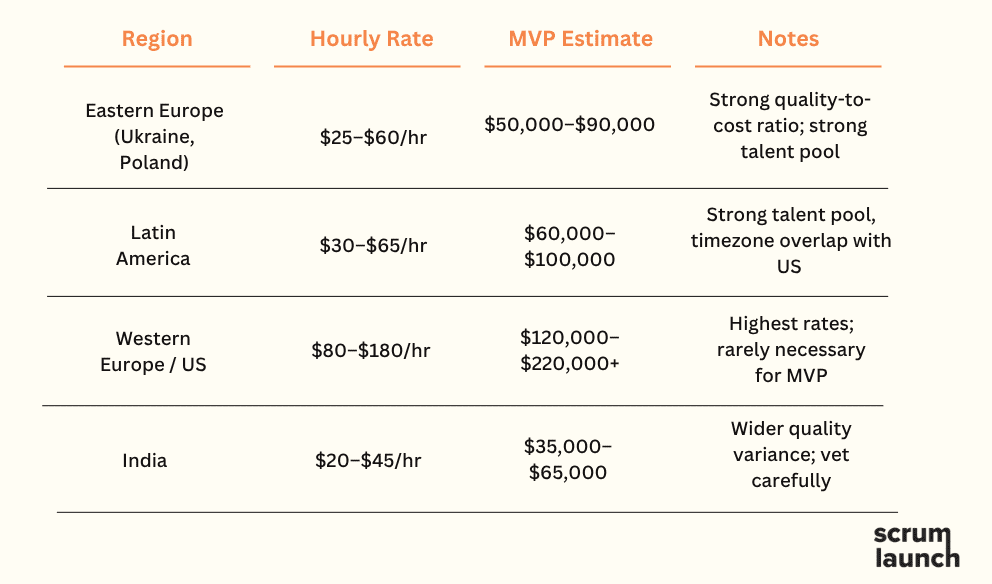
Location is where the cost variance is most dramatic. Location is where cost variance is most dramatic: hourly rates for experienced marketplace developers typically range from $120–$200 in North America (US/Canada), $55–$100 in Western Europe, $32–$48 in Eastern Europe (Ukraine), $30–$45 in Latin America, and $25–$40 in Asia.
Timeline compounds all of these. Rushing a project requires more parallel resources, which drives cost up. Stretching it out means more hours logged and costs rising accordingly. The goal is the right balance of scope, speed, and budget - not the cheapest hourly rate in isolation. A realistic MVP is 4–6 months with a team of 3–5 (1 PM, 1–2 backend, 1 frontend, 1 QA). Founders who expect a Vinted-quality product in 8 weeks for $30,000 are working from incorrect assumptions.
These are realistic ranges for a solid MVP (4–6 months of development) with a competent agency or dedicated team:
What Vinted and Depop Have That You Don't - Yet
A useful way to think about custom build scope is to separate what you're building from what you're deferring.
Vinted and Depop have capabilities that took years and significant engineering investment to build:
- Machine learning-powered search and recommendations. They help surface relevant listings based on browsing and purchase history.
- Visual search, which is extremely useful in finding items by uploading a photo.
- Automated authenticity detection. This one is particularly relevant in luxury/streetwear.
- Seller analytics dashboards - a detailed performance data for power sellers.
- Localized carrier integrations help support country-specific shipping flows at scale.
- International payment infrastructure is indispensable for supporting multi-currency, cross-border compliance.
None of these belong in an MVP. They belong in a future roadmap. The mistake founders make is either including them in the MVP scope (driving up cost and timeline), or not knowing they exist. A well-scoped MVP focuses relentlessly on the core transaction loop: list → discover → buy → receive → review. Everything else is a phase-two problem.
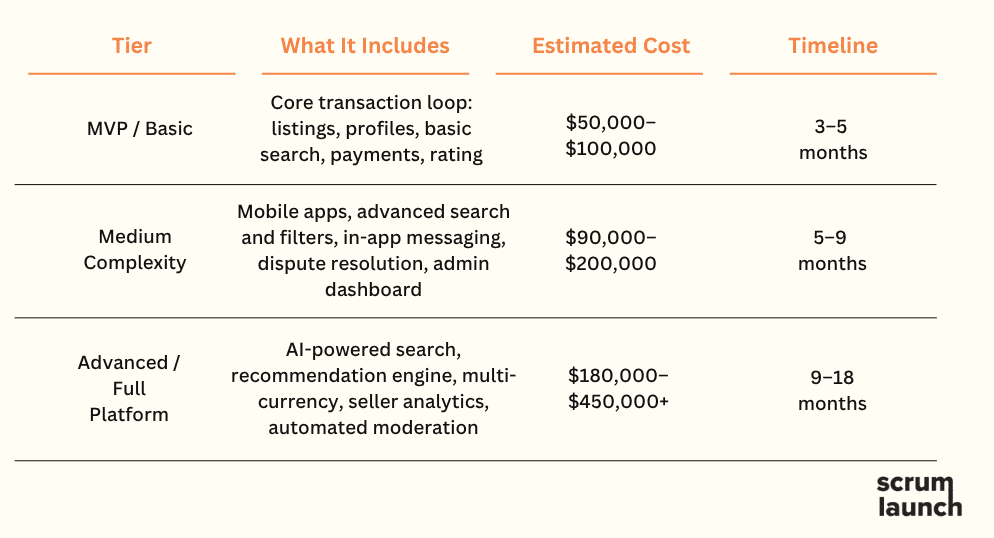
Here is the breakdown of custom development costs by complexity, assuming outsourcing to lower-cost regions such as Ukraine or Latin America.
The Bottom Line: Build Custom When It's Earned, Not Assumed
Most founders with a secondhand marketplace idea should start with Sharetribe, run it for six months, and use real user behavior to answer the questions that actually determine whether a custom build is warranted: What do users do that the platform can't support? Where does the product break? What trust mechanic turns out to be the real differentiator? If the answers point to gaps that no existing platform can fill - a proprietary authentication flow, a unique fee model, a community mechanic that requires custom UX - then a custom build is justified, and it is grounded in evidence rather than assumption. The cost to build a custom secondhand marketplace starts from roughly $50,000 for a simple MVP and can grow to a $450,000+ investment for a full-featured growth platform with mobile apps, advanced search, and robust fraud tooling.


