For most of the last decade, AI systems were built around a relatively simple idea: one powerful model receives an input and generates an output. As large language models improved, that approach unlocked a wave of use cases, from content generation and search to coding assistants and customer support copilots.
But the role of AI inside businesses is changing. Companies are no longer experimenting with AI only as a chatbot or assistant. In 2026, AI systems are increasingly expected to execute real operational tasks: analyze documents, interact with internal tools, retrieve data, coordinate workflows, trigger actions, and support business decisions in real time. And that’s where a single model stops being enough.
Modern AI systems rarely operate in isolation. A production workflow may involve multiple models, APIs, databases, memory layers, retrieval systems, external tools, and even specialized AI agents working together toward a shared goal. The challenge is no longer just generating intelligent output - it’s coordinating all of these moving parts reliably at scale.
That’s the problem AI orchestration platforms are designed to solve. They manage how AI components interact, route tasks between systems and agents, preserve workflow state and context, handle failures, and provide the observability needed to run AI reliably in production. Done correctly, orchestration turns isolated AI capabilities into scalable, production-ready systems.
And as companies push deeper into agentic AI, autonomous workflows, and AI-powered operations, orchestration is quickly becoming one of the most important layers in the modern AI stack. The platform you choose affects everything that follows: scalability, reliability, governance, development speed, and long-term infrastructure cost.
This guide covers 10 platforms worth evaluating in 2026, what each one does best, where it falls short, and which teams it’s built for. If you're a CTO, technical lead, or founder building an AI stack, this is where to start.
Four Categories Worth Knowing Before You Choose
Not every orchestration platform is solving the same problem. The market broadly splits into four categories:
Open-source developer frameworks
They're open-source libraries you install and run wherever you want - your own servers, AWS, GCP, Azure, a local machine. The framework itself is just code. Where it runs is your choice and your responsibility. You still need to decide which LLM powers each agent (OpenAI, Anthropic, a local model), where workflow state and memory are stored (a database you set up), how it scales and how you monitor it - you add observability tools yourself. What these platforms provide is the programming model for AI systems: how agents behave, how workflows are structured, how tasks are routed, and how state persists between steps. They offer the highest flexibility, but also require the most engineering effort.
The most popular platforms in the category: LangChain/LangGraph (highly flexible, stateful graphs), CrewAI (role-based multi-agent teams), Microsoft Agent Framework (Microsoft, graph-based workflows, successor to AutoGen and Semantic Kernel).
Cloud-native managed services
With cloud-native managed services, the provider handles the orchestration infrastructure for you - you don't build or maintain the coordination layer yourself. Instead of building orchestration systems from scratch, teams configure agents, define workflows, connect tools, and let the platform manage execution, scaling, state persistence, and failure handling underneath. The advantage is speed and operational simplicity. The tradeoff is ecosystem dependency. These services work best inside their own cloud environments and integrate most naturally with their provider’s infrastructure, security stack, and AI models. The less your stack overlaps with theirs, the more friction you'll hit.
The most popular platforms in the category: Amazon Bedrock AgentCore (AWS), Gemini Enterprise Agent Platform (Google, formerly Vertex AI Agent Builder), Microsoft Foundry Agent Service (Azure).
No-code/Low-code/Automation
Workflow automation tools were not originally built for AI. However, in modern AI systems, they often serve as the execution layer around AI workflows. Typically, AI agents handle reasoning and decision-making, while automation tools execute actions such as updating CRM records, sending emails, triggering workflows and moving data between systems. These platforms are designed primarily for business teams and operations rather than AI engineers.
The most popular platforms in the category: n8n, Make.
Enterprise-grade platforms
Built for large-scale business operations, these are similar to cloud-native but focus less on orchestration flexibility and more on operational governance, business workflows, compliance, and integration with existing enterprise systems. These platforms are typically more opinionated and come with built-in governance controls, workflow templates, security and audit tooling as well as integrations with CRM, ERP, and enterprise operations software. Usually the most expensive.
The most popular platforms in the category: IBM Watsonx, Agentforce
These categories aren't mutually exclusive - most production AI systems combine more than one. A common pattern: a developer framework handles agent logic, a cloud platform provides managed infrastructure underneath, and a no-code automation tool connects everything to existing business systems. The question isn't always which category to pick, but which combination fits your stack, your team's technical capacity, and your operational requirements.
What to Look for in an AI Orchestration Platform
Before the list, the evaluation criteria. Five things that actually matter in production:
Multi-agent support. Can the platform coordinate multiple specialized agents working in parallel or sequence, not just one agent calling tools?
LLM flexibility. Can you swap or mix models, or does the platform lock you into a single provider? Vendor lock-in at the model layer is a real risk as capabilities shift.
Integration depth. How well does it connect to your existing stack - APIs, databases, memory systems, external tools?
Production-readiness. Does it handle state persistence, error recovery, human-in-the-loop checkpoints, and observability? A platform that works in a demo but breaks at scale is not a platform.
Pricing model. Open-source, usage-based, or enterprise license? Understand the total cost of ownership - for managed platforms, integration and engineering time often exceed the license fee.

What it is: LangGraph is LangChain’s framework for building advanced AI agent workflows. Instead of forcing agents through a fixed linear process, LangGraph lets workflows branch in different directions, loop back when needed, and make decisions at each step based on context and results. The framework is designed for long-running, stateful AI systems - meaning workflows can preserve memory, track progress across multiple steps, and recover from interruptions without restarting from scratch.
Best for: Engineering teams building complex, stateful production workflows where control and auditability matter.
Key features:
- Built-in state persistence and checkpointing with time-travel debugging
- Native support for human approval steps inside workflows
- Fully model-agnostic - works with OpenAI, Anthropic, Mistral, and other providers as well as local and open-source models
- Available in Python and JavaScript
- LangSmith integration for monitoring and evaluation
Limitations: Steep learning curve. LangGraph is far more verbose and lower-level than simpler agent frameworks. In lightweight frameworks, developers can build a basic AI agent in 20 lines because much of the orchestration is abstracted away. In LangGraph, the same workflow may require 100+ lines of code. Teams migrating from LangChain should expect to redesign workflow logic rather than simply swap imports.
Pricing: Open-source and free. LangSmith, LangChain's monitoring and evaluation platform, has a free Developer plan, with the paid tier starting at $39/seat/month.
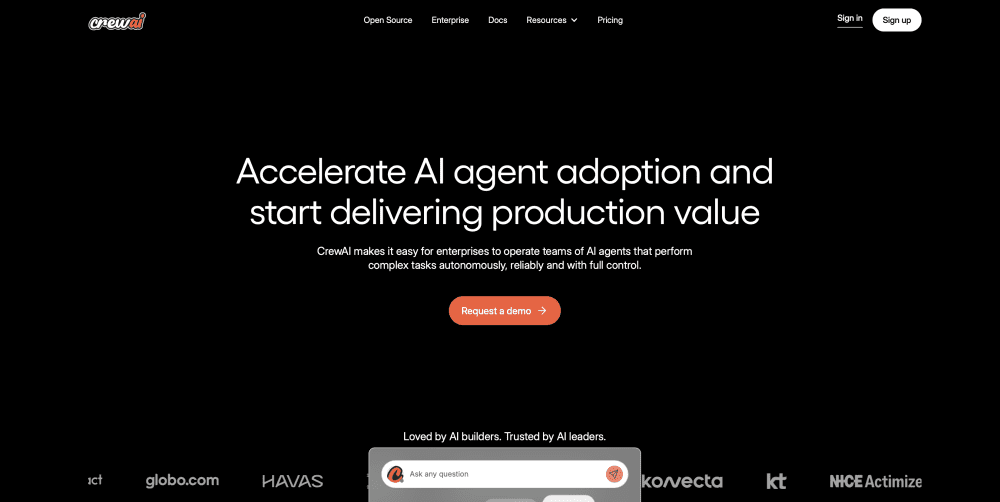
What it is: CrewAI is built around the crew metaphor. Unlike lower-level frameworks like LangGraph, where you define workflow logic explicitly, with CrewAI you define agents by role, goal, and tools, assemble them into a crew, and the framework handles coordination. It supports multiple collaboration patterns, including sequential workflows (agents working step-by-step), and hierarchical structures (manager agents supervising others). The code reads close to plain English, which makes it unusually easy to explain to non-engineers.
Best for: Teams that need multi-agent automation up and running fast, and where the task structure maps naturally to a team of specialists.
Key features:
- Role-based agent design with the lowest learning curve of any major framework
- Sequential and hierarchical orchestration modes
- Enterprise tier with observability, scheduling, and team collaboration
- Fully model-agnostic - natively supports OpenAI, Anthropic, Gemini, and other providers as well as local and open-source models
Limitations: Abstraction that helps at the start becomes a liability at scale. Debugging a failure in a five-agent pipeline is opaque. State persistence is sequential task outputs - not true checkpointing. Teams often prototype in CrewAI and migrate to LangGraph when they need production-grade state management. Token usage is often higher than equivalent LangGraph implementations because more conversational context is passed between agents.
Pricing: Open-source and free. Enterprise tier available (contact for pricing).
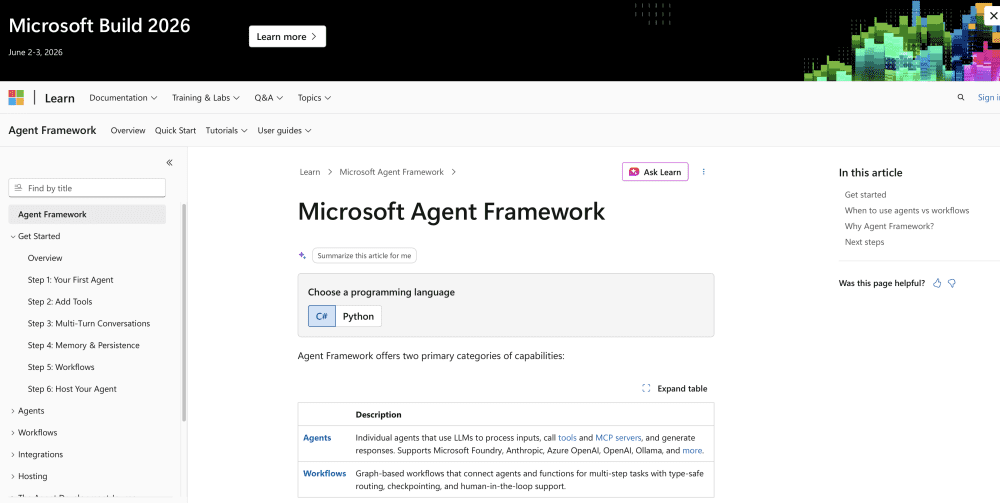
What it is: Microsoft Agent Framework is Microsoft's production-ready answer to a question developers had been asking for two years: AutoGen or Semantic Kernel? The answer turned out to be neither and both. Agent Framework unifies Semantic Kernel's enterprise foundations (middleware, memory, production connectors) with AutoGen's multi-agent orchestration patterns into a single open-source SDK for .NET and Python. Both predecessor projects are now in maintenance mode - bug fixes and security patches only, no new features, making Agent Framework the active path for new Microsoft-aligned development.
Best for: Microsoft and Azure-aligned engineering teams building production multi-agent systems who want a unified, long-term-supported SDK across .NET and Python.
Key features:
- Unified SDK replacing both AutoGen and Semantic Kernel, available in .NET and Python
- Graph-based workflow orchestration with type-safe routing, checkpointing, and human-in-the-loop support
- Native MCP (Model Context Protocol) and A2A (Agent-to-Agent) support built in at 1.0
- Six model providers supported out of the box - Azure OpenAI, OpenAI, Anthropic Claude, Amazon Bedrock, Google Gemini, and Ollama - with one-line provider switching
- DevUI for local debugging of multi-agent workflows
- Long-term support commitment with stable APIs from day one
Limitations: The migration from AutoGen is harder than from Semantic Kernel - the programming model shifted from conversation-centric to graph-based, which requires meaningful rethinking of existing agent logic. Teams not already in the Microsoft/Azure ecosystem will find LangGraph or CrewAI a more natural fit. AG2 - the active open-source community fork of the original AutoGen, remains an alternative for teams that prefer the conversational multi-agent model without Microsoft's unified SDK.
Pricing: Open-source and free. Azure infrastructure costs apply for cloud deployment.
Former Vertex AI Agent Builder by Google
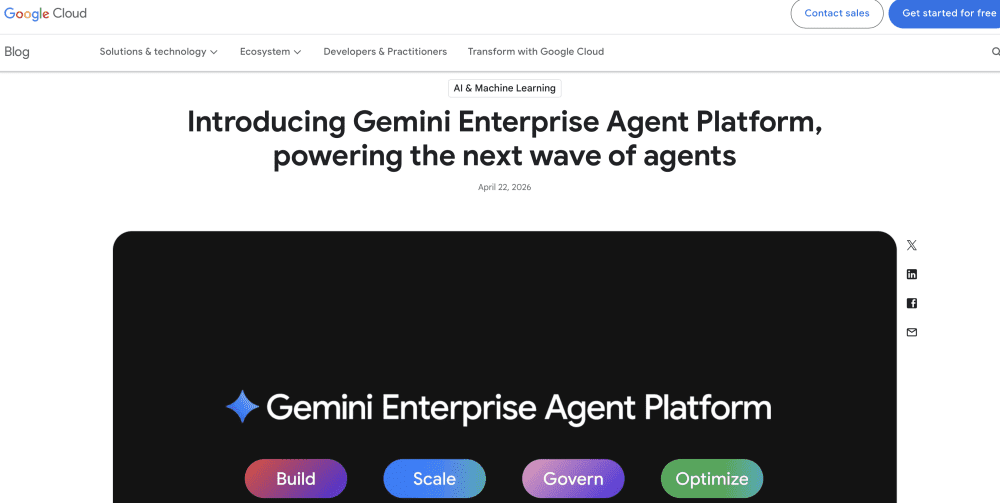
What it is: Google's managed enterprise agent platform, now part of the Gemini Enterprise Agent Platform. This is not just a rebrand - Vertex AI has been consolidated and expanded into a full-stack agentic platform covering model selection, agent development, orchestration, governance, and deployment. Announced at Google Cloud Next in April 2026, the platform introduced Agent Studio for low-code agent building, a persistent Memory Bank for long-term agent context across sessions, and ADK v1.0 now stable across Python, Go, Java, and TypeScript. The ADK gives teams a hierarchical agent tree - a root agent delegates to sub-agents, which can have their own sub-agents.
Best for: Data science and engineering teams already on Google Cloud who want managed agent infrastructure without building it themselves.
Key features:
- Deep native integration with BigQuery, Firestore, Google Workspace, and Vertex AI services
- 200+ models in Model Garden,including Gemini 3, Anthropic Claude, Meta Llama, and Google Gemma
- ADK v1.0 stable across Python, Go, Java, and TypeScript
- Agent Studio for low-code agent building alongside the code-first ADK
- Native support for Google's A2A (Agent-to-Agent) protocol, which enables cross-framework agent communication
- Persistent Memory Bank for long-term agent context across sessions
Supports LangGraph and CrewAI agents as sub-components via native A2A connectors
Limitations: Strong inside the Google Cloud ecosystem - connecting to external systems outside Google Cloud still requires custom integration work, and the platform works best when your data and infrastructure already live there. Model choice, however, is now genuinely broad: Gemini, Anthropic Claude, Meta Llama, and others are all available. Complex pricing across compute, memory, search queries, and model tokens creates billing unpredictability at scale.
Pricing: Usage-based, tied to Google Cloud consumption (API calls, compute, data processed). Enterprise contracts available.

What it is: Amazon's fully managed platform for building, deploying, and operating AI agents at production scale - and AWS's evolution beyond the original Bedrock Agents. AgentCore handles the infrastructure so teams can focus on agent logic: you write the agent code, AgentCore handles session isolation, memory, tool connections, security, scaling, and monitoring. It is designed to work alongside frameworks like LangGraph and CrewAI rather than replace them and works with any foundation model, so you don't have to choose between open-source flexibility and enterprise-grade security.
Best for: Engineering teams with existing AWS infrastructure who want production-grade managed agent infrastructure without building it themselves.
Key features:
- Framework-agnostic - works with LangChain, LangGraph, CrewAI, OpenAI Agents SDK, or your own framework
- Model-agnostic - supports any LLM including models outside the Bedrock catalog
- Managed harness for getting agents to prototype with no orchestration code required
- Built-in session isolation, persistent memory, authentication, and access controls
- Observability, batch evaluations, and A/B testing for continuous agent improvement
- Native MCP and A2A protocol support
- Tight integration with S3, DynamoDB, Lambda, and other AWS services
Limitations: Infrastructure runs on AWS, so teams not already on AWS face meaningful setup overhead to get started. Pricing can be complex with up to 12 independently billable components, and the most common surprises are idle session memory accumulation, CloudWatch observability charges, and policy authorization charges per tool call that don't appear on the main pricing page. Model inference costs are additive on top of AgentCore infrastructure costs.
Pricing: Pay-per-use with no upfront fees. You pay for the AgentCore infrastructure components + underlying model inference tokens.
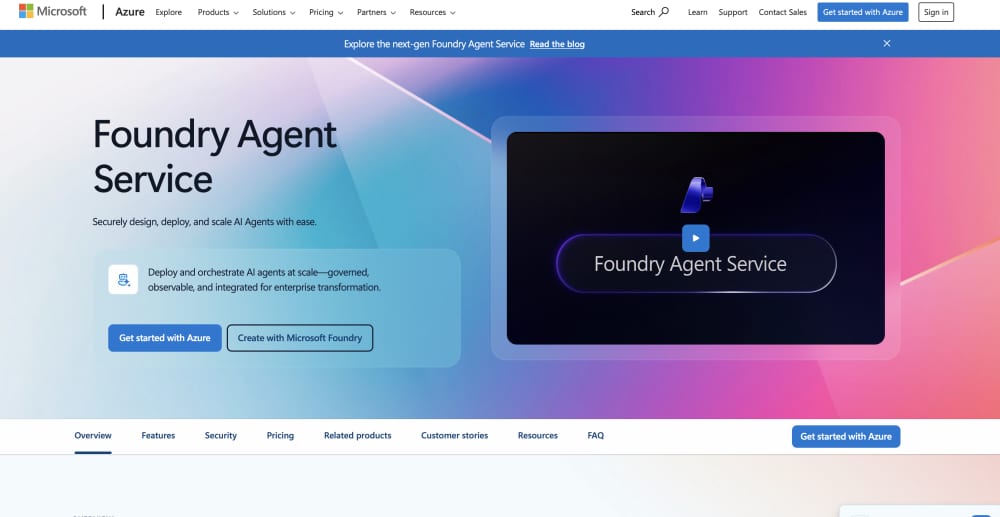
What it is: Microsoft's fully managed runtime for deploying, hosting, and scaling AI agents on Azure - the cloud-native counterpart to Microsoft Agent Framework (which is the open-source SDK for building them). Foundry Agent Service handles hosting, scaling, identity, observability, and enterprise security so teams can focus on agent logic rather than infrastructure. It reached general availability in March 2026, built on the OpenAI Responses API and open to models from DeepSeek, xAI, Meta, and others, with support for LangChain, LangGraph, and custom frameworks.
Best for: Microsoft and Azure-aligned engineering teams that want managed agent infrastructure with enterprise-grade governance, security, and native Microsoft 365 integration.
Key features:
- Works with any framework and model - supports Microsoft Agent Framework, LangGraph, and custom code agents
- 1,400+ action connectors via Azure Logic Apps for workflow automation
- Native MCP support and A2A protocol (preview) for cross-framework agent communication
- Each agent gets a dedicated Microsoft Entra identity for secure, scoped access to resources and APIs without sharing credentials
- Foundry Control Plane for discovering and managing agents across subscriptions, with an Agent Monitoring Dashboard for operational metrics and evaluation results
- Distribution through Microsoft 365 Copilot and Teams - agents deploy where users already work
- Private networking, data residency controls, and role-based access control through Azure RBAC
Limitations: Works best inside the Azure and Microsoft ecosystem. Teams not already on Azure face the same setup overhead as any managed cloud service. Copilot Studio is the low-code alternative for simpler use cases; Foundry Agent Service is the pro-code path designed for complex enterprise scenarios - teams that need a fast no-code setup may find it over-engineered.
Pricing: Pay-per-use, tied to Azure consumption. No standalone platform fee.
 What it is: An open-source workflow automation platform with native AI integrations. n8n lets teams build automated workflows visually, with nodes for calling LLMs, running AI agents, processing data, and connecting to external services. It sits at the intersection of workflow automation and AI orchestration - not a pure agent framework, but increasingly used as the execution layer around AI workflows.
Best for: Technical teams that want visual workflow automation with AI capabilities and full
control over their infrastructure through self-hosting.
Key features:
- Visual workflow builder with 500+ integrations
- Dedicated AI Agent nodes for building LLM-powered agents with memory and tools
- Self-hostable - full data control and no vendor dependency
- Strong support for OpenAI, Anthropic, Gemini, and local models
- Active open-source community with a large template library
Limitations: Not a purpose-built agent orchestration platform - it's a workflow automation tool with AI capabilities. Complex multi-agent coordination and state management require workarounds that a dedicated framework handles natively. Better suited as the execution layer around agents than as the orchestration layer itself.
Pricing: Open-source and free to self-host. n8n Cloud starts at €24/month with 2,500 executions (Starter plan). Execution limits can be hit faster than expected for high-frequency workflows - one workflow triggering every 5 minutes burns through 8,640 executions per month, blowing the Starter plan in 9 days. Pro plan at €60/month for 10,000 executions.
What it is: A no-code visual automation platform with AI integrations. Make allows business and operations teams to connect apps, automate workflows, and incorporate AI actions, including LLM calls and AI agents, without writing code. Like n8n, it functions more as an automation execution layer than a dedicated AI orchestration platform.
Best for: Operations and business teams that need to connect AI capabilities to existing tools and workflows without engineering involvement.
Key features:
- Visual drag-and-drop scenario builder with 3,000+ app integrations
- 400+ pre-built AI app integrations
- Native modules for OpenAI, Anthropic Claude, and Google Gemini — plus HTTP integration for connecting to any other model with an API
- No infrastructure to manage - fully cloud-hosted
- Strong library of pre-built templates for common business workflows
- Real-time execution monitoring
Limitations: Designed for business automation, not AI agent orchestration. Multi-agent coordination, state persistence, and complex reasoning workflows are outside its scope. At high volume, usage-based pricing can become expensive quickly.
Pricing: Free tier with 1,000 operations/month. Paid plans from $12/month (Core, 10,000 operations). Credit-based billing — every step in a scenario counts as one operation, including filters and routers. AI agent workflows consume significantly more credits per run than standard automations.

What it is: Agentforce is Salesforce's native AI agent platform, built directly and deeply integrated into the Salesforce ecosystem. Agents are grounded in Data Cloud, which means they read Salesforce records, respect existing sharing rules, and write back without API glue. The Atlas Reasoning Engine handles structured multi-step reasoning - plan, refine, act - rather than simple text prediction.
Best for: Revenue operations, sales, service, and customer success teams where Salesforce is the system of record.
Key features:
- Native CRM grounding - agents work with live Salesforce data without brittle integrations
- Declarative, low-code Agent Builder accessible to Salesforce admins (no developer required for most workflows)
- Einstein Trust Layer for governance and zero-retention data handling
- Strong support for sales, service, marketing, and commerce workflows
- Strong compliance posture (SOC 2, data residency controls)
Limitations: If your stack isn't Salesforce-centric, Agentforce is the wrong tool. Connecting to external systems requires MuleSoft or custom integrations. Agents are built for Salesforce workflows - not general-purpose orchestration. Pricing adds up fast at scale.
Pricing: $2 per conversation (best for customer-facing agents) or $500 per 100k Flex Credits (~$0.10 per action). Salesforce Foundations offers a free tier with 200k Flex Credits (plus Agent Builder and Data Cloud credits) for qualifying Enterprise customers. Large enterprise deployments commonly reach $250,000+ in the first year when including Data Cloud, implementation, and usage beyond the free credits.
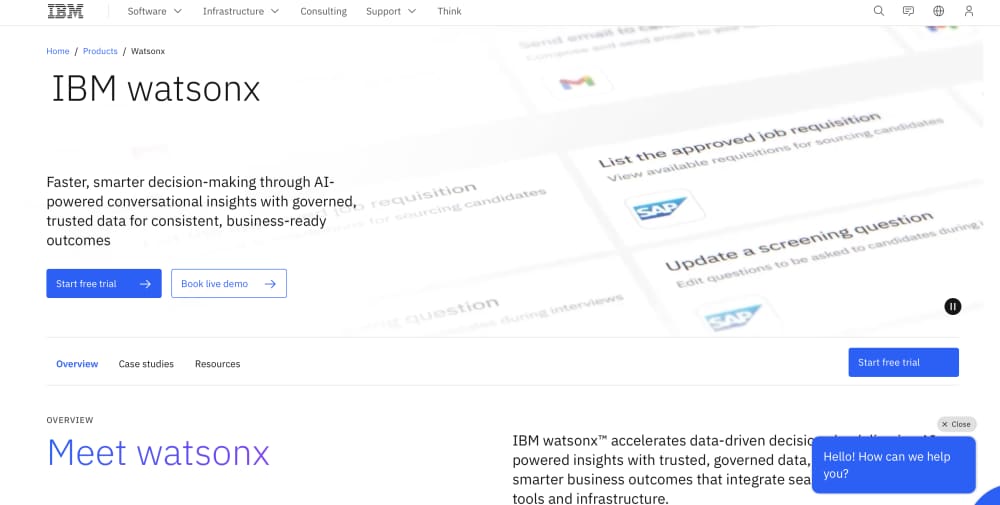
What it is: IBM's enterprise AI platform, covering model development, deployment, and governance across the full AI lifecycle. watsonx Orchestrate - the orchestration-specific component - allows enterprises to build AI agents and automate business workflows with strong emphasis on governance, auditability, and integration with existing enterprise systems (SAP, Salesforce, ServiceNow).
Best for: Large enterprises with strict governance, compliance, or data residency requirements - particularly in regulated industries like finance, healthcare, and government.
Key features:
- Enterprise-grade governance with built-in bias detection, explainability, and audit trails
- watsonx Orchestrate for agent-based workflow automation
- 100+ prebuilt agents and 700+ enterprise system connectors out of the box
- Supports multiple foundation models including IBM Granite and third-party models (OpenAI, Mistral, etc.)
- Deep integrations with SAP, Salesforce, ServiceNow, and other enterprise systems
- On-premises, cloud, and hybrid deployment options
Limitations: Complex to implement and expensive. Built for large enterprise environments - startups and mid-market companies will find it overengineered for most use cases.
Pricing: Typically one of the most expensive options in this list. watsonx.ai (base platform) costs start at $0/month (Essentials) or $1,110/month (Standard). Tiered subscriptions for watsonx Orchestrate start at ~$530/month (Essentials) up to ~$6,360+/month (Standard). Premium and large deployments are custom-priced and can become very expensive quickly.
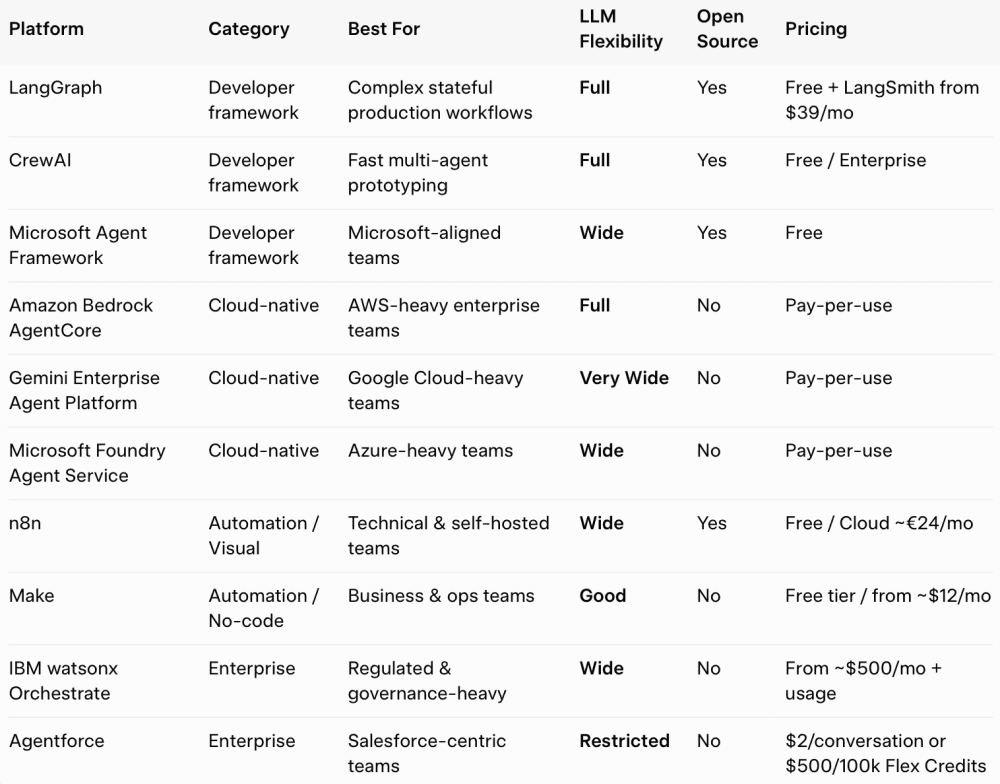
How to Choose the Right Platform
The right choice depends less on features and more on three questions: where your data lives, what your team can actually build, and what you need agents to do in production.
"We're building a customer-facing AI agent on our existing cloud infrastructure." Match the platform to your cloud. AWS teams should start with Amazon Bedrock AgentCore, GCP teams with Gemini Enterprise Agent Platform, Microsoft teams with Microsoft Foundry Agent Service. The managed infrastructure cuts setup time significantly and native integrations reduce ongoing maintenance.
"We want full control, prefer open-source, and have a team that can build." LangGraph for production-grade stateful workflows where precision and auditability matter. CrewAI for faster iteration with role-based multi-agent teams. Microsoft Agent Framework if you're in the Microsoft ecosystem and need enterprise-grade multi-agent orchestration with long-term support.
"We need to automate internal operations — sales, support, or CRM workflows." If Salesforce is your system of record, Agentforce is the architecturally correct answer. For large enterprises in regulated industries, IBM watsonx is worth the complexity for the governance controls it provides. For teams without a dominant enterprise platform, n8n or Make lets operations teams automate AI-assisted workflows without developer involvement.
Before evaluating platforms, map every system your AI workflow needs to connect to - your CRM, databases, APIs, ticketing systems, data warehouses, whatever is in the chain. Then check which platform has those connections built in natively. Native integrations - where the platform was designed for that connection from the start - are significantly easier to maintain in production than custom connectors built on top. A workflow that can't reliably reach the systems it depends on is a prototype, not a product. Integration fit narrows the shortlist faster than any feature comparison.
Conclusion
The AI orchestration market matured fast. A year ago, most of these platforms were in early beta or didn't exist in their current form. Now they're running in production at real companies, handling real workflows, and the differences between them are meaningful. The best platform is the one your team can ship with, not the one with the most features on the comparison page. Start with your stack, your compliance requirements, and your team's technical capacity. That will narrow the list faster than any benchmark.
Starting from your stack and your team’s capacity is the right instruction, and the second half of it is who maintains the orchestration once it is running. Ours tend to be Python developers working next to the data team.