This article breaks down the cost of building a home services marketplace, what drives the budget up, and what a realistic number looks like across the building options you have.
The Main Competitors and What They Tell You About Your Build
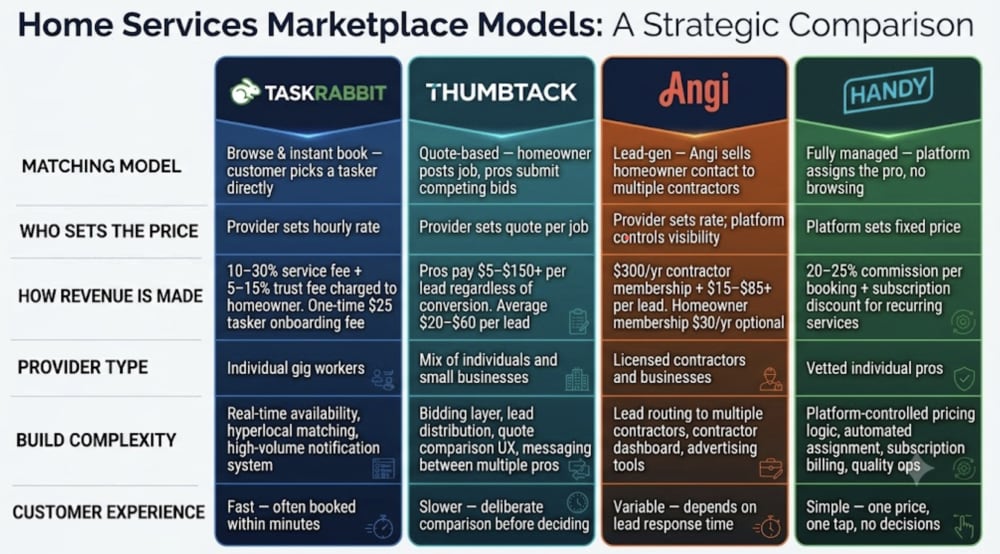
TaskRabbit, Thumbtack, Handy, and Angi all operate in the home services space. They are not versions of the same product. They run on fundamentally different matching models, and that difference is what should drive your early technical decisions.

TaskRabbit operates a true two-sided marketplace for on-demand gig work. Customers browse available Taskers, compare profiles and rates, and often book quickly. The platform charges homeowners an additional service fee on top of a Tasker’s hourly rate, typically ranging from 10% to 30%, plus an additional Trust & Support Fee, usually 5–15% of the total task price. Taskers set their own prices. New Taskers pay a one-time onboarding and registration fee (typically around $25). This model demands sophisticated real-time availability, hyperlocal matching, and a robust notification system that can handle spikes in activity.
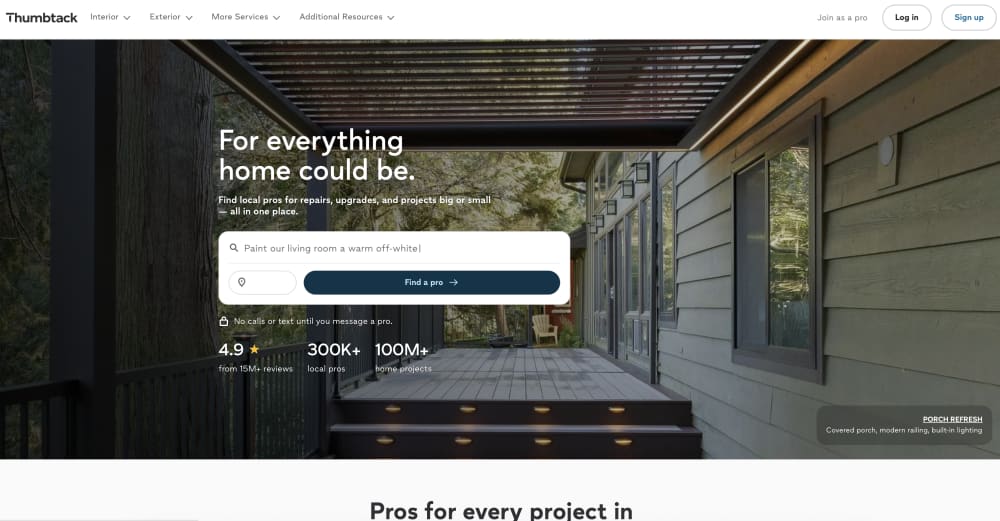
Thumbtack runs a quote-based model. A homeowner describes the job, and interested pros submit quotes to compete for it. Thumbtack primarily makes money by charging professionals for leads - to get the homeowner’s contact information or to officially “claim”/respond to that job opportunity, the professional has to pay Thumbtack a fee (called a “lead”), regardless of whether it converts. Thumbtack lead costs generally range from $5 to over $150+ per lead, with most service professionals paying an average of $20 to $60 per lead. The build complexity here shifts: you need a bidding and messaging layer, a lead distribution system, and clear UX that helps users compare offers effectively. The consumer experience is slower by design - it's deliberate consideration, not instant booking.
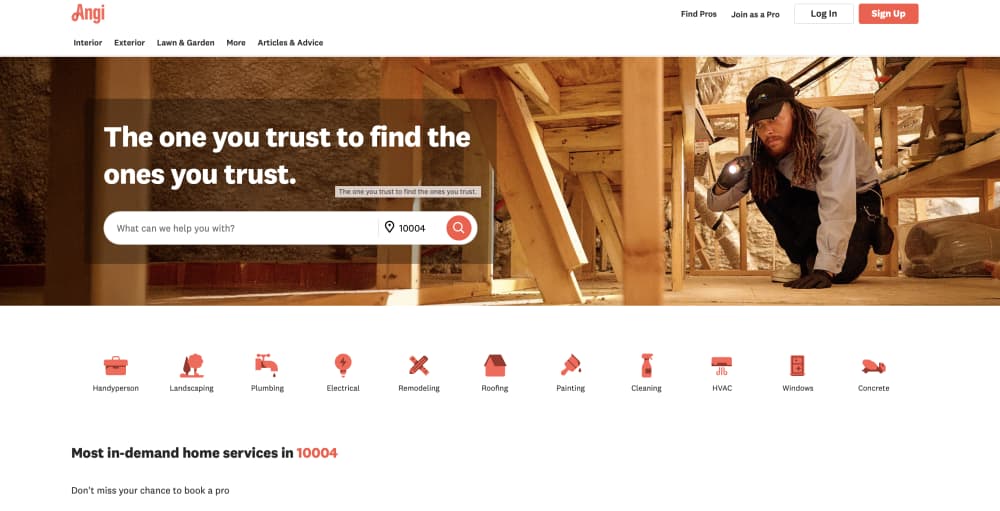
Angi connects homeowners with local service professionals for everything from small repairs to large projects. Unlike TaskRabbit, which works with individual gig workers, Angi primarily connects homeowners with licensed contractors and businesses. A homeowner requests a service, and Angi sells that lead, typically to several contractors simultaneously, all competing for the same job. Homeowners can use the platform for free or pay $30 per year for a savings membership offering 20% off hundreds of pre-priced services. Contractors pay a $300 annual membership fee plus $15–$85+ per lead regardless of whether they win the job, and can pay additionally for better visibility in search results.
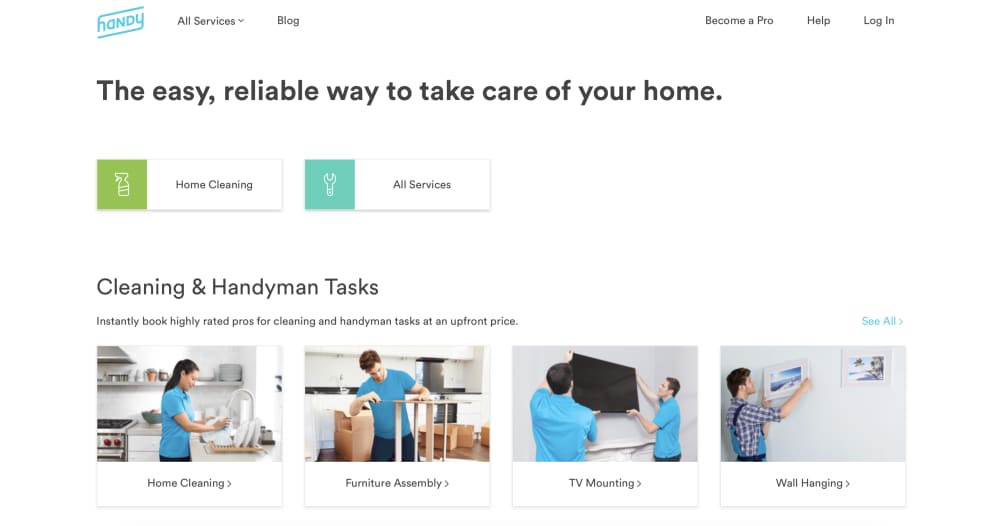
Handy (Now part of Angi) takes a different, fully managed, concierge-style approach. Customers book a service (e.g., cleaning), and the platform handles pricing, assigns the pro, and owns the service quality promise. Homeowners pay a fixed, platform-set rate; they don't browse providers or negotiate. The core revenue comes from a 20% to 25% commission taken on each completed booking. On top of the per-booking commission, Handy runs a subscription model for recurring services - homeowners who commit to weekly or biweekly bookings pay a lower per-session rate in exchange for a predictable schedule. That recurring revenue layer is one of Handy's most distinctive features and one of the strongest retention mechanics in the category. At the same time, this is the most operationally intensive model to build and run, but it produces higher customer lifetime value because quality is standardized and repeat bookings are built into the product rather than left to chance.
Why does this matter before you write a line of code? Because the matching and monetization models aren’t features - they are the architecture. Choose your model before you scope the build, not after.
Where the Opportunity Actually Lives
The home services market is not winner-take-all. It is too large, too fragmented, and too locally dependent for any single platform to own. TaskRabbit has scale. What it doesn't have is a lock on every category, every geography, and every user expectation that has emerged recently.
Here is where the gaps are:
Underserved markets
TaskRabbit has built a strong presence in North America and parts of Europe, but large markets across Asia, Latin America, the Middle East, and Africa still don't have a dominant home services platform. The opportunity isn't only geographic. Even in countries where TaskRabbit operates, coverage is often concentrated in major cities. Smaller cities and suburban areas usually have fewer providers and lower service availability, leaving room for local platforms built around regional needs.
The vertical opportunity
TaskRabbit is built to support dozens of different services, from furniture assembly to moving and home repairs. That broad approach works, but it also means the product has to fit many different use cases. A vertical marketplace can do the opposite. Whether it's senior care, pet services, cleaning, or HVAC, every part of the platform, from onboarding to search and trust features, is designed around one customer and one type of provider. That focus often leads to a better user experience and stronger customer retention.
AI advantage
Most home services platforms were built long before today's AI tools existed. Their matching, pricing, scheduling, and customer support rely on workflows that were never designed for AI. A platform built today starts from a different place. AI can match customers with the right provider, automate support, optimize pricing, and improve scheduling from day one. Every booking and review makes the system smarter over time. Legacy platforms can add these capabilities, but rebuilding years of infrastructure around AI is much harder than designing for it from the start.
A trust problem nobody has solved
Home services are built on trust. Customers aren't just hiring someone to complete a task - they're inviting a stranger into their home. Reviews alone are no longer enough. People increasingly expect verified professionals, transparent pricing, real-time arrival tracking, secure payments, and clear accountability if something goes wrong. Many platforms still treat these as extra features. New entrants have an opportunity to make trust the foundation of the product instead of an afterthought.
What You're Actually Building
Regardless of the booking model you choose, you're not building a single app. You're building a platform that has three core components: the homeowner experience, the provider experience, and the admin tools that keep everything running.
The exact features depend on whether you're building a browse-and-book marketplace like TaskRabbit, a quote-based platform like Angi, or an on-demand service. But regardless of the model, the core transaction loop in plain terms is post a job → match with a provider → communicate → pay → review. Every feature above exists to make that loop work reliably. Anything outside it is a phase-two decision.
Homeowner side
Registration and profiles are the entry point: email, phone, social login, address verification for location-based matching.
Search and filtering have to work by category, location, availability, and price range - a homeowner looking for a plumber available this Saturday shouldn't have to scroll through irrelevant results.
Booking and scheduling are where most of the UX complexity lives: date and time selection, job description, photo upload for context, and confirmation flow.
In-app messaging allows customers to communicate with providers directly inside the job thread, share photos, and clarify details before and during the job. It keeps communication on-platform and out of SMS, which matters for dispute resolution later.
Payment at checkout needs to feel instant and secure - card storage, one-tap rebooking for repeat customers, and clear fee disclosure before confirmation.
Post-job review and rating close the trust loop by capturing customer feedback, improving provider visibility, and feeding the matching system with quality signals that influence future bookings.
Service provider side
This is the operational layer. Providers are not casual users - they’re running a business inside your platform.
Onboarding flow covers profile creation, service category selection, coverage area, hourly rate or pricing setup, and document uploads for licenses and insurance.
Job management is the daily workflow: receiving job alerts, accepting or rejecting requests, managing schedules, and in-app messaging with customers. Providers rely on messaging to confirm job details, coordinate arrival, and handle changes in real time.
Earnings dashboard shows completed jobs, pending payouts, and payment history. If this isn’t clear and reliable, providers stop trusting the platform.
Admin and ops side
This is the invisible layer that makes everything work at scale.
Provider verification handles identity checks, review of submitted documents and background check results.
Booking management allows internal teams to intervene in edge cases, cancellations, or scheduling conflicts.
Dispute resolution manages issues between homeowners and providers.
Payments and payouts control money flow, including holds, refunds, and contractor payments.
Fraud detection and monitoring protects the platform from abuse.
Analytics and reporting help optimize supply, demand, and pricing over time.
This layer is usually underbuilt in early versions and becomes one of the most expensive parts to scale.
The Features That Surprise Founders
Every founder budgets for profiles, search, and payments. The features below are the ones that don't make it into early scope conversations and then show up as unplanned development cycles after the first investor demo or the first real user complaint.
Background checks
Background checks cover criminal and risk screening and are a core trust layer in virtually every home services platform - any app sending someone into a private home is exposed without them. TaskRabbit processes background checks through Checkr, a third-party screening company used across the gig economy. Integrating Checkr or a comparable service like Certn means building an API connection, handling webhook callbacks for check status updates, gating provider access until a check clears, and displaying verification status to homeowners in a way that actually builds trust. On top of the engineering cost, there's a per-check fee that scales directly with provider volume.
One number that surprises almost every founder: background check integration alone adds $10,000–$20,000 in development cost, plus $15–$30 per background check at runtime paid directly to Checkr. At 500 provider onboardings, that's $7,500–$15,000 in per-check fees before a single job is booked. Budget it as an operational line item from day one, not a development afterthought.
Identity verification
Background checks confirm criminal history. Identity verification confirms the person submitting the check is who they claim to be - these are separate integrations and separate costs. Platforms like Persona handle document scanning, selfie matching, and fraud detection, and also charge per verification, so the same scaling cost logic applies. Connecting identity verification into your onboarding flow, handling edge cases like expired IDs or failed matches, and building a review queue for manual escalations add scope that most early estimates ignore entirely. Higher-trust categories like senior care or access to a home while the owner is absent, all need this from day one. Lower-risk categories like furniture assembly or cleaning can reasonably defer it to a later phase.
License and insurance validation
It only applies if your platform covers licensed trades: electricians, plumbers, HVAC technicians. A cleaning or handyman platform has no legal requirement to validate a trade license because no license is required for those services. For licensed trades, skipping this creates direct legal exposure. Capturing documentation at onboarding is straightforward - a document upload field solves it. Validating it ongoing - checking expiry dates, flagging lapses, blocking job access when coverage drops - is not. Unlike background checks and identity verification, there's no per-check API fee here. The cost is engineering time: building the logic that tracks document status, triggers renewal reminders, and gates platform access automatically rather than relying on manual review at scale.
Real-time availability and calendar sync
Availability sounds simple until providers start changing schedules, running late, or syncing multiple calendars. Suddenly you're dealing with time zones, travel buffers, overlapping bookings, manual overrides, and external calendar integrations. Instant-booking platforms live or die on availability accuracy. A provider who shows as available on Saturday but is actually booked creates a cancellation, a bad review, and potentially a lost customer.
Recurring bookings
Not glamorous, but commercially important. A homeowner who books a cleaner every two weeks is your best retention mechanic. Supporting recurring bookings means handling scheduling logic, automatic payment processing, provider assignment consistency, and cancellation policies for recurring series. Platforms that launch without this add it within six months, usually after watching repeat customers drop off because rebooking manually is too much friction.
Provider payouts
Accepting payments from customers is only half the problem. You also need to calculate platform fees, release funds to providers, handle refunds, payment holds, chargebacks, and tax reporting. As soon as money starts flowing in both directions, the payment system becomes significantly more complex than a standard checkout flow.
What Options Do You Have for Building It
Before the cost breakdown, the main question is how you can build this, because the answer affects not just the budget but the timeline, the risk profile, and how much control you have over the product long-term. Usually, you have two main options to choose from.
White-label platforms
There are vendors that sell pre-built home services marketplace software: Yelo by Jungleworks, and Yo!Gigs are the most commonly referenced.
Yelo by Jungleworks is a SaaS platform built for multi-vendor marketplace founders, with annual plans starting at $5,999/year for the Pro tier and $9,999/year for Premium. Mobile apps, delivery management, and advanced marketing automation are add-ons priced separately. Yo!Gigs takes a different approach entirely - a one-time license fee starting at $1,249, giving you the source code outright with no recurring platform charges. Both offer provider onboarding, booking flows, payment integration, and admin dashboards out of the box.
The ceiling is real and it arrives fast. Custom matching logic, proprietary verification flows, your own fee structure, and any UX that doesn't match the template - all of these require either expensive customization work or workarounds that accumulate into technical debt. You're also building on someone else's infrastructure, which creates vendor dependency that's hard to exit cleanly.
Use this path if you're pre-validation and need something live within weeks to test demand in a specific city or category. Go in knowing that if the idea works, you'll likely rebuild.
Сustom build
This is where almost every serious home services platform founder lands, usually sooner than expected. The matching logic, the three-sided UX, the verification stack, and the payments architecture are all complex enough that white-label solutions hit their ceiling quickly.
A custom build gives you full control over the product, the data, and the roadmap. It also means you own the timeline, the risk, and the cost.
If You Go Custom, What Does the Cost Depend On?
Two founders can describe the same product and receive estimates that differ by $200,000. That gap isn't agency markup or bad faith - it's the result of a handful of variables. Here's what actually moves the number.
Except for the type of the app you are planning to build, its monetization model and features it will require that we already discussed above, the cost of the custom development will also depend on the following factors:
Mobile requirement
A home services app that isn't mobile-first isn't competing. Providers are between jobs when job alerts arrive. Homeowners book from their phones. Building a cross-platform mobile app in React Native or Flutter adds $25,000–$60,000 to a typical MVP scope on top of the web build. This is non-negotiable for the category - it's not a cost saving to defer it, it's a market decision.
Number of service categories at launch
Launching with three categories - cleaning, handyman, and furniture assembly - is a different scope than launching with forty. Each category can carry its own pricing logic, its own verification requirements, its own search filters. The broader the launch catalog, the more the admin layer, the onboarding flow, and the search infrastructure need to accommodate variation. We recommend launching narrow and expanding - the product is cleaner and the cost is lower.
Verification stack complexity
Background checks, identity verification, and license validation can be lightweight - basic Checkr integration, manual document review or deeply automated with status webhooks, expiry tracking, and access gating. The difference in engineering time between a simple implementation and a robust one is significant. What you need depends on how much liability you’re willing to take on and the service categories you're launching with. A cleaning platform has different risk exposure than one handling licensed electricians.
Geography at launch
A single-city launch is dramatically simpler than a multi-market launch. One city means one set of tax rules, one currency, one time zone, consistent provider density, and a contained moderation problem. Multi-market adds localization, regional compliance, and the geographic logic that underlies matching and availability. Founders who plan to launch in five cities simultaneously are effectively building five versions of the supply-side problem at once.
Team location
One variable that matters as much as what you build: who builds it. A US-based agency, an in-house team, and a dedicated outstaffed team from Eastern Europe or Latin America are not interchangeable - they produce meaningfully different cost structures for the same scope.
Experienced marketplace developers typically bill at $120–$200 per hour in the US and Canada, $80–$180 in Western Europe, $30–$60 in Eastern Europe, and $30–$65 in Latin America. The same six-month MVP scope produces a very different invoice depending on where the team is located and not because the work is different, but because the hourly rate applied to it is. For most founders building at MVP stage, a dedicated outstaffed team from Eastern Europe or Latin America offers the strongest cost-to-quality ratio.
Senior versus junior team composition
Senior developers cost more per hour and move faster, make fewer architectural mistakes, and require less oversight. Junior developers cost less and require more management time, more QA cycles, and more rework. The math across a six-month build often favors senior-heavy teams even at higher hourly rates - a clean architecture built once is cheaper than a junior build that needs to be refactored before you can add the next feature.
Cost Breakdown: MVP vs. Growth vs. Full Platform
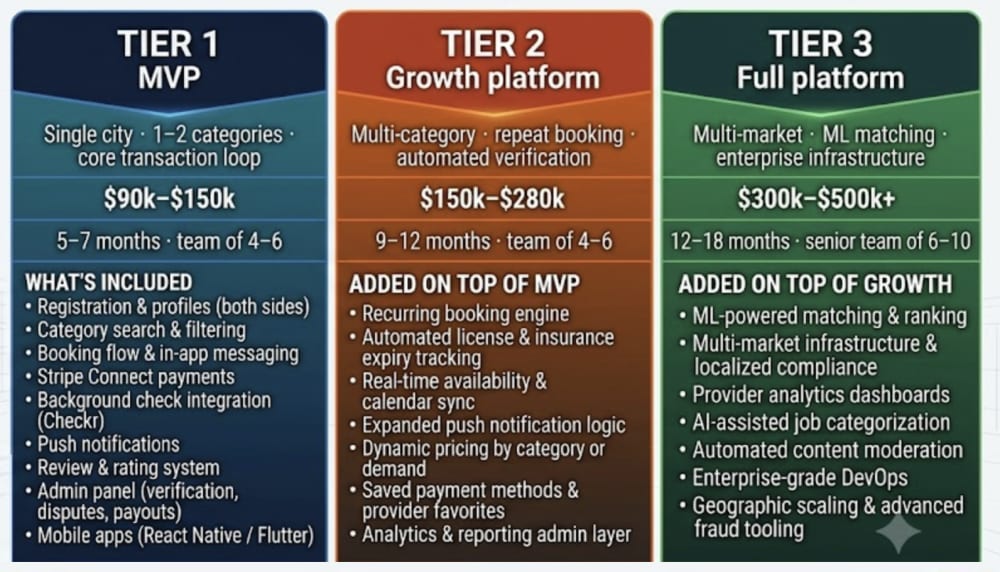
Tier 1: MVP — Single city, one or two service categories, core transaction loop
This is the version you use to validate demand, onboard your first hundred providers, and find out whether your matching model works in practice. It covers all three panels - homeowner app, provider app, and admin dashboard, built to production quality, not prototype quality. The budget covers a skill-based matching engine, background check integration, and multi-party payments. It also includes cross-platform mobile apps for both the homeowner and provider sides, built in React Native or Flutter. Mobile is not optional in this category - a home services platform without a native mobile experience isn't competing.
What's included: registration and profiles on both sides, category search and filtering, booking flow, in-app messaging, Stripe Connect payments, basic background check integration via Checkr, push notifications, review and rating system, and an admin panel covering provider verification, dispute handling, payout management and mobile apps for both homeowner and provider sides.
What's deferred: real-time GPS tracking, recurring bookings, insurance validation automation, advanced matching logic, and anything requiring ML.
Timeline: 5–7 months with a team of 4–6.
Cost range with an Eastern European or Latin American team: $90,000–$150,000
Tier 2: Growth platform - Multi-category, repeat booking, automated verification
This is what the MVP becomes once you've validated the model and need to compete seriously. The matching logic gets smarter, the provider onboarding becomes more automated, and the homeowner experience gets the features that drive retention: recurring bookings, saved payment methods, provider favorites, and real-time job status.
What's added: recurring booking engine, automated license and insurance expiry tracking, real-time availability and calendar sync, expanded push notification logic, dynamic pricing by category or demand, and a more robust admin layer with analytics and reporting.
Timeline: 9-12 months with a team of 4–6 (4–5 months of additional development on top of the MVP).
Cost range: $150,000–$280,000 total
Tier 3: Full platform - Multi-market, ML matching, enterprise-grade infrastructure
This is where you're competing with TaskRabbit directly. Enterprise platforms with AI matching and multi-city support require a fundamentally different infrastructure investment - geographic scaling, localized compliance, advanced fraud tooling, and a matching algorithm that improves with data over time.
What's added: ML-powered matching and ranking, multi-market infrastructure with localized tax
and compliance handling, provider analytics dashboards, visual search or AI-assisted job categorization, automated content moderation, and enterprise-grade DevOps.
Timeline: 12–18 months from scratch with a senior team of 6–10.
Cost range: $300,000–$500,000+
The Bottom Line
Building a home services app is a major undertaking, but the cost isn’t fixed -it’s shaped by your early strategic choices: the matching model, launch scope, mobile priority, and team location. And TaskRabbit's moat isn't its app. It's a decade of data, geographic liquidity in hundreds of markets, an IKEA partnership that generates pre-qualified bookings at scale, and AI integrations that other players like Thumbtack are only now beginning to build. None of that is replicable at launch, and none of it should be in your MVP scope. The right MVP strategy is the opposite: launch in one city, one or two categories, and build density before expanding. You don’t need to beat TaskRabbit everywhere on day one. A platform with 200 active providers in one market is more valuable than one with 20 across ten markets. A well-scoped MVP focuses on one thing: making the core transaction loop work reliably enough that real users book real jobs and come back to do it again.