So, the question is no longer "serverless or containers?" but "where does each one fit best?"
This article explains the hybrid reality: why it emerged, what it looks like in practice, where serverless actually shines, where containers make more sense, and how engineering teams build hybrid architectures that scale with their products.
What Serverless Actually Means in 2026
Serverless, also referred to as FaaS (Function as a Service), has never meant "no servers." It means someone else's servers, with the underlying infrastructure managed by the cloud provider. AWS Lambda is the canonical example. Google Cloud Functions, Azure Functions, and Cloudflare Workers are the main alternatives.
You write a function, deploy it, and the platform handles provisioning, scaling, availability, server maintenance, and operating system updates, while you focus on writing and deploying the app code. The model is event-driven by design: an HTTP request arrives, a message drops into a queue, a file lands in storage - the function fires, executes, and disappears. You pay primarily for actual usage rather than for keeping infrastructure running all the time.
For instance, an image-processing function can remain dormant until a user uploads a photo, at which point it wakes up, executes quickly, and shuts down again. Other common serverless workloads include sending onboarding emails, processing payment webhooks, generating PDFs or invoices, transforming uploaded files, and running scheduled background jobs. None of these tasks requires a continuously running service. They are triggered by events and finish quickly, which makes them a natural fit for serverless.
This approach can be highly cost-efficient for workloads with unpredictable traffic because you avoid paying for idle time. For a startup that needs to move fast, launch as quickly as possible, and keep burn low, that matters enormously.
The biggest advantage of serverless is operational simplicity. No server provisioning. No capacity planning. No patch management. A two-person team can deploy a production API in a day without a dedicated DevOps engineer.
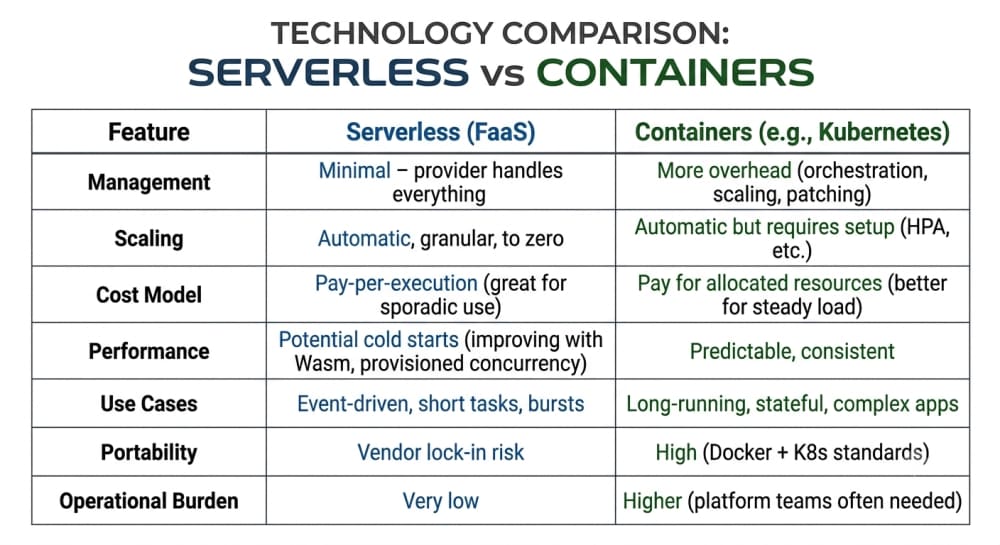
Of course, serverless architecture involves trade-offs. Instant scalability comes at the cost of platform limitations - execution time limits, statelessness by default, limited runtime control, and cost structures that favor sporadic over sustained traffic.
Specifically, functions typically have strict execution time limits (e.g., a few minutes) and memory constraints. Long-running tasks or applications with consistently high loads may prove inefficient. Next, "cold starts" - the latency experienced during the initial invocation of a function, can cause slight delays. For latency-sensitive apps where every millisecond matters, such delays can be significant.
The high level of infrastructure abstraction also comes with reduced control. For example, you cannot control exactly how functions scale or where exactly they execute. You do not have a persistent server, you cannot use a local file system, and code execution can be interrupted.
If you have millions of function invocations per day, it can end up costing more than renting a couple of servers or containers.
Another nuance is dependency on the cloud provider. Each cloud provider has its own implementation, configuration model, and integrated services. The more an application depends on provider-specific features, the harder migration becomes.
Some of these tradeoffs have softened. For instance, provisioned concurrency and pre-warming have reduced cold starts. But the architectural constraints around state, long-running processes, and runtime control remain.
These trade-offs don't make serverless better or worse than containers - they simply make it a better fit for certain types of workloads.
Serverless is a better fit when
Traffic is unpredictable or sporadic
Serverless is particularly effective for workloads with bursty or intermittent traffic. A service may receive ten requests one minute and ten thousand the next, yet there is no need to provision additional infrastructure in advance. The platform automatically scales to meet demand and scales back down when the traffic subsides. The same principle applies to infrequent workloads. A scheduled task that runs once a day, or a document conversion service triggered only when users upload files, doesn't justify running containers around the clock. With serverless, you pay only for the compute time actually consumed rather than keeping idle infrastructure online between events.
Your team is small, and DevOps capacity is limited
Serverless removes the operational surface area. No cluster to manage, no nodes to patch, no deployment pipelines to maintain beyond the function deployment itself. For a team of two or three engineers, that removal of overhead is a genuine productivity multiplier. Developers can focus on building application logic while the cloud provider handles infrastructure management and scaling behind the scenes. This simplicity is particularly valuable for startups, small engineering teams, and new product initiatives where infrastructure expertise is limited, and shipping features quickly is more important than fine-grained control over the runtime environment.
The workload is event-driven, stateless, and with a short execution time
Serverless is designed for discrete units of work rather than continuously running services. If a task naturally starts, completes within seconds or minutes, and doesn't rely on persistent in-memory state or long-lived connections, the serverless execution model is usually an excellent fit. Most of such functions finish well within platform execution limits while benefiting from automatic scaling and pay-per-use pricing. For instance, Lambda's 15-minute limit covers the vast majority of discrete computational tasks.
You are validating an early-stage product
When teams are still validating a product, serverless allows them to avoid committing to infrastructure before demand patterns are clear. Cloud costs scale in proportion to the product's success rather than running ahead of it. This is critical for an early-stage startup: there is no need to maintain a cluster that would otherwise sit idle for the first few months.
What Containers Actually Mean in 2026
A container packages an application and all its dependencies, including the runtime, libraries, and configuration, into a single portable unit. It runs consistently across different environments: a developer's local machine, a CI/CD pipeline, or a production environment. Docker made containers mainstream by simplifying application packaging and deployment. Kubernetes has become one of the dominant platforms for managing containers at scale.
Unlike serverless functions, containers give teams much greater control over how applications run. They are designed for workloads that need continuous availability, predictable performance, persistent processes, or a customized runtime environment.
Consider a customer-facing app with millions of users. Its API, authentication service, search engine, and recommendation system need to remain available at all times, maintain consistent response times, and handle ongoing traffic. These workloads are not triggered by individual events and then shut down. They are continuously running services, which makes containers a natural fit.
Kubernetes has become the dominant platform for managing containers at scale. The CNCF 2025 Annual Cloud Native Survey highlights how established this ecosystem has become: 82% of container users now run Kubernetes in production, up from 66% in 2023. It is no longer an emerging approach but a core part of modern cloud infrastructure.
The main advantage of containers is control. Teams can define the runtime environment, manage dependencies, allocate compute resources, configure networking, and choose how applications are deployed and updated. This flexibility becomes increasingly valuable as systems grow more complex.
The rise of AI workloads has further strengthened the role of containers. Machine learning systems often require GPU access, specialized libraries, long-running processes, and predictable compute resources. Model training, inference services, vector databases, and AI pipelines typically need a level of runtime flexibility that traditional serverless functions do not provide. Gartner predicts that by 2027, more than 75% of all AI/ML deployments will use container technology as the underlying compute environment, which is a major increase from fewer than 50% in 2024.
Cost is another important difference between containers and serverless. While serverless pricing is tied directly to individual executions, containers usually involve paying for allocated infrastructure that remains available regardless of whether the workload is using its full capacity. This model provides cost predictability and can become highly efficient when workloads run consistently at scale.
The main tradeoff is that control comes with operational responsibility. Running containers requires managing infrastructure, deployments, monitoring, security updates, and resource utilization. Kubernetes automates many of these processes, but it also introduces additional complexity through cluster management, configuration, networking, and operational tooling.
Besides, a Kubernetes cluster consumes resources continuously, whether it is sitting idle or operating at full capacity. While costs are predictable and fixed over time, they require smart node sizing, proper autoscaler configuration, and constant monitoring of utilization. The more consistently your infrastructure is used, the lower the cost per request becomes, but during idle periods, you are essentially paying for "air."
Containers are the better fit when
The workload is long-running or stateful
Standard serverless functions have a strict execution time limit, typically up to fifteen minutes. It makes FaaS unsuitable for batch processing large volumes of data, video transcoding, data pipelines involving long-running SQL queries, or machine learning model training. Kubernetes imposes no such limitations; the cluster readily handles long-running tasks.
Traffic is sustained and predictable at high volume
At consistent high throughput, a Kubernetes cluster with reserved nodes is significantly more cost-effective than FaaS per-invocation billing. The crossover point varies by workload, but the industry consensus suggests that at a volume of tens of millions of requests per month, container platforms are almost always the more economical choice.
You have latency-sensitive functions
"Cold start" refers to the latency experienced during the initial invocation of a function; this can range from hundreds of milliseconds for lightweight runtimes to several seconds for Java or .NET environments lacking specific optimizations. For many apps, this delay is negligible, but for latency-sensitive systems, such as trading platforms or interactive applications, consistent response times matter. Teams can reduce cold starts with techniques like provisioned concurrency, which keeps a pool of function instances pre-initialized and ready to handle requests. But this adds cost and reduces some of the simplicity that makes serverless attractive. For latency-sensitive workloads, containers typically provide more consistent response times because application instances remain running and ready to serve requests.
Runtime control matters
Serverless gives you less control over the underlying runtime environment. Containers allow teams to define the operating environment more precisely, including runtime versions, dependencies, networking configuration, GPU access, and supporting services. If you need control over how your code executes at the system level, deep customization, strict isolation, or detailed operational visibility, containers are the better path. In regulated industries or security-sensitive environments, containers also provide superior control through custom security policies, runtime attestation, network isolation, and compliance tooling that serverless platforms often restrict.
Choosing containers does not mean abandoning serverless. Many organizations run core application services in containers while continuing to use serverless for event-driven tasks such as notifications, file processing, and scheduled jobs.
The middle layer: serverless containers
Between serverless functions and traditional container platforms, a middle ground has also emerged. Managed container platforms such as AWS Fargate and Google Cloud Run allow teams to package their entire apps into a Docker container and run them with custom runtimes, dependencies, and long-running processes, with the cloud provider managing the underlying infrastructure, scaling, and container orchestration for them. In this way, you get much of the flexibility of containers without the operational overhead of managing servers or Kubernetes clusters.
This is the right default for teams that need more than a Lambda function, along with more control but are not yet ready for the operational overhead of Kubernetes. This approach provides more flexibility while preserving much of the operational simplicity associated with serverless.
Cloud Run, in particular, has a scale-to-zero capability that eliminates idle compute cost - useful for workloads that have extended quiet periods but need container-level control when they run. For teams migrating from serverless toward containers, it is the lowest-friction first step.
Building for Evolvability
The best hybrid architectures are not designed to be permanent. They are designed to be easy to change.
A service that starts as a Lambda function should be structured so that migrating it to a container later is a small lift, not a rewrite. That means avoiding deep dependence on Lambda-specific features and separating the application logic from the cloud platform layer. The part of the application that solves the actual business problem should remain independent, while the Lambda-specific code only handles communication with the platform, such as receiving events and triggering the function.
Similarly, a Kubernetes service that needs to scale to zero during off-peak periods should be considered a candidate for migration to managed container platforms. The application itself does not need to be rewritten - the same container package can be deployed to a different platform. The main change is that Cloud Run takes over infrastructure management, scaling, and server provisioning instead of Kubernetes. If the application does not rely on Kubernetes-specific features, this transition can be relatively straightforward.
The architectural goal is workload portability - components that can move between compute models when utilization patterns, team capacity, and cost structures evolve, without rewriting the app. It is harder to achieve than it sounds, because it requires deliberate decoupling at the point where the application code touches the infrastructure. But it is the difference between a hybrid architecture that stays manageable over three years and one that calcifies into something nobody wants to touch.
The Practical Starting Point
If you are building a new system and deciding how to structure the hybrid architecture, start with the simplest configuration and add complexity only when a specific constraint demands it.
Default to serverless for anything new that is stateless, event-driven, and low-volume. Lambda or Cloud Functions for webhooks, async jobs, scheduled tasks, and lightweight API endpoints. There is no infrastructure to provision, no cluster to manage, and no deployment pipeline to set up beyond the function deployment itself.
Add serverless containers when you hit the first real constraint - a job that runs longer than 15 minutes, a service that needs a custom runtime, a workload that needs to scale to zero but can't be a stateless function. Cloud Run is usually the right call here. One Dockerfile, no cluster management.
Graduate to Kubernetes when orchestration complexity justifies it: multiple teams deploying to the same cluster, complex inter-service traffic routing, stateful workloads with specific resource requirements, GPU scheduling for ML inference. That graduation should be driven by a specific need, not a technology preference.
The default is simple. The migrations have clear triggers. The architecture evolves with the team and the product rather than being designed for a future state that may never arrive.
The Bottom Line
The serverless vs. containers debate assumes you have to pick. The production reality says otherwise: many engineering teams now run both, because the workloads inside a real system have genuinely different characteristics that each model handles better. The strongest engineering teams treat compute choice as an ongoing architectural decision rather than a one-time commitment. They evaluate services based on workload characteristics, team capacity, traffic patterns, cost efficiency, and compliance requirements and then choose the execution model that fits best. As systems evolve, the right choice may change. Traffic grows, teams scale, and new requirements emerge. Mature teams adapt their architecture deliberately instead of staying locked into an initial decision because of a habit.


