Below, we’ll break down how Lovable and v0 perform in practice, their key features, engineering limitations, and practical use cases, helping teams decide which tool fits their workflow, product stage, and development style.
Overview of Lovable
Best Use Case: MVPs without code

Lovable positions itself as a "superhuman full-stack engineer," generating complete web apps from conversational prompts. It focuses on the complete development cycle with a strong emphasis on user-friendliness. It generates frontend (React/TypeScript) from ready-made UI pieces, sets up a basic backend (often Supabase) for databases/auth, and manages hosting. No local installs, no repo headaches, everything runs inside the browser.
In 2026, it boasts GitHub sync for version control, advanced modes like Agent Mode for autonomous development, Plan Mode for iterative debugging, and Visual Edits for point-and-click UI tweaks, reducing iteration time significantly. It integrates with tools like Stripe for payments, Clerk for advanced auth, Shopify for e-commerce basics, and various APIs.
Lovable is suitable for designers, product managers, and non-technical founders who want to quickly create high-quality interactive interfaces without having to manually code every detail. Users often note that it's the fastest way to create demo concepts for stakeholders, especially when the focus is on design rather than complex backend logic.
Its features include
Chat-based interface: Lovable uses an intuitive chat interface that mimics working with an experienced developer. It is optimized for ease of use and lowers technical barriers for designers and product managers, allowing them to create interactive and beautiful prototypes without extensive programming knowledge. Built-in Agent mode lets Lovable implement and verify changes directly into a project, handling execution end-to-end with minimal supervision.
It also allows making immediate changes based on user instructions, which is critical for maintaining a rapid development cycle.
Plan mode: From Agent mode active by default, Lovable allows switching to Plan mode (former Chat Mode). It is essentially a “thinking before doing” approach. Instead of immediately applying changes, Lovable creates a structured plan outlining the steps it will take to implement a feature or fix a bug. You can review and refine this plan before any code is touched, which helps prevent mistakes or unexpected AI behavior. Iterative debugging happens naturally: you approve the plan, let Lovable execute it, then repeat the process until the app works as intended. It makes development safer and more predictable.
Visual editing mode: In addition to generating interfaces via chat, Lovable offers a Visual Edit function that allows users to directly interact with layouts and styles for refinement rather than introducing text commands, which is especially appealing to designers. It eliminates the need for manual code editing. Users can tweak it directly like Figma - no prompts, no credits used for most changes, which is more convenient for those who prefer drag-and-drop interaction over coding. This extra layer of control helps reduce debugging time caused by AI "hallucinations" or unexpected functionalities.
Code Mode: While Lovable started more "prompt/visual-only" focused (and many non-technical users still build entirely that way), paid plans now give access to Code Mode where users can edit the code directly inside the browser if they want or need to. It's meant for targeted fixes or advanced tweaks without leaving Lovable (no need to export first). While most non-tech users never touch it, semi-technical ones enjoy it for quick adjustments that Visual Edits can't handle perfectly.
Supabase integration: For basic backend functionality, Lovable supports integrations, particularly with Supabase, for tasks such as user authentication, database integration, and data management. Thanks to these integrations, Lovable goes beyond just frontend generation, offering something akin to full-stack functionality that allows prototypes to work with simple server-side logic. This is especially attractive for startups and small teams that need to demonstrate a working prototype without a dedicated development team.
Lovable Limitations
Despite its high accessibility, Lovable also has its challenges:
Scaling and production readiness: Despite its speed in generating frontend prototypes and basic full-stack features (likeSupabase logins, databases, and Stripe payments), finalizing the app for real use can sometimes hit delays, especially when more advanced logic is required. AI might get most of it right, but small bugs, unexpected behaviors, or mismatched pieces sometimes appear. Fixing them means going back and forth with more prompts, which takes extra time and credits. Lovable is the better fit when the priority is clarity and speed rather than complex production apps.
Overly complex code for simple tasks: Although the tool is very effective on the frontend, it sometimes generates overly complex code for simple tasks. This complexity increases the workload for developers, who have to refactor or simplify the generated code.
Occasional AI hallucinations: Like many generative AI tools, Lovable can sometimes add features or capabilities that were not explicitly requested, break things while "fixing" others, or introduce new bugs. It often results in wasted credits and time and requires subsequent manual correction. Good prompting helps, but it's not foolproof.
Credit Limits and unpredictable costs: Every action - chatting, generating code, fixing bugs, using Agent Mode for autonomous work costs credits. It’s not easy to predict exact costs for bigger apps. For instance, Agent Mode can use more than 1 credit per action, so usage isn't always transparent upfront, and many users say they "burn through" plans faster than expected. The free plan is particularly limited in terms of daily or monthly message limits. For continuous and rapid prototyping, these limitations can slow down the creative process, forcing users to frequently switch to paid plans.
Deployment and code export: Lovable has one-click publish to its own hosting (lovable.app subdomain or custom domain on paid plans). Exporting the app or moving it to a fully custom infrastructure requires extra work. While the code can be exported, backend assumptions and proprietary integrations make production reuse challenging, as the underlying foundation can hardly be controlled. So, it is best suited to staying inside its ecosystem for MVPs rather than for engineering flexibility.
Lovable Pricing
Lovable's pricing structure is tiered. The free plan is enough for testing ideas, which is why Lovable tends to attract non-technical founders who just want to shape app layouts fast without thinking about code or cloud resources. The pricing in paid plans is built around “shared credits,” which makes it really friendly for teams that want to experiment or build simple prototypes together. You don’t pay per seat, which keeps things affordable if you're working with multiple collaborators or want to keep a small team inside the same workspace.
Free Tier: Provides 5 credits per day with a total limit of 30 credits per month. Ideal for light
prototyping on an experimental basis.
Pro Plan: Starts at $25 for 100 credits/month shared across unlimited users. It unlocks private projects, custom domains, user roles and permissions, and the ability to remove the “Lovable” badge from deployed apps.
Business Plan: Starts at $50 for 100 credits/month shared across unlimited users. It builds on Pro with organization-level features such as SSO, enhanced workspace controls, and design templates to speed up internal builds.
For larger organizations, Lovable also offers a custom Enterprise plan with dedicated support, higher usage limits, and tailored security and compliance options.
Conclusion
Lovable shines when speed, simplicity, and non-technical accessibility are the priorities. It delivers visually appealing, interactive MVPs quickly, but its flexibility and code control are limited. While it feels like no-code at first, it quickly transitions into low-code and eventually full-code for more sophisticated applications.
Overview of V0 by Vercel
Best use case: React UI for production apps
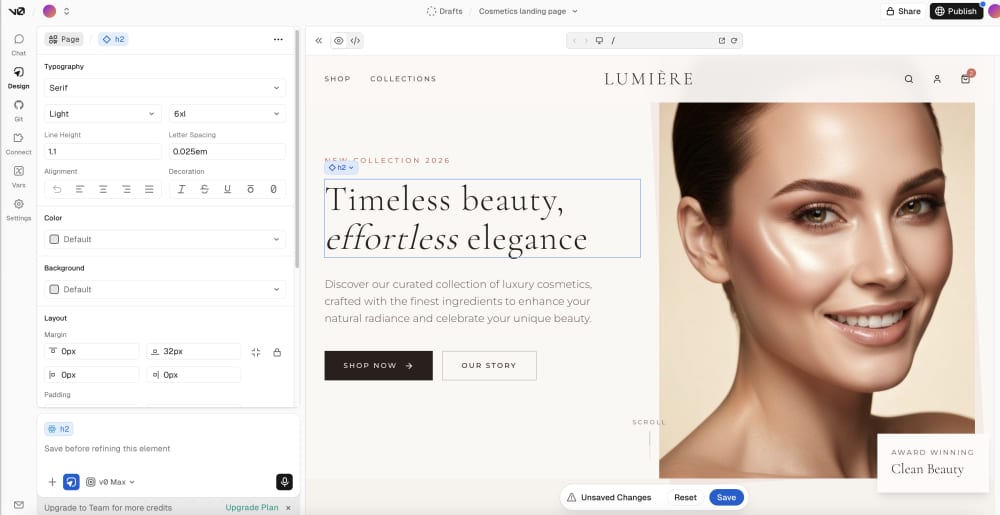
v0 is an AI-driven prototyping platform developed by Vercel, a company known for its innovations in the field of Next.js and seamless web deployments. It started in 2024 as a fast generator for React components using Tailwind CSS and shadcn/ui patterns from simple text prompts or imported images/Figma designs. By early 2026, with the major "new v0" update as of February 3, it has evolved into a full-production tool for building and shipping real apps and agents, not just prototypes.
The February 2026 release rebuilt v0 from the ground up to close the "prototype-to-production" gap: it now imports existing GitHub repos, pulls in your environment variables/configs automatically, runs previews in a sandbox that matches real Vercel deploys, and supports secure backend integrations. It makes it ideal for developers and teams who want clean, extensible code they can ship quickly without weeks of rewrites.
V0 integrates deeply with GitHub (import repos, push changes, PRs, branching) and the Vercel Marketplace for databases (Supabase, Neon, AWS, Snowflake), auth (via Clerk), payments (via Stripe), and more. Deployment is one-click to Vercel's infrastructure - fast previews, global CDN, automatic HTTPS, and production protections. The interface is developer-oriented: side-by-side code previews, a full VS Code-style editor (built in on the new version), and natural language prompts that generate production-grade React/Next.js code.
V0 is designed to provide a high level of automation in creating frontend interfaces and full apps in the React/Next.js. It is a powerful tool for rapid UI prototyping, especially for designers and developers who need fast frontend iterations without rewriting code. The generated code is clean and well-structured, minimizing the need for manual modifications, although minor adjustments may be required to meet branding requirements.
Its features include
Natural Language Code Generation: Users can create modern React components using Tailwind CSS and shadcn/ui elements by entering commands in natural language, resulting in ready-to-use interfaces generated in a matter of seconds. This speed is especially useful during hackathons, when creating quick demos for presentations to stakeholders or launching customer-facing sites. And while both v0 and Lovable use natural-language chat, Lovable treats chat as the primary way to build and evolve an app, while v0 treats chat as a faster way to write and connect code.
Figma Integration: Users can import designs from Figma directly into v0 to use them as a starting point for generating user interfaces. v0 now recognizes the exact colors and design tokens used in Figma files when importing designs. Integration with Figma is especially useful for teams that actively use graphic layouts. Users can move directly from visual design to code with minimal effort, which benefits both designers and developers during project handover and accelerates development
Adaptive Layouts and Design Mode: Interfaces generated by v0 behave like real application UIs rather than static mockups. Layouts automatically adapt to different screen sizes, interactive elements, and even animations, work out of the box, and common states like loading, empty, and error views are included by default. It allows for immediate testing of interfaces in real-world conditions without significant additional refinement. In a design mode, users can visually tweak spacing, colors, and structure, without rewriting code, making early refinement fast and practical. While Lovable also generates responsive layouts that adapt across screen sizes, it focuses more on speed and visual completeness rather than detailed handling of interface states.
Backend Support: v0 is UI-first with strong full-stack evolution in 2026. Vercel's February update added a sandbox runtime, where previews execute real server-side code, along with direct connections to databases and APIs via Vercel Marketplace. Unlike Lovable, v0 does not automatically generate a complete backend by default. Instead, backend functionality is assembled through prompts and explicit integrations with external services. v0 treats the backend as real infrastructure: visible code, external services, and long-term ownership. In other words, v0 helps you build a backend, while Lovable helps you have a backend.
Deployment Integration: One of the key advantages is the integration of v0.dev with Vercel. Anything you generate in v0 can be deployed almost instantly to a live, server-backed environment with a single click. There’s no manual setup of servers, build scripts, or environments - v0 handles the handoff from generated code to a running app automatically. Unlike Lovable’s managed hosting, Vercel is a real hosting provider that runs the code on actual server-side infrastructure, including APIs, serverless functions, and database integrations, and you get full control over scaling, environment variables, routing, and performance.
Limitations of V0
Despite its power and efficiency, v0.dev has several limitations:
React/Next.js Focus: In 2026, v0 generates full React/Next.js pages, API routes, server actions, and app structures (not just isolated components). You can import entire repos, build agentic workflows, and deploy full apps. However, it's still React/Next.js-only (no native Vue, Svelte, Angular, etc. - outputs are opinionated toward Vercel's stack). If your stack uses Vue, Svelte, Angular, or another framework, it's not a great fit as outputs won't integrate easily.
Learning Curve: Although v0.dev is designed to be accessible to users without technical experience, it often requires at least a basic understanding of programming and design principles and the ability to read/modify real React code. It ensures easy integration of the generated code into existing codebases.
Dependence on the Vercel Ecosystem: One-click deployment is tightly integrated with Vercel, and while this integration offers many benefits, it can lead to vendor lock-in. Code is exportable via GitHub (full ownership), but losing Vercel's infra/performance/security means extra work. Organizations seeking more platform-agnostic solutions may find it difficult to switch from Vercel to another platform if needed.
Customization Requirements: Despite the cleanliness of the generated code, there are instances where the output requires significant refinement to match specific brand guidelines or unique interaction patterns. Developers may need to manually add event handlers, state management, or custom styles.
Full-Stack Not Fully Native: V0 is UI-first with strong agentic/full-app support now (connects databases/APIs securely, generates API routes), but backend logic/databases rely on integrations (Marketplace tools like Supabase/Neon). For deep custom server-side needs, you may still handle some setup or refinements yourself - it's not as "prompt-to-complete-backend" as some competitors.
V0 pricing
v0 follows a usage-based system, which is common in developer tools - the more you generate, the more you pay. For experienced builders, this model feels natural: you only pay for what you use. However, the per-user pricing in the Team plan can get expensive if you’re working with multiple collaborators, especially compared to Lovable’s shared-credit structure.
Free Tier: Users receive 7 messages per day, providing basic prototyping capabilities, ideal for initial exploration.
Premium Plan: Priced at $20 per month, this plan increases the number of messages. It also offers higher attachment size limits and the ability to import designs from Figma.
Team Plan: Priced at $30 per user per month, this plan is designed for collaboration, offering features such as centralized billing and team interaction.
Business plan: This plan has the same credit structure as Team ($30/user + daily credits), but adds privacy options and fits teams that want more control.
There is also an Enterprise customized plan similar to the one from Lovable that offer dedicated support for large organizations requiring extensive customization and higher usage limits.
Conclusion
If you think in components and want control over your UI, v0 will feel more natural, particularly powerful for teams already in the Next.js/Vercel world. It produces better code, integrates into real dev workflows, and is easier to maintain long-term if you’re building a more serious product. But while it feels accessible through prompting and visual tweaks at first, it quickly transitions into requiring real coding knowledge and ecosystem decisions.
Bottom Line
Lovable and v0 operate at different ends of the spectrum, one designed to get beginners moving quickly through conversation-driven creation, and the other built for developers who want high-quality, production-grade code. On the surface, they both feel like magic, but they are not magic for the same type of person. If you are a non-technical founder, Lovable can feel like finally having a dev friend who listens to your ideas and turns them into something you can click on. If you are a developer who lives inside Next.js and Tailwind, v0 feels like a super-fast frontend partner that writes the boring parts for you so you can focus on the core aspects of your product. V0 wins for developer handoff and polished UIs, while Lovable surpasses it in the speed of creating fully functional applications and non-technical workflows. The best way to know which one clicks for you? Spend 15 minutes in each free tier with the same small idea - the difference usually becomes obvious fast.
Both get you to a working screen quickly; neither answers what happens at the second month, when the generated code needs a team that can read it. That handover is the part our React developers are usually called in for.