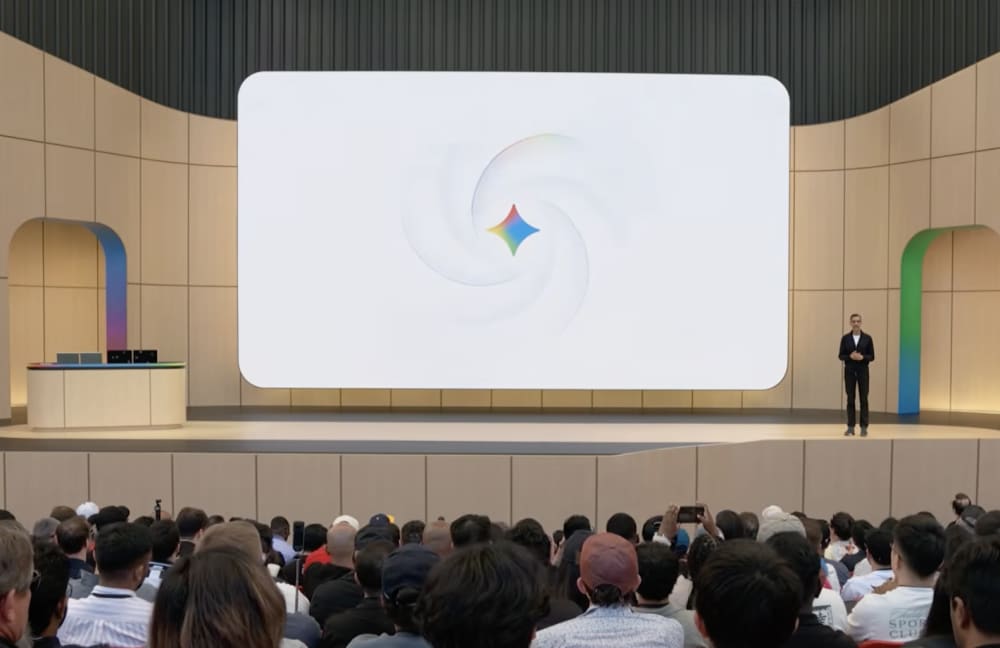
This week, Google held its latest I/O 2026 conference. Their annual major presentation traditionally focuses on artificial intelligence, and this year’s event was no exception: new Gemini models, agents that perform tasks on behalf of the user, and deep integration of AI into search, shopping, and creative tools.
Here is the breakdown of the biggest announcements from Google I/O 2026, what they reveal about Google's broader AI ambitions, and what these changes could mean for the future of the industry.
Gemini 3.5 Flash
The conference's key technical announcement is Google’s new foundational family of models - Gemini 3.5, built upon a new approach: combining cutting-edge AI with the speed required for real-time agentic tasks.
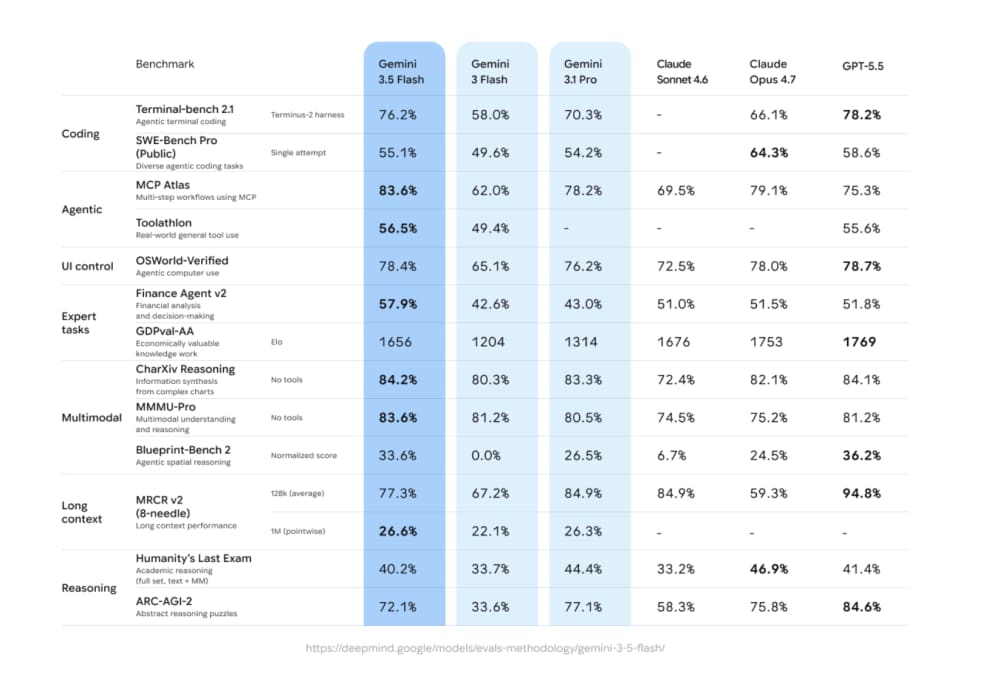
Gemini 3.5 Flash is the first released model. Google claims that this model outperforms Gemini 3.1 Pro on coding tasks and agentic benchmarks while running four times faster than competing models, with a price point often half as high.
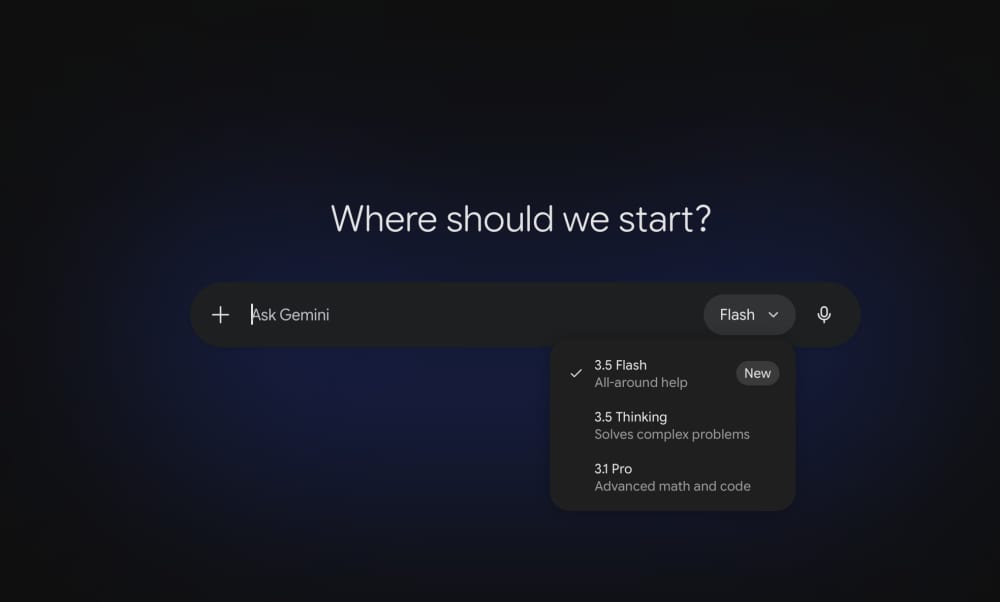
It is already available via the Gemini app for Android and iOS, and AI Mode in Google Search to everyone at no cost. Developers are invited to work with Flash 3.5 in Antigravity and the Gemini API through Google AI Studio and Android Studio. It is also available within Gemini Enterprise
products.
Google also announced during the event that the model has the potential to reduce enterprise AI costs by "more than $1 billion per year." Of course, it’s Google's own marketing, not an independent assessment. But even if we apply a heavy discount to that figure for realism, it still marks a significant shift. When a baseline model - one performing "better than Gemini 3.1 Pro"- becomes available completely free to everyone through the Gemini app, it undermines the core logic of Anthropic and OpenAI's charging $20/month for access to their top-tier models.
By releasing Gemini 3.5 Flash for free to everyone, Google is effectively forcing a price reduction across the industry through massive distribution. A segment of users who previously required a paid subscription to ensure high quality can now be fully served by Gemini's free version. It doesn't make Claude or GPT obsolete for complex tasks; rather, it lures less demanding paid users away from Google's competitors. Soon, we will be able to see how Anthropic and OpenAI respond - whether by lowering prices, expanding their free tiers, or introducing entirely new pricing models.
Gemini Omni
Google also presented Gemini Omni - a multimodal model for generating video. Billed as the "successor to Veo 3," it's architecturally more versatile - it can accept any input (text, images, audio, and video) and produce video anchored in the real world.
While marketed as a major step forward, Omni appears to be more of an evolutionary improvement over Veo 3. Sora 2, Veo 3, Runway Gen-3, and Pika 1.5 already support various multimodal workflows, including generating or editing video from combinations of text, images, and other media. Omni’s main contribution is its more unified approach and video editing via conversational dialogue. For example, you can shoot a simple video without editing and ask the AI to add the necessary graphics. Each request builds on the previous one: the physics, characters, narrative, and overall consistency remain intact, so the model doesn’t have to generate the entire video from scratch.
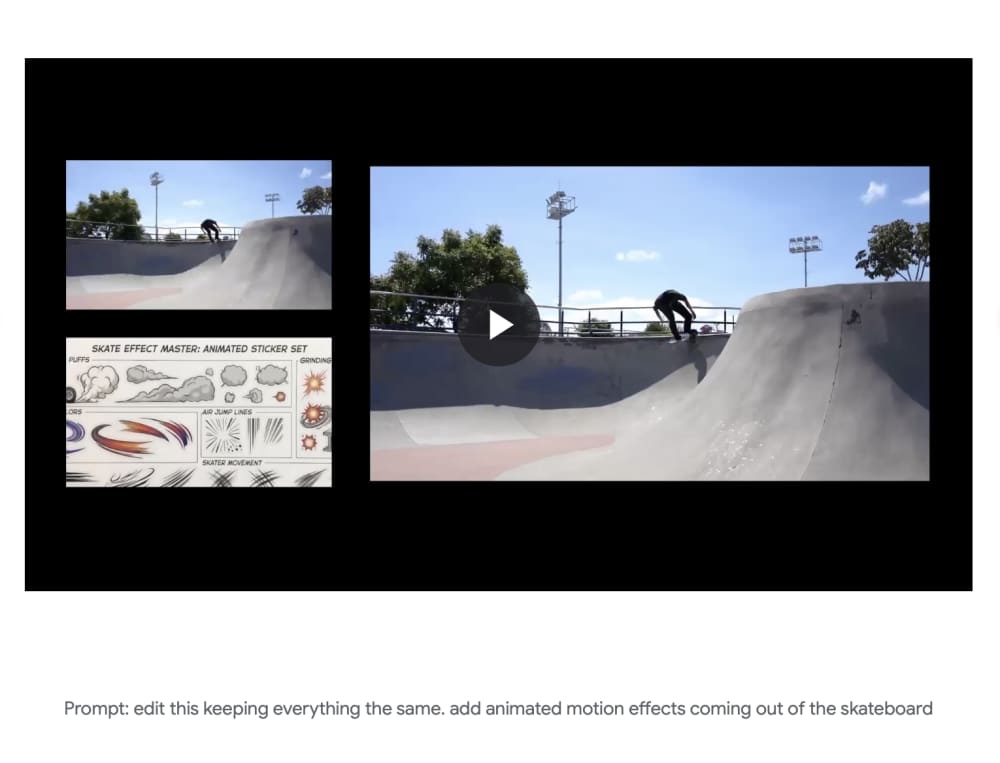
Omni Flash is being rolled out in stages starting from its launch, as is typical for Google. It’s worth noting that while AI adoption is high overall, dedicated video generation still sees relatively limited use outside of marketing teams. It is primarily used by marketers for short social media and advertising content. Omni is unlikely to dramatically move the needle at launch, but quality improvements could change this significantly in a year or so.
Gemini Spark
The main news for the consumer segment is Gemini Spark - a personal AI agent in the Gemini app. Google announced it with the phrase "Yes, you can close your laptop". It directly addresses the common frustration (often joked about in memes) of having to keep your laptop open 24/7 just to keep agents running.
Google offered a solution that is neither local software nor a browser extension, but a full-fledged, stateful backend agent that continues to operate 24/7 on dedicated Google Cloud virtual machines, even when a user's laptop is closed, or their phone is in Do Not Disturb mode. It can connect to Google Workspace apps, including Docs, Gmail, Sheets, and Slides, as well as to third-party apps such as Canva and Instacart. This summer, Google plans to greatly expand third-party compatibility through the MCP (Model Context Protocol), allowing Spark to connect to a much wider range of services and truly operate beyond the Google ecosystem.
Google describes it as "an active partner that performs real work on your behalf and under your direction." In a demo, Spark simultaneously created a Google Sheets planner, a letter to a new neighbor, and a to-do list document with a single voice brief - all from multiple devices in parallel.
Gemini Spark represents a fundamentally different architectural category than Claude Code, ChatGPT, or Cursor, not through a superior model, but through its runtime environment. Most existing tools depend on active sessions that die when you close the tab. In contrast, Spark offers a persistent, always-on agent with long-term memory and task scheduling. While Anthropic and OpenAI have been adding background tasks, and tools like OpenClaw fill this space in the open-source world, Spark takes a top-down approach: it’s essentially a virtual machine hosting a proactive agent that’s accessible from any device. This is a meaningful shift. Anthropic and OpenAI are selling an enhanced feature inside their subscriptions. Google is using its massive Google Cloud infrastructure to sell the underlying platform.
Spark is rolling out gradually. Trusted testers gain access this week. A beta version will be available to Google AI Ultra subscribers in the US starting next week ($200/month following announced reduction from $250). In the coming months, once Spark exits its beta phase in the US, and the first real-world use cases emerge, business users may stop asking “Claude or Gemini?” and start asking: “Should I rent a persistent agent on Google Cloud, or stick with a subscription that has usage limits?” These options entail different cost structures, different operational speeds, and different levels of vendor dependency.
The primary concern now is privacy. A continuously running agent with access to email, calendars, and documents constitutes a massive attack surface. Google presented neither a security architecture nor details regarding data encryption at rest, nor a model for access control among sub-agents. All of this was glossed over on stage, and it will need to be addressed in a separate discussion once the feature rolls out to users.
Biggest Update to Search in History
Another application of Gemini 3.5 Flash is within Google Search. However, the transition to this new AI model is far from the only new feature introduced in Google Search. The search engine is now more AI-driven, highly personalized, and significantly more visual. Google describes this Search update as the biggest in its 25-year history.
The search bar is now dynamic - it adapts in real time to better understand what the user actually wants. It can process not just text, but also images, videos, files, and even open Chrome tabs. Search will process not only text queries but also images, videos, files, and open Chrome tabs. Google introduces a generative interface, so if the answer to a query is best explained visually, it will generate an interactive response in the form of tables, graphs, simulations, and small applications right in the results. For complex goals like planning a wedding, moving house, or building a fitness routine, it can create a custom dashboard the user can return to later. It’s worth noting that when it comes to real-world business questions, a technology is still two to three years away from maturity - not something we can expect to see by the summer of 2026.
Next, Google has also introduced information agents in Search - the user can set up background monitoring 24/7 of any topic, including news, blogs, social media, finance, sports, and shopping, and they will generate intelligent summaries and deliver them directly to the user.
For instance, a job seeker could ask an agent to track openings that match specific skills and salary expectations, and receive alerts when suitable roles appear. Someone planning a trip could provide dates and preferences, and the agent would scan travel websites and compare options automatically. A gamer could receive notifications about new releases, limited editions, or announcements.
The main idea of this approach is that in the future, the user will search less and interact and receive more. And it means the content must become such that the agent will find and use it as relevant. But at the same time, the majority of users will not set it up correctly. Those who do, will become dependent on whatever Google decides to surface in the results. Google already has a track record of downranking organic results in favor of paid ads and its own products. So it can be useful as a morning digest but dangerous if relied on as the sole source of information.
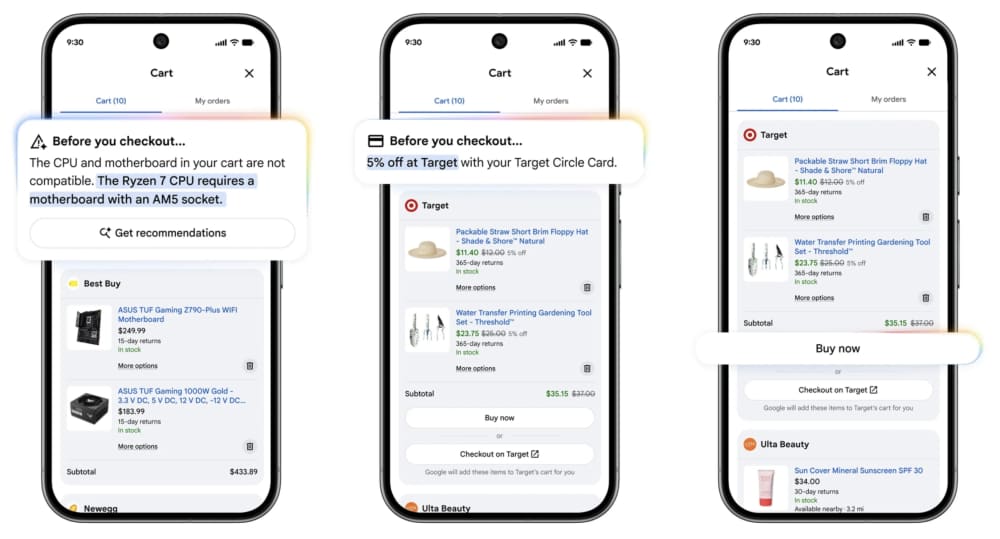
Finally, Google announced Universal Cart - specialized shopping agents that can compare prices, find discounts, check product compatibility, track price changes, and recommend items based on budget and needs. These agents are deeply integrated into Search, Gemini, YouTube, and Gmail. While it may look like another AI shopping tool, the real impact is strategic: Google is directing its massive search traffic toward its own agents. This poses a serious competitive threat to Amazon, AliExpress, Booking.com, and other e-commerce platforms.
Antigravity 2.0: a new level of development
Google has also presented Antigravity 2.0, an updated agent development platform. Antigravity was launched in 2025 as an agent-driven IDE and a direct competitor to Cursor and Claude Code. Over the past time, numerous updates have accumulated, which found their reflection in version 2.0, a complete overhaul designed for multi-agent orchestration.
It’s now a standalone desktop app and CLI for those who prefer working in the terminal, which contains no code editor UI at all. Instead of being a place where you write code with an AI helper, it is now a control center where you manage a team of AI agents who do the work for you in parallel. You can now use whatever code editor you already love (like VS Code, Cursor, or IntelliJ) while running Antigravity 2.0 on the side as your AI workforce controller. From an architectural standpoint, Google has unified its agent-coding product line: previously, Gemini Code Assist and Gemini CLI existed as separate entities; now, everything has been consolidated under the Antigravity umbrella.
Antigravity 2.0, with its CLI, SDK, and OS integration, is a formidable competitor to Cursor and Claude Code. If Google can maintain model quality on par with Anthropic, smaller players in the AI coding space will come under significant pressure. Cursor currently boasts a community, but it lacks its own model weights as well as the scale of Google Cloud.
The free tier for Antigravity has been retained, but for serious professional work, Google has introduced a new intermediate plan: AI Premium at $100/month, offering 5x the usage limits compared to the Pro tier that costs $20/month. The cost of the top-tier AI Ultra plan has been reduced from $250 to $200, bringing Google in line with the industry standard for high-end agent compute. OpenAI charges $200 for ChatGPT Pro. Anthropic charges $200 for Claude Max. This is the new standard for top-tier AI subscriptions, and it's being established at $200/month. The introduction of the new intermediate $100/month plan signals a move to capture professional developers who find standard $20/month co-pilot subscriptions (like Cursor and Claude Code) too restrictive for heavy, multi-agent background workflows.
Bottom Line
Google’s AI strategy is no longer about individual products - it’s about building one AI ecosystem across every device. The goal is simple: one AI layer, one account, one ecosystem everywhere. The bet is simple: if the same AI powers all your devices and understands your context everywhere, switching away from Google becomes much harder. The competition is no longer just about who has the best AI model; it’s about who controls the ecosystem where that AI lives. But at the same time, strong keynote demos don’t guarantee real adoption. The real test will be whether people actually buy these products, developers build for them, and the experience works as smoothly in everyday use as it does on stage.