Booking a hotel room feels trivial today. Open Booking.com, pick your dates, choose a hotel that looks good, and done. But if you are running a hotel, you know that it isn’t just reservations. There are dozens of interdependent processes, multiple departments, and back-office operations happening at the same time. To keep it all moving smoothly, and ensure guests leave happy, hotels rely on specialized hotel management software (HMS).
What is Hotel Management Software (HMS)?
At its core, HMS is the command center of your hotel. It takes hundreds of small, messy, repetitive tasks - reservations, check-ins, housekeeping, POS transactions, billing - and centralizes them. It connects departments so everyone knows what’s happening. No more chasing papers or asking staff if “room 302 was cleaned yet.” You see it, in real time, in one place.
Originally, HMS was about front-office basics: bookings, check-ins, room pricing, invoices. That alone replaced a lot of tedious, error-prone paperwork. Today? HMS goes far beyond the front desk. It’s now the backbone of hotel operations, supporting everything from revenue strategy to staff management and guest personalization.
It’s worth noting that an HMS can fit both small and large hotels, and depending on the size of businesses, software may have different functions. A complete hotel management software solution typically includes:
-
Property Management System (PMS): Handles reservations, check-ins/check-outs, room assignments, billing, and dashboards for your front desk.
-
Booking & Reservation Management: Lets guests book directly via your site or app, reducing reliance on third-party platforms.
-
Channel Manager: Syncs availability and pricing across Booking.com, Expedia, Airbnb, etc. No more double-bookings or manual updates.
-
CRM: Tracks guest preferences, loyalty programs, and communication history. Personalization is key to repeat business.
-
Revenue Management System (RMS): Dynamically adjusts pricing based on demand, seasonality, competition, and occupancy. AI-driven RMS is standard in 2026.
-
Housekeeping & Maintenance Management: Assigns tasks, tracks room status, and often comes with mobile apps so staff can update in real time.
-
Point of Sale (POS): Connects payments from restaurants, bars, spas, and gift shops directly to the guest’s account, automatically adding charges to their room bill in real time.
-
Back-Office Management: Payroll, taxes, accounting integrations, inventory control - everything that happens behind the scenes.
-
Admin Panel & Analytics: Dashboards for occupancy, Average Daily Rate, Revenue Per Available Room, revenue breakdowns, operational KPIs. Predictive analytics and AI insights are standard now.
The benefits are obvious: streamlined operations, happier guests, higher profits, and a platform that scales with your business. But here’s the hard question every hotel owner faces: off-the-shelf SaaS or custom build? Choosing between ready-made systems with monthly payments over many years and custom-built systems that require significant upfront costs can be a difficult task. And each option has its pros and cons.
Here are some of the most popular SaaS hotel management software offers on the market in 2026 - widely used by independent hotels, boutique properties, and larger hotel groups. These platforms are typically cloud‑based (SaaS), scalable, and cover key functions like PMS, channel management, booking, reporting, guest experience, and integrations:
Cloudbeds - one of the most widely adopted all‑in‑one hotel management platforms combining PMS, booking engine, channel manager, payments, and analytics in a unified system.
Mews - Modern cloud‑native PMS with strong automation, mobile capabilities, and open API integrations.
Oracle Hospitality OPERA Cloud - enterprise‑grade cloud PMS used by large hotels and chains, with deep integration and advanced operational features.
RMS Cloud – full cloud PMS with strong revenue management and scalable features.
Off-the-shelf hotel software often advertises a nice, neat monthly fee. Looks simple, predictable at first glance. But reality? Way messier. Most tools cover the basics. Want advanced features like dynamic pricing or dashboards across multiple properties? That’s extra. Per-room pricing, tiered packages, channel manager connections, booking commissions. Suddenly your “fixed” cost starts creeping up. And don’t forget integrations - linking your PMS to accounting, POS, or door locks, isn’t free.
As your hotel grows, so do these costs. Small boutique hotels can start under $200/month. Add a booking system and basic PMS? $200–500/month. Add revenue tools, keyless entry, integrations? Now you’re $800–1,500/month, or roughly $30k over three years. For large chains with enterprise setups covering full PMS, AI-driven revenue tools, and custom integrations, three-year costs can hit $500k+.
Custom hospitality software offers another route. You’re not trying to bend your hotel to fit someone else’s system - you build something that fits your workflow exactly. Off-the-shelf platforms cover the basics. They’ll get you check-ins, bookings, and billing. But what if your needs are more complex? Real-time reporting that aggregates multiple revenue streams. An inventory system that tracks restaurants, spas, and activities simultaneously. Or a reservation engine that handles split stays, fractional ownership, or unique membership rules. Standard PMS? Not built for that. Custom software? Totally possible.
Custom makes sense when your hotel does things no standard software can. Split-stay bookings, multi-currency pricing, complex group allocations, personalized CRM, automated communications, advanced booking engines, specialized housekeeping - these are all areas where custom software can give you a real edge.
It also makes sense if you run multiple properties with different models, need unified reporting, and have both budget and patience to invest upfront. High ongoing SaaS costs can justify a one-time custom build, especially if proprietary features like AI pricing or loyalty integrations can create a distinct advantage over competitors.
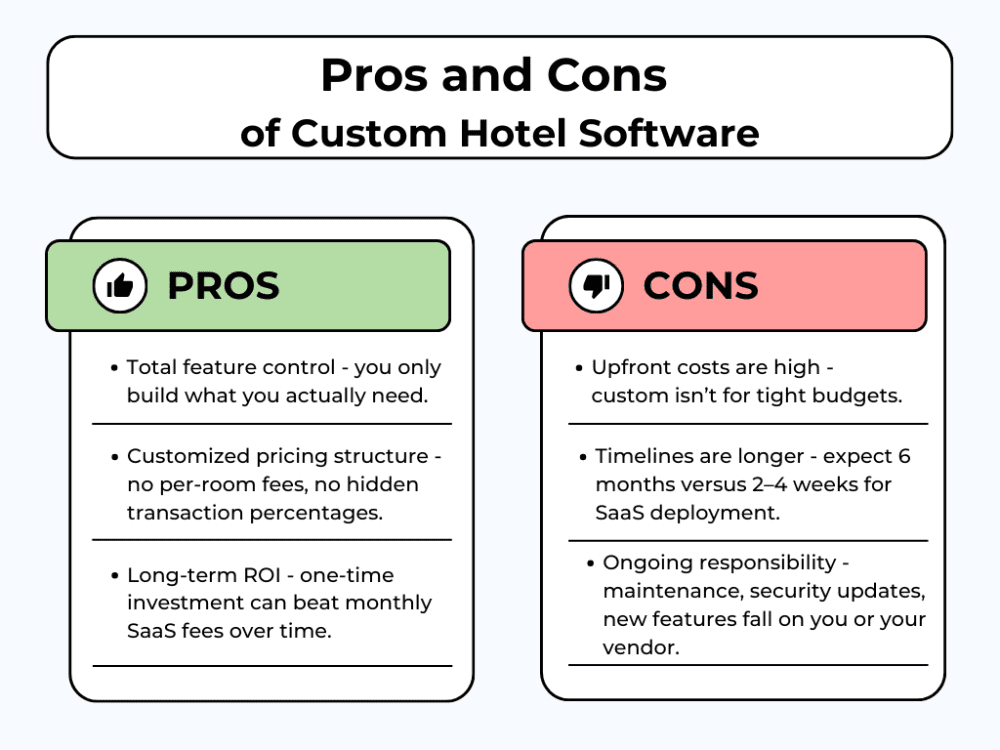
Let’s talk numbers. Basic custom builds start around $50,000 and climb from there. That’s just the upfront cost. Maintenance, hosting, updates - they all add up. And don’t underestimate the timeline: six months is the bare minimum, covering market research, requirements, UI/UX, development, testing, deployment, and ongoing maintenance. You’ll be working closely with a development partner to create a software, designed exclusively for your business.
Now, let’s break down the real cost of building custom hotel software. Custom hotel software isn’t a flat monthly fee - it's a calculated investment. How much you spend will depend on complexity, features, and integrations. How big is your hotel? What features do you actually need? Which systems does your software need to talk to? These questions determine whether you’re looking at a $50k MVP or a $500k enterprise build. But unlike SaaS, you know exactly what you’re paying for, and it scales with your needs, not someone else’s pricing model.
Key Factors That Drive Costs
1. Size and Type of Hotel
A small boutique property? You probably don’t need half the modules a resort chain does. More rooms, more locations, more services - complexity scales, and so does the price.
2. Feature Scope and Modules
Every additional module adds cost. PMS, booking, inventory, billing, admin dashboards, mobile apps - they all add development time, and consequently money. Start with an MVP: core features only. Get something live fast, test it, learn, iterate.
3. Integration Requirements
Hotels don’t live in a vacuum. Your PMS has to talk to OTAs, channel managers, payment gateways, accounting software, CRM, and maybe even legacy POS systems or smart door locks. Each integration adds cost, typically $8k–15k per major system depending on API quality.
4. Mobile Apps
Guest apps, staff apps, management dashboards - they all add cost. But they also add operational leverage and guest satisfaction. This isn’t optional if you want to compete in 2026.
5. Security & Compliance
Data security isn’t optional. Encryption, role-based access, PCI DSS /GDPR compliance - all essential. Off-the-shelf authentication systems can save $10k–15k, but you still need someone thinking about this from day one.
6. Development Team: Composition and Location
Do you hire in-house or outsource? In-house gives control and direct communication, but costs more. Outsourcing can be dramatically cheaper. Location alone can double or triple your budget. Hourly rates give a sense of scale:
- North America: $80–150/hr
- Western Europe: $60–120/hr
- Eastern Europe: $35–70/hr
- Asia (India, China): $20-$60 per hour
- Latin America (Argentina, Brazil): $30-$65 per hour.
For perspective: a $100k build with an Eastern European team could easily cost $500k if done with North American developers. For more details, check our blog post on why outsourcing is an excellent option and the blog about the best countries to hire from.
Here are the common custom hotel management software development scenarios:
Basic (Minimum Viable Product – MVP)
An MVP Approx. Cost: $50,000 – $100,000
Includes only the essential features to run your hotel. It’s a great starting point to test the waters and get a functional product quickly.
Features: Core booking engine, basic room inventory management, simple guest profiles, and reservation calendar.
Mid-tier platform
Approx. Cost: $100,000 – $180,000
This tier adds automation and integration capabilities, streamlining more of your daily operations
Features: Everything from MVP plus automated communications, basic reporting dashboards, POS integrations, mobile apps for staff, a housekeeping management module, rate management tools, and API access for third-party integrations. Serves growing hotel groups needing standardized operations.
Advanced/Enterprise
*Approx. Cost: $180,000-600,000+: *
Complete platform or large hotels, resorts, or chains, an enterprise solution offers comprehensive control and advanced guest-facing features.
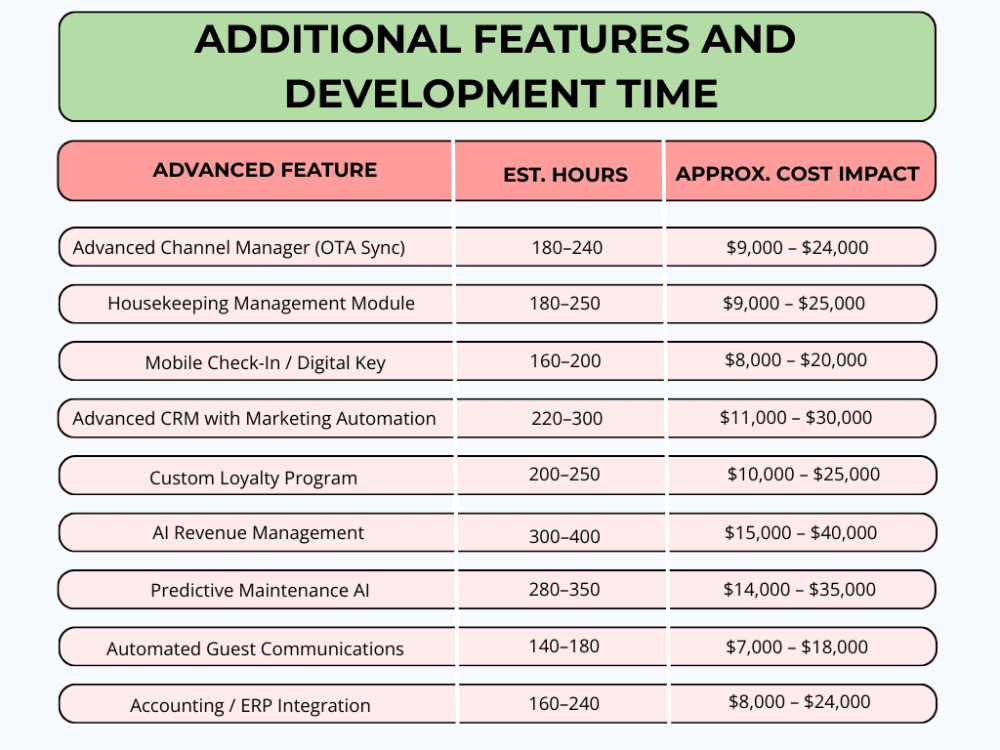
Features: All of the above, plus AI-powered revenue management, advanced predictive analytics, automated maintenance scheduling, comprehensive CRM with marketing automation, custom loyalty programs, advanced financial reporting, IoT integration for smart rooms (for keyless entry, room service) and multi-property management.
These prices are possible if you cooperate with developers from Eastern Europe. The development cost can be 2-3 times higher if you choose specialists from the USA, Canada, or Western Europe.
 .
.
Ongoing Costs You Can’t Ignore
Custom software isn’t a one-and-done deal. Even after launch, there’s a budget you need to account for:
- Hosting and cloud infrastructure: Your software needs a home that runs fast and reliably. The bare minimum you should expect to pay starts from $2,5k per year.
- Maintenance & Updates: 15–25% of your build cost. Features break, APIs change, your software evolves.
- Security Audits (PCI/GDPR): $1.5k–$5k+. Don’t skip this - you’re handling guest data, payments, and compliance.
- Third-Party APIs: Varies. Integrations cost money, and sometimes it’s more than you expect.
Bottom Line
Yes, the upfront investment in custom software can feel high. But let’s put it in perspective: this isn’t just software. It’s a reflection of your ambition. It’s a platform built for your hotel’s workflow, your guests, your brand. Off-the-shelf SaaS is cheap at first. But the longer you grow, the more subscriptions, integrations, and hidden fees pile up. Focus on your hotel’s real needs, set clear objectives, and partner with developers who understand hospitality. The result? Software that runs your operations smoothly, delights guests, and grows with your business. In the end, the question isn’t “how much does it cost?” - it’s “what value does this create for my hotel?” And if you do it right, the value far outweighs the price.


