Healthy lifestyles and nutrition have never been more relevant. People are increasingly paying attention to what they eat - and ironically, the same technology that made our lives more convenient and often more sedentary is now the thing helping us course-correct. Nutrition apps are those tools that allow users to track meals, build healthier habits, and stay aligned with their wellness goals. But here’s the catch. In 2026, users don’t want another calorie counter. That market is already saturated. Today’s users expect apps that behave more like intelligent health companions - tools that combine AI, wearable integrations, and personalized recommendations that actually adapt to their lifestyle. If you're a developer, startup founder, or product manager exploring this space, it’s worth understanding the current reality of building nutrition apps. Below, we’ll break down how modern nutrition platforms work, what features matter most today, and what it actually takes to build a product that people will use consistently.
Nutrition App Development in 2026: Costs, Features, and Is It Still Worth It?
Unlock AI-driven nutrition app growth: $30B market opportunity in 30 minutes.
Modern Nutrition Tracking Apps: What Users Expect
At the simplest level, nutrition tracking apps help users monitor what they eat and connect those habits to health outcomes. But the value goes beyond basic food logging. These apps help people maintain healthier eating patterns, manage body weight, plan diets more effectively, monitor nutrient intake, and also identify potential food allergies or intolerances. Not long ago, achieving this level of insight required regular consultations with doctors or professional nutritionists. Today, users expect that guidance on their phone - and they expect it to be smart. The apps winning in 2026 aren't just logging food. They're integrating with wearables, adjusting recommendations in real-time based on activity and sleep data, and using computer vision so users can snap a photo of a meal instead of manually entering every ingredient. In 2026, photo logging - previously quite gimmicky - has finally crossed the accuracy threshold where it actually becomes useful and reliable. It's already actively and effectively used in apps like Nutrola, Cal AI, and SnapCalorie. That's why minimal-friction logging is now table stakes.
AI and machine learning have made genuinely adaptive nutrition guidance feasible without a clinical team behind every recommendation. That shift is significant. It's not just convenience. It's democratizing access to health guidance that was previously expensive and time-consuming to get.
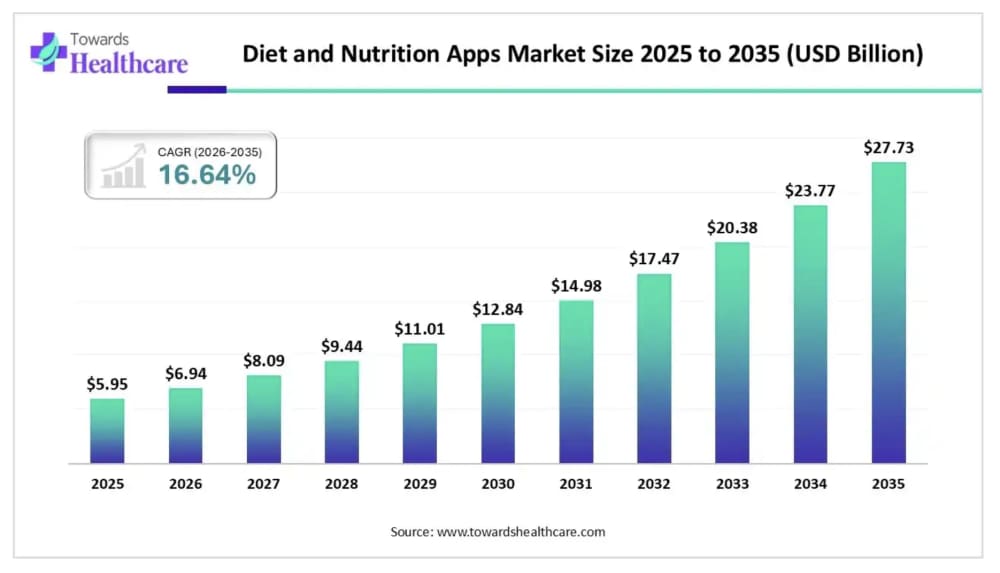
The global nutrition app market is exploding. Recent 2026 estimates place it around $7–17 billion, with strong projections toward $27–35 billion by the mid-2030s (CAGRs ranging from 13–20% depending on scope). For example:
- Towards Healthcare (Jan 2026 report) : ~$6.94B in 2026 → $27.73B by 2035 at 16.64% CAGR.
- The Business Research Company(2026 report) : ~$16.91B in 2026, growing at ~20% short-term from 2025 levels.
- Roots Analysis: ~$6.13B in 2025 → $28.36B by 2035 at 16.6% CAGR.
Before You Build: Pick Your User
One of the biggest mistakes founders make in this market is building for everyone. A generic nutrition app in 2026 is competing with MyFitnessPal, Noom, and a hundred well-funded alternatives. That's a brutal fight.
The smarter entry point is going narrow. The market for nutrition apps isn't one market - it's dozens of underserved ones. Bodybuilders with precise macro requirements. Pregnant women navigating trimester-specific nutrition. People managing Type 2 diabetes or IBS. Vegans tracking micronutrient gaps.
Each of these audiences has specific needs that a general-purpose app will never fully serve. A focused app can speak the user's language, surface the right data, and build a community that a generic product never could. Retention is almost always stronger in niche products because the app feels built for a person using it, not for everyone.
So, pick your User before you pick your features. Everything else - what you build, how you prioritize, how you market - gets clearer once you know exactly who you're solving for.
What to Actually Build - And in What Order
The fastest way to kill a nutrition app is trying to build everything at once. The smarter move is thinking in layers.
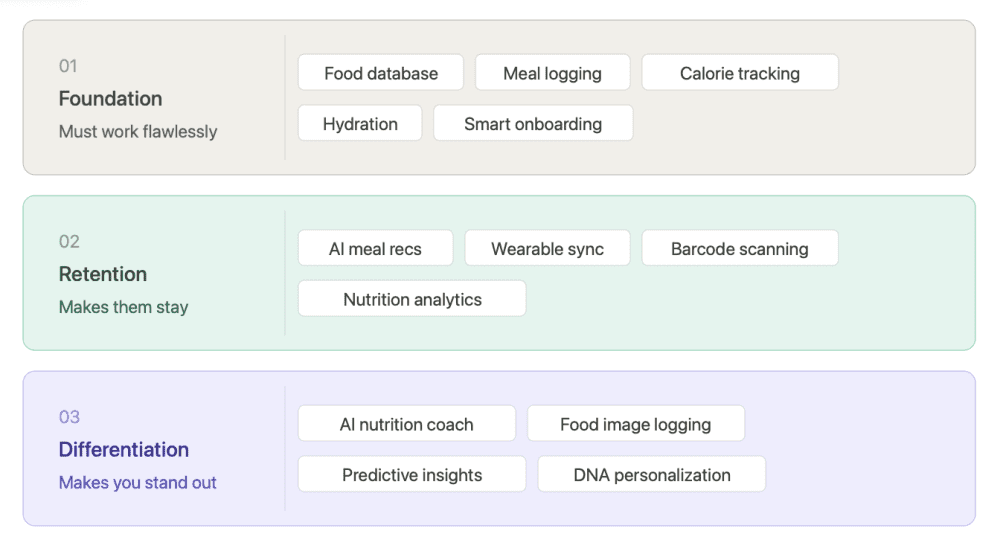 Start with what users need to trust you. Your MVP needs clean onboarding that collects the right data upfront - goals, allergies, dietary preferences - so the experience feels personal from day one, not generic. Pair that with a solid food database that covers global cuisines and branded products, reliable meal logging with offline support, calorie tracking, and hydration. That's it. That's your foundation. None of it is exciting, but all of it has to work flawlessly or users leave.
Then build what makes them stay. Once the basics are solid, the features that drive retention are the ones that make the app feel intelligent. AI-powered meal recommendations that actually learn from behavior over time. Wearable integration that syncs activity data and adjusts nutrition targets dynamically - beyond basic Apple Health/Fitbit sync, top performers now pull real-time data from Oura ring, Whoop band, or Levels CGM patch for post-meal glucose insights and instant tweaks. Barcode scanning for instant food logging. A nutrition analytics dashboard that shows trends, not just today's numbers. These aren't premium add-ons - in 2026, they're the standard users expect before paying for a subscription.
Then build what makes you different. The next-gen layer is where the real differentiation lives. Generative AI nutrition coaches that act as virtual dietitians. Food image recognition that eliminates manual logging entirely. Predictive health analytics that flag risks before users feel them. DNA-based diet personalization for users who want precision over convenience. Emotion-aware eating insights that address the psychological side of food. Hyper-realistic recipe generation that auto-adjusts for time available, household budget, beginner/intermediate cooking skills, and cultural/regional tastes (e.g., swapping quinoa for rice in budget-conscious Latin-inspired meals). These features aren't table stakes yet, but they're where the industry is heading, and the teams building toward them now will have a meaningful head start.
Start with what users need to trust you. Your MVP needs clean onboarding that collects the right data upfront - goals, allergies, dietary preferences - so the experience feels personal from day one, not generic. Pair that with a solid food database that covers global cuisines and branded products, reliable meal logging with offline support, calorie tracking, and hydration. That's it. That's your foundation. None of it is exciting, but all of it has to work flawlessly or users leave.
Then build what makes them stay. Once the basics are solid, the features that drive retention are the ones that make the app feel intelligent. AI-powered meal recommendations that actually learn from behavior over time. Wearable integration that syncs activity data and adjusts nutrition targets dynamically - beyond basic Apple Health/Fitbit sync, top performers now pull real-time data from Oura ring, Whoop band, or Levels CGM patch for post-meal glucose insights and instant tweaks. Barcode scanning for instant food logging. A nutrition analytics dashboard that shows trends, not just today's numbers. These aren't premium add-ons - in 2026, they're the standard users expect before paying for a subscription.
Then build what makes you different. The next-gen layer is where the real differentiation lives. Generative AI nutrition coaches that act as virtual dietitians. Food image recognition that eliminates manual logging entirely. Predictive health analytics that flag risks before users feel them. DNA-based diet personalization for users who want precision over convenience. Emotion-aware eating insights that address the psychological side of food. Hyper-realistic recipe generation that auto-adjusts for time available, household budget, beginner/intermediate cooking skills, and cultural/regional tastes (e.g., swapping quinoa for rice in budget-conscious Latin-inspired meals). These features aren't table stakes yet, but they're where the industry is heading, and the teams building toward them now will have a meaningful head start.
Build vs. Buy: The Decision That Will Define Your Timeline
Most early-stage teams default to building everything themselves. It feels like the right call - more control, more flexibility, no vendor dependencies. In practice, it's usually how teams burn six months solving problems that were already solved.
The smarter question isn't can we build this? It's: Does building this ourselves create any competitive advantage? For most of the technical components in a nutrition app, the honest answer is no.
License your food database. This is the clearest build vs. buy decision you'll face. A reliable, global food database with accurate nutritional data, regional cuisines, and branded products takes years to build and constant resources to maintain. Edamam, Nutritionix, and similar providers have already done that work. Use them. Your competitive advantage is not a better database - it's what you do with the data.
Use APIs for barcode scanning and food recognition. Both are solved problems with mature, accurate solutions available off the shelf. Building your own from scratch at MVP stage is an engineering distraction that delays the features that actually matter to users.
Plug into existing AI infrastructure for recommendations and coaching. Unless your core differentiation is a proprietary algorithm - and be honest with yourself about whether it actually is - building your own recommendation models from scratch is overkill. The generative AI APIs available in 2026 are good enough to deliver a compelling coaching experience without a dedicated ML team.
What you should build from scratch is everything that directly expresses your niche. The specific logic that makes your app feel built for a bodybuilder, or a pregnant woman, or someone managing diabetes - that's yours. That's where the custom work pays off. Everything else is infrastructure, and infrastructure has vendors.
The Details That Kill Good Products
There are three decisions that most teams underestimate early and regret later. Notifications done wrong will get you deleted. Smart, behavior-driven nudges, reminding a user to log lunch based on their actual habits, not a generic 12pm alarm, are the difference between helpful and annoying. Most apps ship generic notifications and wonder why engagement drops off in week two. Real-time data processing isn't optional if you're integrating wearables. Users expect their calorie budget to update the moment their Apple Watch logs a workout. Lag kills trust fast. Architecture decisions made at MVP stage will determine whether you can actually deliver this at scale. Offline functionality. It is the one thing teams always defer and always regret. People track meals at restaurants, on hikes, on planes. If the app breaks without connectivity, the habit breaks with it. Consider building offline logging from the start as retrofitting it later is painful and expensive. Battery consumption. If your app is aggressively syncing wearable data and running background processes, users will notice it draining their battery and kill it. This is especially relevant if you're doing real-time processing. Worth architecting thoughtfully early.
What Does It Actually Cost?
The cost of diet and nutrition app development obviously varies on app complexity, features, development team location and integration requirements. Three honest tiers:
MVP to validate your idea: $25,000–$50,000 What it covers: Calorie tracking, food logging, basic profiles. MVPs often skip AI and wearables initially. The goal is validating the niche and core logging experience before layering intelligence on top. Enough to test whether your niche wants what you're building.
A product users will actually pay for: $50,000–$90,000 What it covers: AI meal recommendations, wearable sync (Apple Health, Fitbit), personalized meal plans, and real-time feedback. This is where smart build vs. buy decisions directly affect your budget - teams that license food databases and plug into existing AI APIs consistently come in at the lower end of this range. Teams that try to build everything from scratch consistently blow past it.
Enterprise-grade with deep personalization: $90,000–$200,000+.
What it covers: AI-driven hyper-personalization, telehealth integration, multi-platform deployment, full compliance infrastructure. This is not a first product - it's where you go after you've validated the market and secured the budget to serve it.
The number most founders miss entirely is what comes after launch. Maintenance, OS updates, AI model retraining, third-party API costs, and compliance - GDPR, HIPAA, local health regulations - are ongoing investments, not one-time line items. Budget for them from the start or they'll surprise you six months in.
How to Make a Nutrition App That Sticks?
Keep it focused. The mistake most teams make is building too wide, too fast. Pick a specific user - someone managing diabetes, someone doing endurance sports, someone with food intolerances - and build something genuinely excellent for them before expanding.
Think about the features that move the needle. AI-driven meal personalization tied to real biometric inputs, seamless wearable integration, food logging that doesn't feel like a chore and realistic recipe adjustments for time, budget, cooking skill, and cultural preferences - so the plan survives Monday chaos.
The Business Model Question
The biggest names in this space, MyFitnessPal, Noom, Lifesum, are primarily consumer businesses. That's where the volume is, where the feedback loop is fastest, and where most successful apps are built and validated. Subscription is the dominant model, and it works, if you solve the churn problem. Users sign up motivated and cancel when momentum fades. Retention, not acquisition, is where this business is actually won or lost. B2B partnerships with employers, insurers, or healthcare providers do exist and can significantly change the unit economics when you get there. But they require compliance overhead, clinical credibility, and a sales cycle that's out of reach for most early-stage teams. The companies that land these deals typically got there after proving strong consumer traction first - not by targeting B2B from day one.
The Bottom Line
The nutrition app opportunity in 2026 is bigger than it's ever been. And that’s because the technical barriers have never been lower. You can prototype fast, ship an MVP in weeks, and access powerful AI APIs without a research team. The market is growing. The infrastructure - AI, wearables, mobile - is all there. That's the good news. The bad news is that everyone else can do the same. The moat isn't in the technology anymore - it's in how well you understand your user, how fast your team iterates based on real feedback, and whether your product genuinely improves someone's life or just adds another icon to their home screen.
See Where AI Can Improve Your Team in 30 Minutes
We'll map your first automation steps.
FAQ
The market is saturated, but new apps can absolutely succeed, even in a crowded market. The winning move is niching down early (e.g., diabetes management, vegan micronutrients, or high-protein for athletes) so your app feels truly built for that user.