One business launches a clean MVP for $25,000–$50,000 in three months. Another invests $200,000+ in a complex platform with branched architecture, real-time features, and multi-market scaling. Both approaches can be justified - the question is which specific problem you need to solve.
How AI and No-Code Solutions Are Changing the Game
Artificial intelligence (AI) and machine learning (ML) have created a two-sided economic reality shaping app development in 2026:
On the one hand, AI-enabled development tools can reduce development time and human resource requirements. With AI-assisted coding, automated testing systems, intelligent project management tools and ready-made backend solutions, it’s easy to assume development no longer requires full engineering teams. A task that previously required weeks of manual coding can now be completed in a few days, potentially reducing overall project costs.
On the other hand, the same technology raises user expectations. Faster development doesn’t mean simpler products. Users now expect chatbots, personalization, recommendations, and predictive features by default. And building these capabilities requires specialized expertise and infrastructure. Skilled AI engineers are expensive, and implementing machine learning models increases both complexity and upfront investment. A simple chatbot may be affordable, but a full predictive analytics system quickly becomes a significant expense.
So, in reality, starting a project has become more affordable, but building apps that meet today’s expectations, keep users engaged and deliver high performance, security, and scalability still requires significant investment.
Key Cost Drivers in 2026
Here’s what actually influences your budget for app development in 2026 and how recent changes play out:
1. Complexity and features
The complexity of the required features remains the most significant factor determining cost. The more features you pack in, the higher the price tag of custom app development. More screens, user roles, real-time data, or advanced tech, all increase hours and cost - each extra piece means more coding, more testing, and more ongoing care.
AI is no longer optional for many modern apps. Features like chatbots, recommendation engines, image/video generation, predictive analytics, and personalization are increasingly expected. Advanced AI capabilities - computer vision, speech recognition, anomaly detection for IoT - bring another level of complexity. They require bigger datasets, heavier infrastructure, and fine-tuning. These projects almost always start around $100K and scale up from there. In short, the required investment is determined by the features users expect, not just the ambition behind the idea.
2. Platform and tech stack
This hasn’t changed much - a simple web app is usually the most budget-friendly option, and if you also need to launch a mobile app, native iOS and Android built separately cost more than a cross-platform build (React Native, Flutter). When choosing between native and cross-platform development, you should understand that neither is automatically the right choice - it depends on your users and your product. The tech stack you pick will set both the initial bill and the pace of your long-term maintenance costs.
For most startups, cross-platform development is the sweet spot. One codebase covers iOS and Android, saving 30–40% on development costs while delivering native-level performance for most use cases. Native development makes sense if you need direct hardware access - think AR/VR, sensors, or gaming.
What has changed is that cross-platform development is not always the best fit for heavy AI workloads. Hardware-heavy products also come with additional costs. Running on IoT devices, AR/VR headsets, or custom sensors adds complexity to integration and testing, increasing both development time and budget.
3. Team and Regional rates
The same MVP can cost $25K or $120K depending on who's doing the work. Freelancers are the lowest hourly cost and the highest coordination overhead. Works well for small, well-defined pieces of work. Gets painful fast if scope is unclear or if you need multiple people working together.
In-house only makes sense if you're building a tech company where engineering is a core competency, not a vendor relationship. Otherwise, you’re paying full salaries and benefits for skills you may not need yet.
Outsourcing your app development remains one of effective methods of lowering the costs. It allows you to focus on the task rather than gathering your team, hiring, etc.
Rates vary a lot by geographic location. It’s not a secret that teams from the US, Western Europe, or Singapore usually work at the highest rates: $120-200/hour and even more. Meanwhile, Eastern Europe offers engineering quality of the same level at average rates of $35-70/hour. The cheapest option is Asia and it usually has higher risks in terms of communication, quality control, and deadline adherence.
When you are selecting the location of your app development team, one of important parameters to consider is time zone compatibility. Even if the team works qualitatively, but it’s +10 hours from you, any task stretches at least a day due to delayed responses, clarifications, approvals. In addition, cultural compatibility matters greatly: developers from different countries can mean very different things by the same terms. We’re not talking about stereotypes; it’s more about decision-making style, responsibility format, and ability to ask clarifying questions.
What has changed recently is the growing popularity of Latin America as an outsourcing destination. Expertise has matured, rates remain competitive ($40–80/hour depending on seniority), and the time zone overlap with North American clients eliminates much of the async friction that makes Eastern European or Asian engagements harder to manage. For US-based founders in particular, it's worth including in your shortlist.
4. Maintenance and ongoing costs
Even with a clear development estimate, it doesn’t mean the software budget is truly final. Moreover, building the app is not even a half the story. So, one of the main mistakes is focusing only on development. Ongoing expenses matter: cloud infrastructure, data management, privacy/compliance, user tracking, version updates, and performance monitoring.
For Ai-driven apps, models need to be refreshed, APIs get updated, accuracy has to be monitored, and infrastructure scales as usage grows. In practice, that means the first release is only the starting point.
Many apps fail post-launch because maintenance was underestimated, not because development went wrong. Projects most often fail after launch, when users behave differently than expected, or bugs missed by QA emerge, or OS updates break logic, or new regulations force architecture changes. Typical annual maintenance runs 15–25% of the development cost.
5. Speed to market and MVP strategy
You could hardly find a startup that plans a “full build first” today. Instead, they launch an MVP to test the market and then iterate. This approach means lower initial spend, smaller feature set, faster launch, and slower incremental spend. A strong MVP strategy can reduce risk and initial cost, but you will still have to plan the subsequent iterations and scale-up budget.
Today there are two main strategies for early-stage development. The first is using low/no-code tools like Lovable for fast, cheap prototyping, but what you build there usually can't serve as a foundation for v1. Once the concept is validated, you start the real build from scratch. The second is investing in professional development from the start: more expensive upfront, but the code carries forward. Neither is wrong. It's a question of whether you need to validate the idea before spending, or whether you already have enough conviction to build once.
App Development Cost Breakdown by Complexity (2026)
Let’s be honest: asking “How much does an app cost?” without context is meaningless. The price is almost entirely determined by complexity. App complexity isn’t just a pricing factor. It dictates team size, tech stack, and development time. Every extra feature, integration, or expectation adds layers - of work, risk, and cost. If you want to set a realistic budget, you need to understand what each level actually entails. Let’s break it down from simple MVPs to AI-powered platforms.
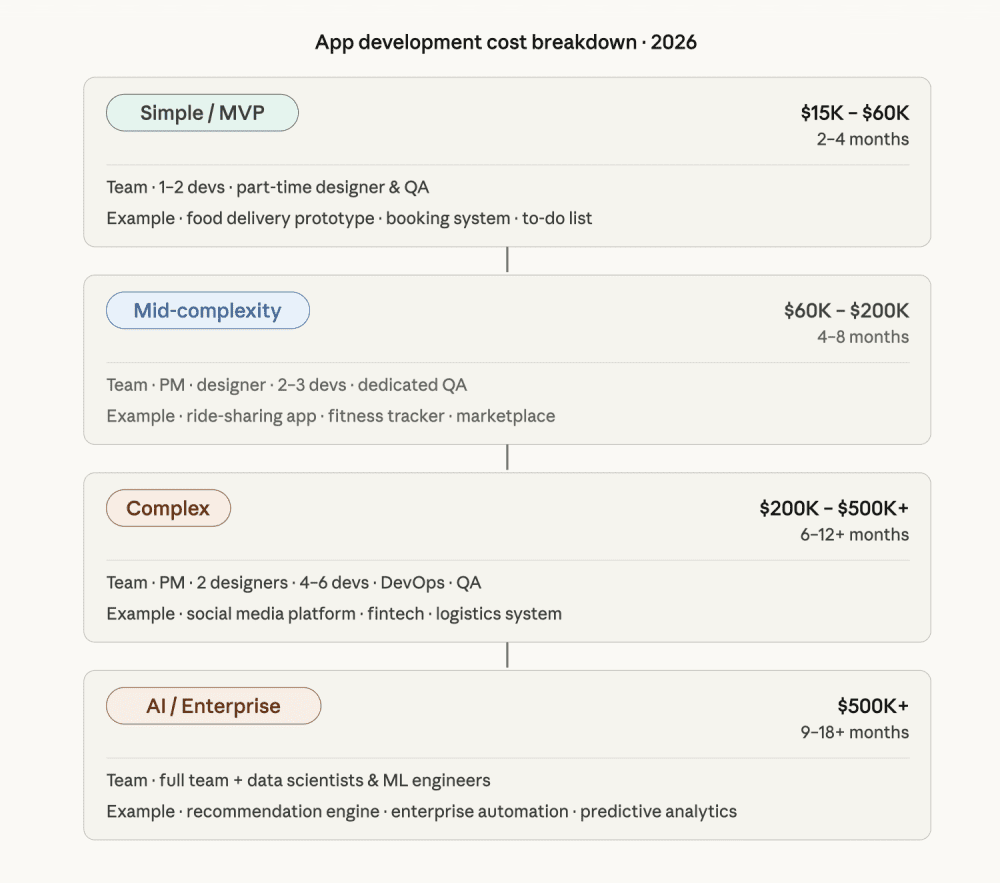
Simple App / MVP: $15,000 – $60,000 (2–4 months)
These are apps that do one thing well. Think of them as the “minimum viable product” stage - great for startups testing ideas or businesses building basic tools. They don’t try to be everything at once. Simple apps are cheap for a reason. They validate ideas fast, but they don’t scale. Once you start adding features or complexity, costs rise - quickly.
Team: 1–2 full-stack developers, part-time designer & QA.
Integrations: Social logins (Google/Facebook), basic map API
Examples: a basic food delivery prototype, a simple booking system, a stripped-down e-commerce app, or even lightweight tools like a to-do list or a calculator.
Mid-Complexity App: $60,000 – $200,000 (4–8 months)
Now we’re talking about apps that actually do more. These are full MVPs or growth-stage products. They need real-time data, third-party integrations, and a more polished UX. At this stage, architecture matters. You need performance, scalability, and reliability, not just features. Every decision now affects future costs.
Team: Project manager, designer, 2–3 developers, dedicated QA.
Integrations: Payment systems (Stripe, PayPal), mapping APIs (Google Maps or Mapbox), social logins, and basic analytics.
Examples: Fitness app with subscriptions, a ride-sharing app, or a marketplace with payment and chat features.
Complex / Feature-Rich App: $200,000 – $500,000+ (6–12+ months)
These are multi-feature, multi-user apps built for serious scale. They often power entire ecosystems, not just one function. Here, you’re moving into territory where AI, automation, and predictive analytics start adding real value - and real cost.
Team: Product manager, multiple designers & developers, DevOps, QA.
Integrations: Multiple third-party APIs, ERP and CRM systems, analytics dashboards, and compliance-ready frameworks such as HIPAA or GDPR.
Examples: social media networks, enterprise-grade marketplaces, advanced fintech or logistics systems.
AI-Powered or Enterprise App: $500,000+ (9–18+ months)
This is the “big league.” These apps combine complex architectures, massive data pipelines, and intelligent automation. Projects are complex, expensive, and high-stakes, but also potentially transformative.
Team: Full product + data scientists, ML engineers, security experts. Requires specialized infrastructure and MLOps.
Integrations: These apps often connect to multiple external systems - ERP, CRM, analytics platforms, cloud pipelines, and third-party APIs. Integration isn’t a one-time task; it’s continuous and deeply tied to AI workflows, and a major contributor to both development time and cost.
Examples: AI-driven recommendations engines, enterprise automation tools, predictive analytics platforms.
Recommendations for Startups and Tech Companies
Understanding cost is one thing. Making the right decisions around it is another. And that starts with recognizing that development is usually less than half the real story. So, budget for the total cost of ownership - factor in maintenance, updates, cloud infrastructure, monitoring, marketing, user acquisition, and compliance. Start with an MVP, measure results, iterate, and keep improving. Agile teams and flexible contracts make this sustainable.
Time matters as much as money. If your market window is tight, speed is a priority. AI-assisted tools, low-code platforms, or flexible teams can get you to launch faster. Delays cost more than any savings from a slower, “cheaper” build.
Don’t add AI just because it’s trendy. Add it where it solves a real problem. If you’re thinking about a chatbot, image generation, or predictive analytics, start by defining the use case clearly.
Check your data: models are only as good as the inputs. Use pre-trained models when possible - rebuilding from scratch is expensive and rarely worth it early.
Pick the right stack and the right team. For lean launches, cross-platform development with offshore or nearshore teams often makes sense. For high-performance or brand-sensitive products, native development with specialized engineers pays off. Flexible staffing - outstaffing, team augmentation, scaling up or down - lets you control costs without sacrificing speed.
Summing up
The actual cost of building an app depends primarily on its complexity. A reasonable MVP in 2026 will typically land between $30K and $100K. Below that, you're either building something very narrow or cutting corners that will cost you later. AI can decrease costs in some areas, but it can also raise them - through data processing, integrations, performance demands, and ongoing maintenance. Entry-level apps have become cheaper, high-end, AI-driven apps more expensive. The smartest founders focus less on the cheapest option and more on strategic value, clear requirements, and a reliable team that can grow with the product.