The 2026 FIFA World Cup is on. Running from June 11 to July 19, it is the first tournament ever hosted across three countries - the United States, Canada, and Mexico. It is also the largest in the competition's history, with 48 national teams, 16 host cities, and billions of viewers around the world.
Just as importantly, it has become the most technology-driven sporting event we've ever seen. While most people think the FIFA World Cup is about what happens during the 90 minutes on the pitch, behind every match is an operation of extraordinary complexity that has to work without fail.
The 2026 World Cup offers one of the best real-world examples of tech and AI deployed at massive scale. It isn't an experimental pilot or a proof of concept. These systems are already running during one of the world's largest live events, with virtually no room for error.
From AI-generated player avatars and sensor-equipped match balls to an AI-powered platform for team analysis, FIFA is introducing tools to support referees, improve team preparation, enhance broadcasts, and transform how fans experience the game, both on and off the pitch.
Here is how AI and technology are transforming the World Cup 2026.
AI-powered corporate assistant for match analysis
Most people assume football matches are won on the training ground or during the 90 minutes on the pitch. That's certainly true. But modern football is increasingly won before kickoff by making better decisions with better information.
Every match generates an enormous amount of data. Player movements, ball tracking, formations, tactical adjustments, historical performances, and thousands of in-game events all contribute to a growing stream of information. The challenge has never been collecting the data.
It's turning that data into insights quickly enough to influence the next match. Until recently, that required expensive analytics teams and specialized software that many national federations simply couldn't afford.
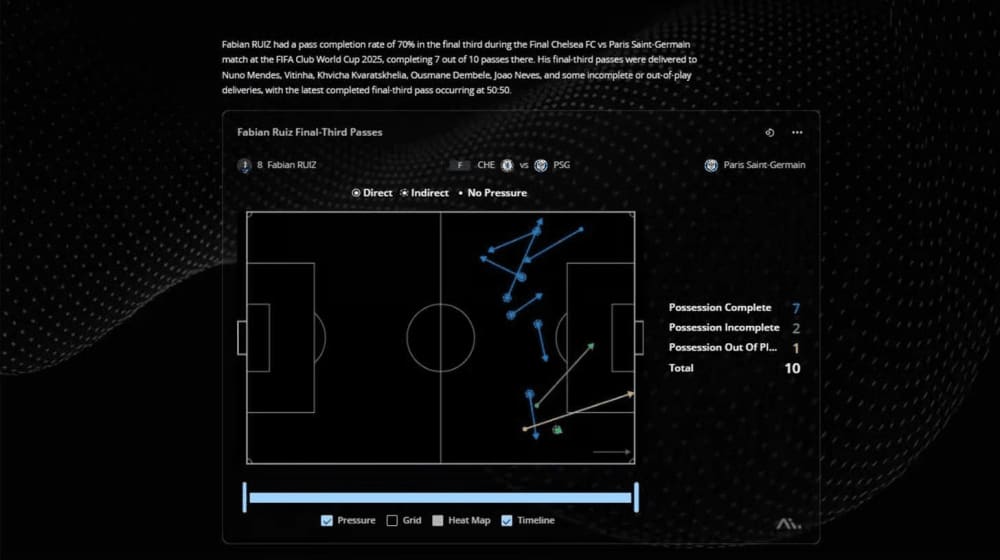
For the 2026 World Cup, FIFA is changing that with Football AIPro, an AI-powered assistant developed in partnership with Lenovo. Instead of manually digging through reports and video footage, with this tool coaches and analysts can ask questions through a conversational interface, much like ChatGPT, and receive detailed answers in seconds.
Rather than overwhelming the coaching staff with raw data, Football AI Pro generates text summaries, tactical reports, video breakdowns, graphical visualizations, and shot maps that make patterns much easier to spot. Coaches can evaluate opponents, identify tactical weaknesses, refine match strategies, and better understand their own team's performance before the next game.
The platform combines generative AI with football-specific intelligence to search through more than 2,000 match metrics, including player positioning, tactical formations, passing sequences, defensive structures, match events, statistics, and video footage. Teams can even recreate previous matches in an interactive 3D environment, allowing coaches to review key moments from virtually any angle and better understand how individual decisions influenced the outcome.
The bigger shift isn't that AI makes football analysis faster. It definitely does. It's that advanced analysis is no longer reserved for the wealthiest organizations. Every one of the 48 teams competing in the tournament now has access to the same AI-powered platform, regardless of budget or federation size. By making sophisticated analytics available in every participating team's language, FIFA is lowering one of the biggest competitive barriers in international football and giving every nation access to insights that were previously available only to the world's leading football teams.
3D avatars of all players

Few decisions in football generate more debate than an offside call. A goal can be decided by a matter of centimeters, yet for years fans have been asked to trust a replay showing a few colored lines drawn across the screen.
The challenge isn't collecting enough camera footage. It accurately reconstructs where every part of a player's body was at the exact moment the ball was played, often during high-speed movements or when players are partially hidden from view.
To make those decisions faster and more accurate, FIFA is expanding its semi-automated offside technology, with AI-powered digital avatars developed in partnership with Lenovo. The system already tracks the ball and every player's position 50 times per second using multiple cameras installed around the stadium. If the system detects a potential offside, it automatically alerts the video review officials.
What's new for the 2026 World Cup is that all 1,248 players from the 48 national squads, each comprising 26 players, have their own personalized 3D avatar. Before the competition, each player spends a few seconds in a specialized scanning booth that captures precise body measurements.
When a potential offside is reviewed, the avatar is combined with the live tracking data to reconstruct the player's exact body position, even when some body parts aren't fully visible from any individual camera angle. Instead of relying on generic player models, officials review incidents using digital replicas that accurately represent each player's shoulders, arms, legs, and feet - the body parts that often determine whether an offside offense has occurred.
With this tech, rather than displaying a frozen frame with overlapping lines, the system generates a 3D animation that explains the final decision for both the referee and millions of viewers watching in the stadium and at home.
The bigger benefit isn't simply more advanced graphics. It's greater confidence in the decision-making process. By making complex VAR reviews easier to understand, FIFA is improving transparency for players, coaches, and fans while using AI to solve one of football's most difficult real-time officiating challenges.
AI cameras on referees

Most football broadcasts show the game from dozens of camera angles around the stadium. But none of them captures the one perspective that often matters most: what the referee actually saw in the moment.
To address it, FIFA has introduced Referee View technology, giving fans a first-person view from a camera mounted on the referee. The technology performed exceptionally well during the 2025 FIFA Club World Cup in the USA, allowing millions of fans to see on-field action from a first-person perspective rather than from the sidelines.
But while the idea itself is straightforward, the technical challenge is not. Referees are constantly sprinting, changing direction, accelerating, and stopping. A head-mounted camera naturally produces shaky footage that can be difficult to watch during a live broadcast.
To solve this problem, Lenovo developed the Referee View AI Stabilizer, a custom AI-powered synchronization and stabilization engine that corrects motion in real time by eliminating shake and blur so viewers can see a clearer first‑person view from the referee’s position as if they were in the middle of the pitch alongside the players. The result is a 50% reduction in visual jitter, creating a dramatically smoother viewing experience.
The value goes well beyond producing a more interesting camera angle. Referee View helps explain why officials make certain decisions by showing exactly what they could and couldn't see during critical moments. It also provides valuable footage for referee training and post-match analysis, helping officials review positioning, decision-making, and match management. For fans, the technology creates a more immersive broadcast that brings them closer to the game, adding a new dimension to the broadcast experience.
Adidas Trionda "smart" ball
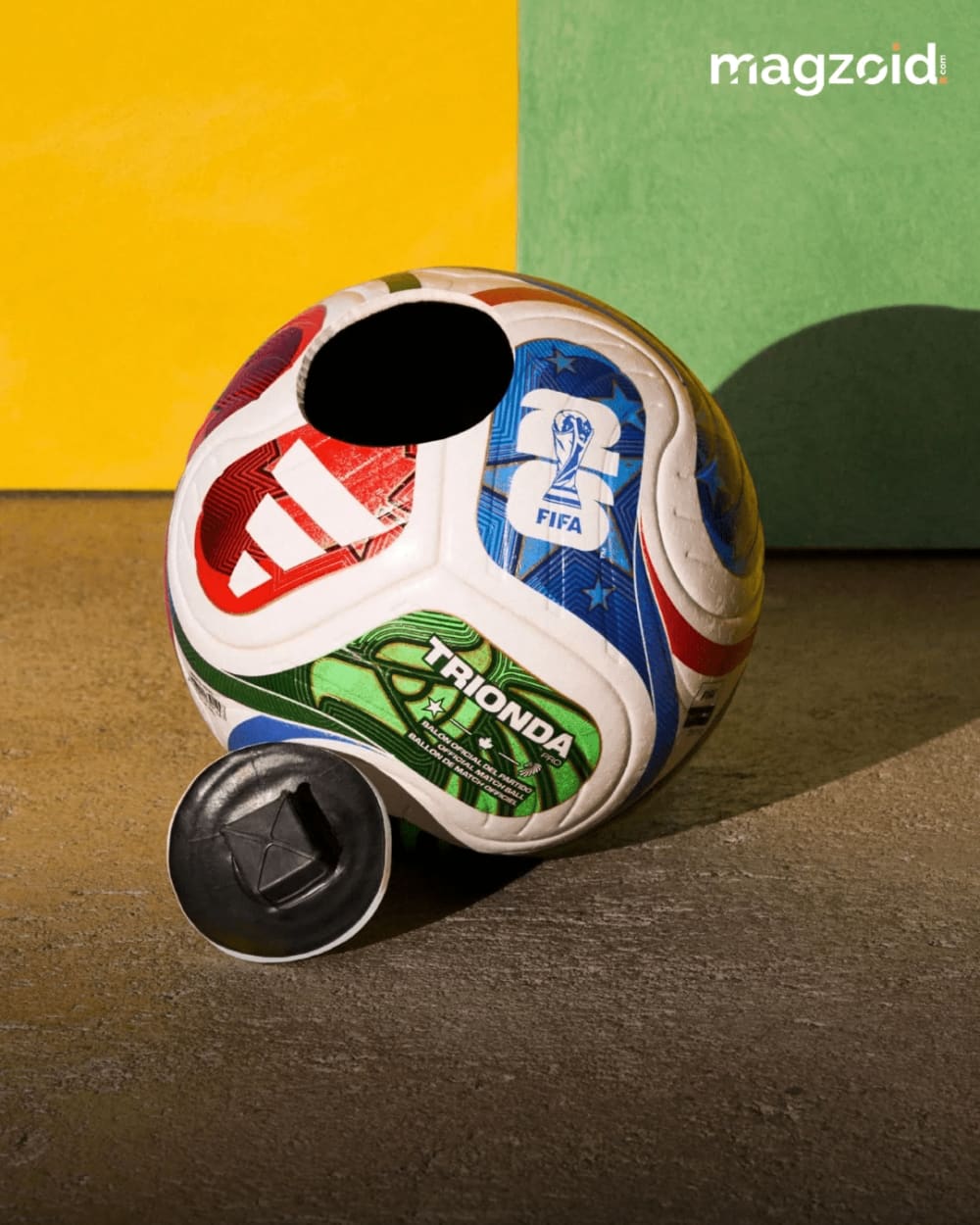
For the 2026 World Cup, one of the tournament's most important sources of data is the ball itself. The new [Adidas Trionda ball]https://inside.fifa.com/innovation/innovating-the-game/connected-ball-technology, specially designed for the 2026 World Cup, is named Trionda - Spanish for "three waves." The name symbolizes the union of the host nations, as for the first time in history, the tournament is co-hosted by three countries: the USA, Canada, and Mexico. The ball features a four-panel design with intentionally deep seams, ensuring optimal flight stability through a balanced, uniform distribution of air resistance. Additionally, special textured patterns improve grip for striking and dribbling in wet or humid conditions.
The real innovation, however, is hidden inside. The ball contains an ultra-lightweight motion sensor that allows judges to track its every move, recording data 500 times per second. With this technology, referees can determine the exact moment of impact when a player touches the ball, enabling faster and more accurate offside decisions. According to FIFA, it will also facilitate the detection of handballs and the awarding of penalties by recording any contact with the ball,
something that has traditionally been difficult for referees to spot using video footage alone.
That reduces guesswork and can help them reach decisions faster and with more confidence, while also cutting down the time fans spend waiting for a verdict.
The data doesn't benefit referees alone. It also creates new ways for broadcasters to bring the game to life. During matches, viewers can access various fascinating metrics, such as, for instance, ball speed, shot power, spin rate, and flight path. With these insights, fans can better understand what they're watching.
The bigger trend extends well beyond football. Physical objects are becoming connected devices that continuously generate data. The World Cup ball is no longer just sports equipment - it's another intelligent sensor contributing to a real-time AI system that helps officials, broadcasters, teams, and fans experience the game in entirely new ways.
Augmented reality for fans
For decades, watching football has meant watching what broadcasters choose to show you.
Even with multiple camera angles and statistics, the experience has always been filtered through the broadcast. The 2026 World Cup starts to change that relationship.
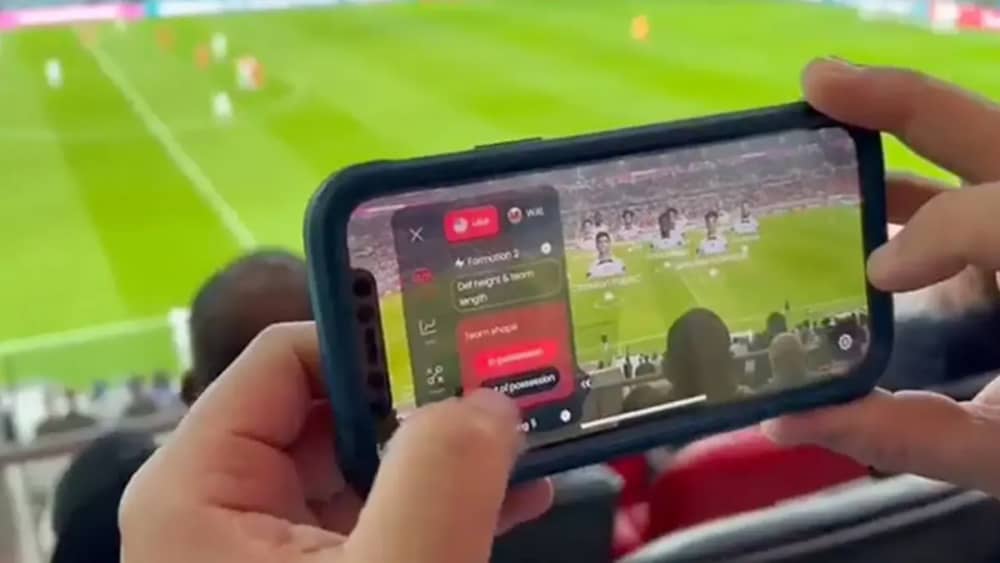
Every fan attending a match receives a personalized Fan ID, that unlocks access to a range of digital experiences throughout the tournament. Instead of passively consuming information, fans can engage with contextual data layered directly onto the match environment. This builds on features tested in previous tournaments (like 2022 in Qatar) and is being expanded for 2026 with better 5G and tracking tech.
Among the most interesting features is augmented reality. By pointing their phone at the pitch, fans can view contextual information about players, relevant statistics, positioning data, and match context overlaid directly onto the live action. It adds another layer of insight without taking their eyes off the match.
Beyond live viewing, the same platform extends into personalization - from stadium information and interactive analytics to customized tournament merchandise that can be designed and ordered directly through the platform.
The shift is subtle but important. The game is no longer something you only watch. It becomes something you can explore in real time, with data as part of the experience.
Final thoughts
The 2026 FIFA World Cup is more than the biggest and most geographically complex tournament in football history. It’s also the moment where technology becomes an integral part of the game. From AI-powered analysis tools that give all 48 teams access to elite-level tactical insights, to 3D player avatars and sensor-equipped match balls that improve officiating accuracy, this World Cup shows how powerful data, AI, and immersive tech become when used on a very large scale. There are still open questions around execution, fan experience, and keeping the human drama of football intact. But the direction is already set. Football is becoming more transparent, more accessible, and more interactive, without losing its soul.